According to Oracle Hospitality research, 73% of travelers want to use their mobile devices to manage their hotel experience, with 38% preferring a fully self-service model. The operational case writes itself: digital room service menus reduce front desk call volume, route orders directly to the kitchen, and consistently lift average order values through built-in upselling prompts.
This guide covers the five best digital room service menu platforms for hotels in 2026 — with verified pricing, honest feature breakdowns, and a clear recommendation on which system fits which property type.
Key Takeaways
- Digital room service menus let guests browse, order, and pay from their phone via QR code — no app download, no phone call
- Top platforms for 2026: IRIS, Foodiv, GoTab, RoomOrders, and FineDine — each suited to a different hotel type
- Look for PMS/POS integration, real-time menu updates, multilingual support, and room-number-linked billing before committing to any platform
- Dynamic QR codes let hotels update the linked menu instantly, no reprinting of room tent cards required
What Is a Digital Room Service Menu for Hotels?
A digital room service menu is a web-based interface — accessed via QR code, in-room tablet, or a link sent through the hotel's messaging system — that lets guests browse F&B offerings, customise orders, and submit requests directly to the kitchen or POS. No app download required.
Three Delivery Models
| Model | How It Works | Best For |
|---|---|---|
| QR code | Guests scan a code on a tent card or TV screen; menu opens in browser | Most hotels — zero hardware cost |
| In-room tablet | Dedicated device mounted in-room; always-on menu access | Luxury and premium properties |
| Hotel app integration | Menu embedded in the property's branded app | Loyalty-driven branded chains |
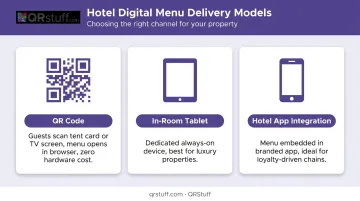
QR codes dominate because they require no hardware investment per room and no app install from the guest.
The delivery model, though, is only half the picture. The platform powering that menu needs to handle hotel-specific logic that generic restaurant tools routinely skip.
What Makes Hotels Different From Restaurants
Hotels have requirements that general restaurant ordering platforms often miss:
- Serves guests in their language — 1.4 billion international tourist arrivals in 2024 means an English-only menu locks out a significant share of your guests
- Time-based menu switching — breakfast, lunch, dinner, and late-night categories should activate automatically by hour, not manually
- Links orders to room numbers for PMS billing, rather than requiring a separate card transaction at checkout
Best Digital Room Service Menus for Hotels in 2026
Each platform below was evaluated on PMS/POS integration depth, guest-facing UX, multilingual support, ordering and payment capabilities, and pricing transparency. The goal: match the right tool to the right property type.
IRIS
IRIS is a purpose-built hotel guest experience platform used by Marriott, Four Seasons, Mandarin Oriental, and IHG. It functions as both a digital room service menu and a digital concierge — guests access food ordering, service requests, and hotel information from one browser-based interface, no app required.
The PMS integration framework synchronizes check-in, check-out, room moves, and guest profile changes in real time, with confirmed integration with Oracle Simphony Cloud for POS routing.
| Feature | Details |
|---|---|
| Key Features | QR code menus, in-room tablet support, PMS and POS integration, digital concierge, multilingual menus, order tracking, guest analytics |
| Pricing | Starts from $120/month; enterprise/custom pricing available |
| Best For | Mid-scale to luxury hotel brands wanting a unified guest experience platform — not just a standalone room service tool |
Foodiv
Foodiv is a hotel-focused digital ordering system built on a commission-free model — hotels keep 100% of room service revenue with no per-order fees, no setup costs, and no contracts. Guests scan a QR code in-room and order directly through their phone.
The platform can function as a standalone POS or connect with existing POS setups, giving independent properties flexibility without vendor lock-in.
| Feature | Details |
|---|---|
| Key Features | QR code ordering, POS integration, commission-free model, mobile-first menu, real-time order management, customizable digital menus |
| Pricing | Standard $129/year per outlet · Plus $349/year per outlet · Premium $649/year per outlet |
| Best For | Boutique hotels and independent properties that want straightforward commission-free digital ordering |
GoTab
GoTab is a hospitality ordering platform designed for hotels and resorts with multiple F&B outlets. Its tab-based model lets guests open a single tab, order across the pool bar, restaurant, and room service, then settle once at checkout — without re-entering payment details each time.
PMS integration supports room-charge billing through Mews, Stayntouch, and Infor. QR codes deploy across any hotel zone without additional hardware per location.
| Feature | Details |
|---|---|
| Key Features | Multi-venue QR ordering, open tab functionality, payment processing, kitchen routing, real-time menu updates, resort-specific workflows |
| Pricing | Basic $15/month · Pro $99/month · Sync $229/month + card processing from 2.40% + $0.15 per transaction |
| Best For | Full-service hotels and resorts with multiple F&B outlets needing one ordering system across the whole property |
RoomOrders
RoomOrders was built specifically for hotel room service — it originated from a pilot at Hilton Boston Downtown and is designed around hotel workflows from the ground up. Guests identify their room number (or pool chair, table, or deckchair) at the point of order, which routes delivery accurately without staff intervention.
No app download required. Real-time menu management lets operators update prices, mark items unavailable, and adjust availability hours instantly.
| Feature | Details |
|---|---|
| Key Features | Room-number-linked ordering, POS integration, contactless mobile ordering, live menu management, delivery tracking with ETA, order-status notifications |
| Pricing | From $50/month; small transaction fee applies; no setup fees |
| Best For | Hotels of all sizes wanting a purpose-built room service system that integrates with their existing POS |
FineDine
FineDine is a digital menu platform built for upscale restaurants and boutique hotels where presentation matters as much as function. It supports both QR code menus and in-room tablet menus from the same platform, with AI-powered translation across 44 languages — critical for international properties.
The CRM includes AI smart segmentation, item ratings, and smart recommendations for personalised upselling. Branded menu design keeps the hotel's visual identity intact throughout the guest experience.
| Feature | Details |
|---|---|
| Key Features | QR and tablet menus, 44-language AI translation, allergen and ingredient warnings, CRM with smart segmentation, custom branding, upselling tools |
| Pricing | Starter $29/month · Growth $69/month · Premium $135/month (billed annually) |
| Best For | Boutique and luxury hotels where menu presentation, multilingual support, and guest personalization are priorities |
Must-Have Features in a Hotel Digital Room Service Menu
Choosing a platform is only part of the decision. How guests access the menu — and how well that access point performs — matters just as much.
The QR Code Is the Guest's First Impression
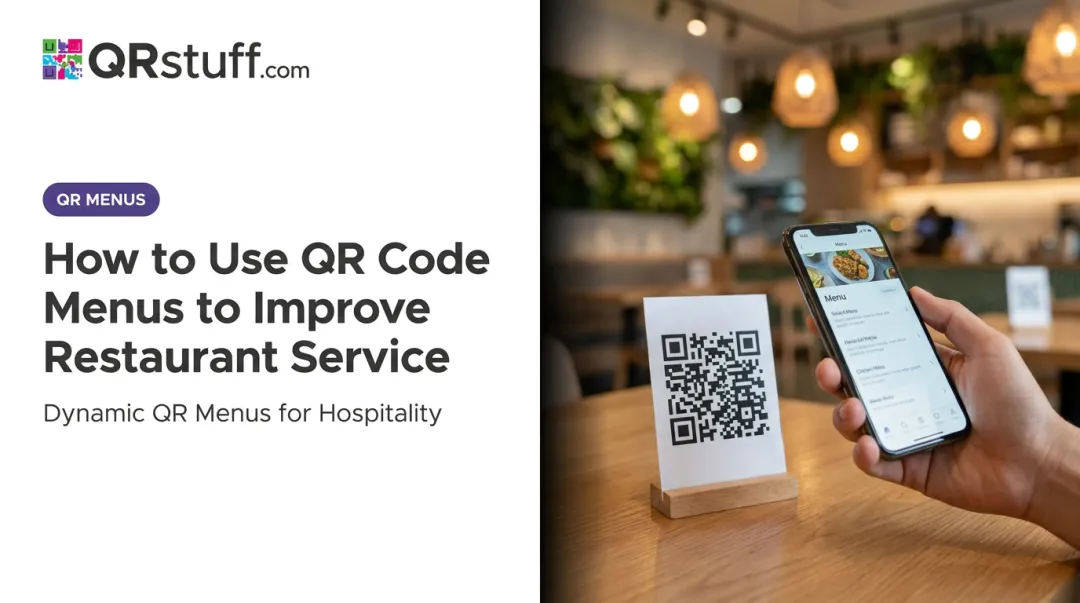
A QR code placed on a room tent card is the first touchpoint in the digital ordering journey. If it's a static code linked to a PDF, the hotel loses the ability to update the menu without reprinting every card across every room.
Dynamic QR codes solve this entirely. Because the destination URL is stored server-side rather than encoded into the code itself, hotels can update the linked menu in real time without touching the physical code. A platform like QRStuff generates custom-branded dynamic QR codes with scan analytics — tracking volume, device types, and peak scan times — giving F&B teams a real operational feedback loop, not just a shortcut for guests.
SuitePad's 2026 room service benchmarking tool, based on 200,000+ real orders from 500+ European hotels, found that top performers generate nearly 3x the room service revenue of median properties — a gap driven largely by menu optimization and ordering technology. In USD terms, that spread translates to roughly $107 vs. $276 per room annually.
Non-Negotiable Operational Features
- Routes orders directly to the kitchen and room bill via PMS or POS integration — eliminating manual transcription errors
- Real-time menu updates — mark items unavailable in seconds without reprinting a single card
- Offering even two languages (English plus the property's most common guest language) cuts friction for international travelers
Revenue-Driving Features Worth Prioritising
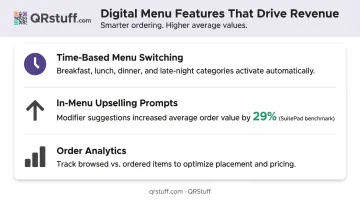
- Automates service period transitions with time-based menu switching — breakfast, lunch, dinner, and late-night categories activate on schedule with no manual toggling
- In-menu upselling prompts — modifier suggestions at the point of order increased average order value by 29% in the SuitePad benchmark
- Tracks which items are browsed versus ordered via order analytics, letting the F&B team optimize placement, photography, and pricing
How We Chose These Platforms
Every platform in this guide was assessed on hotel-specific criteria, not general restaurant features.
Selection factors:
- PMS/POS integration depth — does it connect to the hotel's existing systems, or does it require replacing them?
- Room-number-linked ordering — can the system route delivery to a specific location without staff involvement?
- Multilingual capability — does it handle multiple languages natively, or only through manual menu duplication?
- Multi-zone support — can one system serve room, pool, and restaurant from a single guest interface?
- Guest experience on mobile — does it work on any smartphone browser without an app install?
Common mistakes hotels make when selecting a platform:
- Choosing a restaurant-first platform that lacks room billing integration
- Selecting based on monthly cost without calculating total annual spend including transaction fees
- Not testing the guest-facing mobile experience before signing a contract
The platforms that made this list reduced staff workload without adding new system dependencies to manage. Flat subscription pricing offers a clear transparency advantage over percentage-per-order commission models, particularly for high-volume properties where per-order fees compound quickly.
Conclusion
The right digital room service menu isn't a tech upgrade for its own sake. It directly affects guest satisfaction scores, F&B revenue, and how efficiently the kitchen operates. A boutique hotel with 40 rooms needs something different from a resort with five F&B outlets — matching the platform to the operational model is what drives ROI.
Before committing to a platform, run through three checks:
- Trial the guest-facing QR experience on multiple phone models
- Verify PMS integration depth directly with your technology vendor
- Calculate total annual cost, including any per-order fees
Every platform in this guide ultimately delivers its menu through a QR code — and that code is the guest's first touchpoint. QRStuff gives hotels custom-branded, dynamic QR codes with real-time scan analytics, so the journey from scan to order is fully trackable and the code never needs reprinting when your menu changes.
Frequently Asked Questions
What is a digital room service menu for hotels?
A web-based interface guests access via QR code, tablet, or mobile link to browse the hotel's food and beverage menu, place orders, and pay — without calling the front desk. Most modern platforms work through the guest's phone browser with no app download required.
How do QR code room service menus work in hotel rooms?
A QR code on the room tent card, TV screen, or welcome card links directly to the hotel's digital menu. Guests scan it with their phone camera, the menu opens in the browser, and they submit their order to the kitchen — the whole process takes under a minute.
Can digital room service menus integrate with hotel PMS systems?
Most modern platforms — including IRIS, RoomOrders, and GoTab — offer PMS integration that links orders to the guest's room number automatically, enabling seamless billing and real-time kitchen routing without manual re-entry.
What are the most profitable items on a hotel room service menu?
Beverages, desserts, and breakfast combos typically carry the highest margins. Digital menus that surface these items prominently through upselling prompts and modifier suggestions consistently lift average order values — the SuitePad benchmark found modifiers alone increased order value by 29%.
Are digital room service menus worth the cost?
Top-performing hotels in the SuitePad benchmark generated 2.6x more room service revenue per room than the median. Reduced order errors, lower call-handling time, and higher average check sizes from in-menu upselling typically offset the subscription cost quickly.
How much do hotel digital room service menu systems cost?
Pricing ranges widely: GoTab starts at $15/month (plus transaction fees), FineDine at $29/month, RoomOrders at $50/month, and IRIS at $120/month with enterprise tiers above that. Commission-free models like Foodiv charge flat subscriptions, so calculate total annual cost including per-order fees before committing.