Introduction
Billboard advertising has always been a reach machine. A well-placed board in a high-traffic area can generate millions of impressions — but historically, that's where the story ends. There's no record of who saw it, no way to know which locations drove action, and no mechanism to connect that exposure to an actual sale.
QR codes are changing that dynamic. U.S. out-of-home revenue reached $9.46 billion in 2025, yet attribution has remained one of the channel's biggest unsolved problems.
Adding a QR code doesn't automatically fix that. Plenty of billboard campaigns include QR codes that go unscanned because they're placed on highway placements, sized too small, or link to a generic homepage.
This article covers three concrete advantages QR codes bring to billboard advertising when deployed correctly: measurable engagement, real-time analytics, and the ability to update campaign content without touching the physical installation.
Key Takeaways
- QR codes convert passive billboard impressions into trackable digital interactions
- They work in pedestrian zones, transit shelters, and high-congestion urban areas — not open highways
- Dynamic QR codes let you update destination content after printing, without reprinting
- OOH campaigns finally get attribution data through scan analytics — something traditional billboards never offered
- Without a clear incentive to scan, adoption stays low — no matter where the billboard is placed
What Are QR Codes on Billboard Advertising?
A billboard QR code is a scannable graphic embedded directly in the creative that routes a viewer's smartphone to a specific digital destination — a landing page, video, offer, app download, or event registration.
Where They Actually Work
Context matters more than most advertisers acknowledge. The OAAA advises that QR codes are generally not recommended for highway billboards because drivers have limited time to view and scan them. The placements where QR codes perform are:
- Transit shelters and bus stops (average wait times of 8–9 minutes, per Mineta Transportation Institute research)
- Urban storefronts and street-level placements
- Airport advertising and indoor venue displays
- High-congestion intersections where traffic slows
The scan opportunity depends entirely on dwell time. A viewer standing at a bus shelter for eight minutes has a realistic window to notice, consider, and act. A driver at 55 mph does not. Placement gets the scan — but what happens next determines whether that scan converts.
QR Codes as a Conversion Mechanism
The QR code itself isn't the value. What happens after the scan is. High-performing billboard QR campaigns treat the code as an entry point, not a destination. That means every scan should lead to:
- A purpose-built landing page matched to the ad's message
- A specific offer, discount, or incentive tied to the placement
- A clear single action — sign up, download, buy, or register
Treating a QR code as a design element rather than a conversion trigger is the most common reason these campaigns underperform.
Key Advantages of QR Codes on Billboard Advertising
The three advantages below focus on outcomes advertisers can actually measure: digital engagement, campaign attribution, and operational efficiency. Each one compounds based on placement, creative, and how well the destination matches viewer intent.
Advantage 1: Connecting Offline Reach with Online Engagement
A billboard is constrained by format: five to seven words, a few seconds of attention, then the viewer moves on. A QR code extends that moment into a full digital experience — product pages, video demos, contest entries, event ticket access, exclusive discounts — without requiring the viewer to remember the brand and search for it later.
The offline-to-online gap is real and significant. According to a Nielsen OOH Online Activation Survey, 46% of U.S. adults used a search engine after seeing an OOH ad, and OOH generated 26% of gross search activations while representing just 7% of total ad spend. OOH already drives online behavior. A QR code shortens that path from awareness to action down to a single scan.
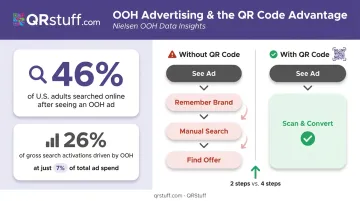
Without a QR code, a curious viewer has to remember the brand name, search manually, navigate to the right page, and find the relevant offer. Each step loses people. With a QR code and a specific incentive, that entire journey compresses to seconds.
KPIs this affects:
- Website traffic attributed to OOH placements
- App downloads from outdoor campaigns
- Landing page conversion rates
- Social media follower growth from billboard CTAs
When it matters most: Time-sensitive campaigns — product launches, limited-run promotions, event ticket sales — where the window between awareness and action directly affects revenue. A viewer who is interested on Tuesday but doesn't search until Thursday may find the offer gone.
Advantage 2: Making Billboard ROI Measurable
Ask any media buyer what their billboard actually drove, and you'll get an estimate. Traffic counts, audience demographics, and impression projections are useful proxies — but none of them tell you whether anyone acted on the ad.
Dynamic QR codes change that. Each scan is a recorded event with associated data. Platforms like QRStuff capture:
- Scan time and date — including time-of-day distribution across a campaign flight
- Device type — iOS vs. Android, allowing landing page optimization based on actual scanner behavior
- Geographic location — country and city-level data showing where scans cluster
- Unique vs. repeat scans — separating new audience acquisition from repeat engagement
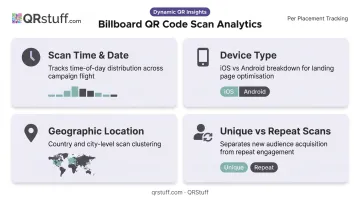
This turns a billboard from an impression-generating asset into a trackable performance channel. Instead of estimating which locations drive behavior, advertisers can compare actual scan counts across placements, identify which creative versions outperform others, and reallocate budget based on real data — not intuition.
KPIs this affects:
- Scan count per placement
- Unique vs. repeat scan ratio
- Time-of-day distribution
- Cost-per-scan across locations
When it matters most: Multi-location campaigns where budget allocation between placements needs optimization, and any campaign where OOH spend requires justification to stakeholders with concrete performance data. QRStuff's Enterprise tier supports campaign tagging and multi-user access specifically for teams managing simultaneous placements across different markets.
Advantage 3: Updating Campaign Content Without Reprinting
Static QR codes encode the destination URL directly into the graphic. If that URL needs to change, the billboard needs to be reprinted and reinstalled. Dynamic QR codes work differently: the graphic is a redirect, and the destination lives in a dashboard that can be updated at any time after printing.
A practical example: a campaign launches with a QR code pointing to a new product page. Three weeks in, the brand wants to run a limited-time discount. With a dynamic QR code, the destination switches in minutes. No new print production, no installation downtime, no additional cost.
QRStuff's dynamic QR codes (available on Lite, Full Suite, and Enterprise plans) allow unlimited destination updates after the code is printed. The same capability supports A/B testing: route scans to two different landing page variants, compare conversion outcomes using UTM parameters in Google Analytics, and keep the version that wins.
KPIs this affects:
- Cost savings on reprinting and reinstallation
- Number of campaign variations tested per flight
- Time-to-update after a campaign change decision
When it matters most: Seasonal retailers running rolling promotions, brands with long-term billboard leases who need to keep content fresh, and multi-phase product launches where the digital experience needs to evolve without touching the physical installation.
What Happens When QR Codes Are Absent
Without a direct response mechanism, a billboard campaign ends at the impression. There's no record of which locations drove behavior, no comparison point between creative versions, and no way to optimize placements based on actual performance.
Advertisers who rely entirely on traffic estimates for placement decisions tend to renew the same locations regardless of whether those locations actually drive action. The spend continues, but the data doesn't improve.
That friction extends to the viewer, too. An OAAA/Morning Consult study found that 78% of OOH viewers took some action after seeing an ad — but without a QR code, that action requires a manual search. Without a direct link, viewers must:
- Recall the brand name correctly
- Search for the right page among results
- Navigate to the specific offer they saw
Intent erodes at each step. A QR code with a specific incentive captures that intent before it fades.
How to Get the Most Value from Billboard QR Codes
Getting value from a billboard QR code requires three things to work together: proper sizing, the right placement context, and a destination that rewards the scan.
Sizing and Design
The standard sizing guideline is a 10:1 ratio — the QR code should be one-tenth the size of the expected scanning distance. A code intended for scanning at 30 feet should be at least 3 feet wide. For contrast, a dark code on a light background is the most reliable approach; complex backgrounds and low-contrast color combinations are the most common causes of scan failure.
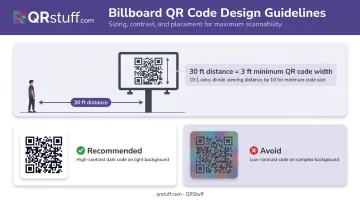
QRStuff exports in SVG and EPS formats for billboard production — vector files that scale to any size without losing clarity. The platform supports custom brand colors, logos, and corner patterns. For billboard applications specifically, keep the center of the code clear of complex logos and prioritize contrast over visual flair.
Placement and Incentive
Placement context determines whether a scan is even possible. Pedestrian-facing placements, transit shelters, and urban storefronts give viewers the dwell time to notice and act. Highway placements generally don't allow it.
Once the scan happens, the destination determines whether it was worth it. A generic homepage won't convert — the landing experience needs to justify the effort. Effective QR code destinations include:
- Exclusive discount codes not available through other channels
- Contest or giveaway entry pages
- Video content that extends the billboard's message
- Event ticket access or appointment booking
- Product pages tied directly to the billboard's offer
Use QRStuff's dynamic QR codes so the destination can be updated if the campaign shifts mid-flight — keeping the physical billboard in place while the digital experience stays current.
Conclusion
QR codes add three concrete advantages to billboard advertising:
- Turn passive impressions into trackable digital interactions
- Give OOH campaigns real attribution infrastructure for the first time
- Let advertisers update campaign content without reprinting
These advantages compound. Each campaign generates scan data that informs the next placement decision — which locations outperform, which time windows drive the most engagement, which incentives convert. Over time, that data builds a performance baseline for OOH advertising that estimates and traffic counts can't provide.
Billboard QR codes deliver results when they're built into the campaign strategy from the start: right location, right size, a compelling incentive, and monitoring in place before launch. Treated as an afterthought, they collect no useful data. Treated as infrastructure, they make every future OOH buy smarter.
Frequently Asked Questions
Frequently Asked Questions
Is it legal to put a QR code on a billboard?
No specific law prohibits QR codes on billboards, but distracted driving laws create real liability risk — a driver scanning a code may violate local hands-free ordinances. QR codes are safest on pedestrian-facing or transit-adjacent placements where scanning doesn't require operating a vehicle.
Are QR codes on billboards a good idea?
Yes, on the right billboards. Pedestrian zones, transit shelters, and high-congestion urban intersections give viewers enough dwell time to scan. High-speed highway placements offer minimal scan opportunity and real safety risk, making them a poor fit.
What is the 3-second rule for billboards?
The 3-second rule refers to the principle that a highway billboard must communicate its core message within approximately 3 seconds — the time a passing driver has to view it. This is why billboard copy stays at 5–7 words, and why QR codes on highway placements are impractical: scanning requires far more than 3 seconds of engagement.
How big should a QR code be on a billboard?
Follow the 10:1 rule — the code should be one-tenth the size of the expected scanning distance. A code scanned from 30 feet away should be at least 3 feet wide. High contrast between the code and background improves scan reliability significantly at distance.
What should a QR code on a billboard link to?
Link to something the viewer can't get by searching the brand online, such as an exclusive discount, contest entry, video content, or direct appointment booking. Generic homepage links produce poor engagement because they don't reward the effort of scanning.
Can I change where a billboard QR code links to after printing?
Yes. Dynamic QR codes allow the destination URL to be updated at any time after printing and installation. QRStuff's Lite, Full Suite, and Enterprise plans all support this — the physical code stays the same while the destination changes in the platform dashboard without reprinting.