GS1 Sunrise 2027 is the retail industry's coordinated push to ensure every point-of-sale system worldwide can read and process 2D barcodes by the end of 2027. It affects retailers, brand owners, manufacturers, and anyone involved in getting products onto store shelves.
This guide covers what the initiative actually is, why the industry is making the switch, which 2D formats are involved, whether compliance is mandatory, and how to start preparing now.
Key Takeaways
- GS1 Sunrise 2027 requires all retail POS systems to read 2D barcodes by end of 2027
- Pilots are already live in 48 countries covering 88% of global GDP
- Traditional 1D UPC barcodes only carry a product ID; 2D codes add batch numbers, expiry dates, URLs, and more in a single scan
- Two approved formats: QR codes with GS1 Digital Link (consumer-facing) and GS1 DataMatrix (compact, healthcare/industrial)
- Dual marking — both 1D and 2D on packaging — is required until 90% of POS systems are 2D-capable
- Not a legal mandate — but major retailers are aligning to this timeline, making compliance practically unavoidable
What Is GS1 Sunrise 2027?
GS1 Sunrise 2027 is a global retail initiative with one clear goal: every point-of-sale scanning system capable of reading and processing the GTIN from both traditional 1D and 2D barcodes by the end of 2027. The "sunrise" refers to the date after which 2D scanning readiness becomes the baseline industry expectation.
Behind this initiative is GS1, a neutral, not-for-profit global standards organization operating in 120 countries with over 2 million user companies. GS1 created and maintains the barcode and data standards at the foundation of modern retail — including the UPC barcodes that have appeared on product packaging for the past 50 years.
The Scale of This Transition
According to GS1's 2024 Global Industry Endorsement Statement, pilots are already underway in 48 countries across all regions, representing 88% of the world's GDP. Endorsers include Nestlé, L'Oréal, P&G, Mondelez, Carrefour, Lidl, Wegmans, and dozens of other global brands and retailers.
Who Is Affected
- Retailers — must upgrade POS scanners from laser-based to imager-based hardware capable of reading 2D codes
- Brand owners and manufacturers — must update packaging to include GS1-compliant 2D barcodes
- Solution providers — software, labeling, and printing partners must support GS1 Digital Link syntax and 2D code generation
The Transition Timeline
Until 90% of POS scanning systems can process GS1-compliant 2D barcodes, products must carry both a traditional 1D UPC/EAN barcode and a 2D code — what GS1 calls "dual marking." After 2027, 2D scanning capability becomes the expected standard, though UPCs won't disappear overnight and will continue to be accepted.
Why the Industry Is Moving from 1D to 2D Barcodes
A traditional 1D UPC barcode does exactly one thing: it tells a scanner what the product is via a Global Trade Item Number (GTIN). That's it. No expiry date, no batch number, no link to any additional data.
2D barcodes change that entirely — a single code can encode multiple data attributes simultaneously:
- Product identity — GTIN for standard POS lookup
- Batch/lot number — for precise product recalls and traceability
- Expiration date — enabling automated freshness management and date-based markdowns
- Serial number — for item-level tracking through the supply chain
- URL — linking consumers directly to product pages, ingredient lists, or sustainability data
The Consumer Demand Factor
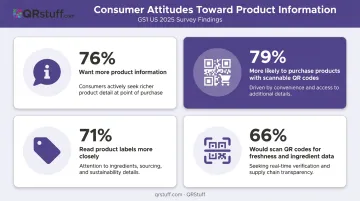
Shoppers increasingly want to know what's in the products they buy — and they're willing to engage. GS1 US's 2025 consumer survey found that:
- 76% of shoppers want more information to inform purchases
- 71% are reading product labels more closely and more often
- 66% would scan a QR code on food packaging for freshness, ingredients, and shelf-life data
- 79% are more likely to purchase products with a scannable QR code providing additional product information
Retailers who ignore this trend aren't just missing an engagement opportunity — they're falling behind consumer expectations that are already reshaping purchasing behavior.
The Supply Chain Efficiency Case
Beyond consumer engagement, 2D codes deliver real operational value. GS1's retail POS guidelines highlight several direct benefits:
- Automatic prevention of out-of-date product sales at checkout
- Date-based price markdowns without manual intervention
- More targeted and faster product recalls using lot/batch data
- Improved inventory visibility and reduced out-of-stocks
- Digital coupon integration directly through the barcode
This is the operational context behind GS1 Sunrise 2027 — the deadline that makes this transition from optional to mandatory for most retailers and brand owners.
QR Codes vs. GS1 DataMatrix: The Two Approved 2D Formats
GS1's retail POS guidance recognises three compliant 2D barcode options, which broadly fall into two formats: QR codes with GS1 Digital Link URI syntax and GS1 DataMatrix.
When to Use Each Format
| Format | Best For | Key Advantage |
|---|---|---|
| QR Code with GS1 Digital Link | Consumer-facing retail packaging | Scannable by any smartphone; supports consumer engagement |
| GS1 DataMatrix / DataMatrix with GS1 Digital Link | Healthcare, pharma, small/constrained packaging | Compact footprint; high data density |
For consumer products, QR codes are the natural choice when brand engagement matters. One scan at checkout captures the GTIN for POS processing; the same scan on a consumer's phone routes them to a product page, sustainability hub, or promotional campaign — no separate code needed for each purpose.
DataMatrix dominates in healthcare. Pharmaceutical blister packs and medical devices rely on it where a small, dense symbol is non-negotiable. If packaging space is severely constrained, DataMatrix is the better choice.
The Dynamic Advantage
For consumer packaged goods, the format choice also shapes how flexible your codes can be long-term. Dynamic QR codes let you update the destination URL without reprinting physical packaging — a significant operational advantage as labelling requirements evolve under Sunrise 2027.
QRStuff generates GS1-compliant dynamic QR codes where the linked content (product information, sustainability data, promotional offers) can be changed after codes are already on shelves. When product details change or regulations shift, brands update their digital content without triggering a reprint cycle.
What Is the GS1 Digital Link Standard?
GS1 Digital Link is a standard that encodes GS1 product identifiers — like a GTIN — into a standard web URL format. A single scan can complete a retail checkout transaction and simultaneously route a consumer to a live web destination. The current version, GS1 Digital Link URI Syntax Release 1.6.0, was ratified in March 2025.
How It Works in Practice
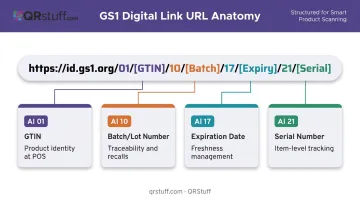
A GS1 Digital Link URL looks like this:
https://id.gs1.org/01/09520123456788/10/ABC123/17/250630
Each segment encodes a specific GS1 Application Identifier (AI):
| AI | What It Encodes | Example Use |
|---|---|---|
| 01 | GTIN | Product identity at POS |
| 10 | Batch/Lot Number | Traceability and recalls |
| 17 | Expiration Date | Freshness management, POS blocking |
| 21 | Serial Number | Item-level tracking |
Why It's Central to Sunrise 2027
GS1 Digital Link is what makes Sunrise 2027 more than a barcode swap. A single compliant code carries structured, machine-readable data for three distinct audiences:
- Retailers — item lookup at POS
- Supply chain teams — traceability, batch and expiry tracking
- Consumers — product information, brand engagement, transparency data
Unlike a generic QR code that points to a single URL, a GS1 Digital Link URL resolves differently depending on who's scanning — a POS terminal reads the GTIN, while a consumer's phone opens a product page. That resolver behavior is the key technical distinction.
Is GS1 Sunrise 2027 Mandatory?
No government legislation mandates Sunrise 2027 compliance. GS1 is a standards organisation, not a regulatory body, and no confirmed legal penalty exists for non-compliance. The legal picture is clear — the commercial picture is not.
Why "Voluntary" Doesn't Mean Optional
Major retailers across Europe, North America, and Asia are aligning their POS upgrade timelines to Sunrise 2027. Trade reporting from Packaging World noted in 2025 that Wegmans was preparing supplier communications around 2D barcode requirements. As more retailers upgrade their systems and begin expecting 2D codes from suppliers, brands that haven't transitioned face potential shelf compatibility issues.
The practical stakes:
- Once 90% of POS systems globally can read 2D codes, retailers may stop requiring a 1D UPC alongside the 2D code
- Brands still relying solely on 1D barcodes at that point could face scanning failures at upgraded POS systems
- Packaging lead times mean preparation needs to start well before the 2027 deadline — not after
Sunrise 2027 is industry-driven, not legally mandated. For any brand selling through mainstream retail channels, the commercial pressure from retailers makes compliance effectively unavoidable.
How to Prepare Your Business for Sunrise 2027
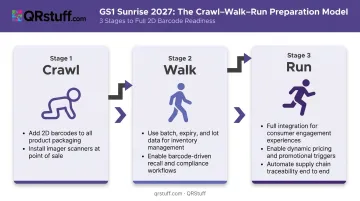
GS1 US frames preparation using a Crawl-Walk-Run model. Here's what that looks like in practice:
- Crawl — Add 2D barcodes to packaging; install imager-based scanners capable of reading them
- Walk — Use additional data — batch numbers, expiry dates, lot codes — for inventory and recall processes
- Run — Full integration of 2D scan data for consumer engagement, dynamic pricing, and supply chain automation
The steps below follow that sequence. Start with infrastructure, then move to packaging, then generation and testing.
Step 1: Assess POS and Scanner Readiness
Traditional laser-based scanners cannot read 2D codes. Imager-based scanners can read both. Before anything else, verify which type of scanners your retail environment uses.
GS1 US publishes a Barcode Capabilities Test Kit (Release 2.0) designed to evaluate existing POS infrastructure. Use it before committing to packaging changes.
Step 2: Plan Dual Marking on Packaging
During the transition, packaging must carry both a 1D UPC/EAN and a 2D code. This isn't just a design decision — it requires coordination across packaging design, IT, compliance, and marketing teams.
One critical detail from GS1's testing: the 2D code must be within 50mm (approximately 2 inches) of the linear barcode's centre to achieve reliable high-speed POS scanning performance. This placement requirement needs to be factored into artwork planning before production.
Step 3: Generate GS1-Compliant QR Codes
Not every QR code qualifies. Brands need codes that conform to GS1 Digital Link URI syntax — encoding the GTIN (and optionally batch, expiry, and serial data) within a structured URL format.
QRStuff's GS1 Digital Link QR Code service generates Sunrise 2027-compliant codes ready for retail POS scanning. One practical advantage for packaging teams: the destination a dynamic code links to can be updated after printing, without a reprint. For brands managing multiple SKUs, bulk generation is available on Full Suite and Enterprise plans — with API access for direct integration into packaging or ERP workflows.
Step 4: Verify Print Quality and Test Across Scanners
A readable code in ideal conditions isn't enough. Test printed codes across:
- Different scanner types and generations
- Variable lighting and surface conditions
- High-speed scanning environments (simulating retail checkout speeds)
Verify codes meet GS1's print quality requirements before committing to full production runs. Fix problems at the test stage, not after 500,000 units are on shelves.
Step 5: Plan for the "Run" Phase
Early movers gain something beyond compliance: data. Real-time scan data from GS1 Digital Link codes can feed directly into inventory systems, consumer loyalty programmes, dynamic pricing engines, and product transparency platforms. Treating Sunrise 2027 as a compliance exercise delivers a working barcode. Treating it as a platform upgrade delivers actionable consumer and supply chain intelligence — and the gap between those two outcomes widens with every scan.
Frequently Asked Questions
What is GS1 Sunrise 2027?
It's GS1's global initiative to ensure all retail POS systems can scan and process 2D barcodes by end of 2027. The goal is to move beyond the data limitations of traditional UPC barcodes and enable richer product data, traceability, and digital connectivity from a single scan.
Is GS1 Sunrise 2027 mandatory?
It's industry-driven rather than government-mandated — GS1 has not issued legal penalties for non-compliance. However, major retailers are aligning POS upgrades to this timeline, making preparation commercially essential for brands selling through mainstream retail channels.
Will Sunrise 2027 phase out UPC barcodes?
Not immediately. Dual marking — carrying both a 1D UPC and a 2D code — is required during the transition period. UPCs will continue to be scanned and accepted after 2027 while the industry scales up to the 90% POS readiness threshold.
What is the GS1 Digital Link standard?
GS1 Digital Link encodes GS1 product identifiers (like a GTIN) into a URL format within a 2D barcode. One scan completes a retail POS transaction and can simultaneously direct consumers to a live web destination: product information, sustainability data, or promotional content.
What does GS1 stand for?
GS1 is a neutral, not-for-profit global standards organization with member organizations in 120 countries and over 2 million user companies. It creates and maintains the international barcode and data standards that underpin global commerce.