Here's the part many brands miss: the collections being designed and sourced today will be the ones needing passports when enforcement arrives. Building the data infrastructure for DPP compliance takes time — often more than a year — and that clock is already running.
This guide covers what the DPP actually requires, which brands are in scope, and a practical step-by-step preparation plan.
Key Takeaways
- The EU Digital Product Passport is mandatory under ESPR — textile rules expected ~2027, enforcement likely from 2028/2029.
- Every brand selling apparel into the EU is in scope — including US, UK, and other non-EU headquartered companies.
- Products will need a physical data carrier (most likely a QR code) linking to verified passport data.
- Expected data requirements include material composition, supply chain traceability, environmental footprint, recyclability, and chemical compliance.
- Supply chain mapping, certification collection, and identifier planning are no-regret actions you can start today.
What Is the EU Digital Product Passport for Fashion?
The Digital Product Passport is a structured digital record attached to a product that captures verified information about its materials, origins, supply chain, environmental impact, and end-of-life handling. Consumers, retailers, and regulators can access it by scanning a physical data carrier — most likely a QR code — on the product label.
Its legal foundation is ESPR (Articles 9–15), which establishes:
- Article 9 — the product passport requirement itself
- Article 10 — requirements for data carriers and unique product identifiers
- Article 13 — the EU-managed DPP registry where passports are registered
The DPP goes well beyond existing textile labels. The current EU Textile Labelling Regulation (1007/2011) covers fiber composition and care instructions on physical tags — and that's where it stops.
The DPP is built for a different purpose entirely. Unlike a woven label, it is:
- Digital and dynamically updatable — data can be revised without reprinting
- Registry-connected — every passport links to the EU-managed DPP registry
- Data-rich — carries supplier information, environmental metrics, and circularity guidance that a physical label simply cannot hold
Which Fashion Brands Are Affected?
The short answer: if your products are sold on the EU market, you're in scope. The obligation follows the product, not the brand's headquarters.
The JRC's preparatory study defines the primary target as apparel and textile products containing at least 80% textile fibers by weight. Footwear is treated as a separate category with its own study timeline.
The rules apply regardless of where your brand is headquartered:
- US-based brands selling into the EU via DTC websites, wholesale, or marketplaces — in scope
- UK brands exporting to EU customers — in scope
- EU-based brands — in scope
What About Small Brands?
Size doesn't automatically equal exemption. No blanket DPP carve-out for SMEs has been confirmed — and while separate ESPR provisions (like the ban on destroying unsold consumer goods) do include SME-specific exceptions, those are distinct from DPP requirements. Small brands selling in the EU should not assume they're exempt and should monitor delegated act updates closely.
EU DPP Timeline: Key Dates to Know
| Milestone | Date / Status |
|---|---|
| ESPR entered into force | 18 July 2024 |
| ESPR Working Plan 2025–2030 adopted | April 2025 |
| Textiles identified as priority category | April 2025 |
| Textile delegated act expected | ~2027 (indicative) |
| Minimum transition period after delegated act | At least 18 months |
| Earliest plausible enforcement for textiles | 2028–2029 |
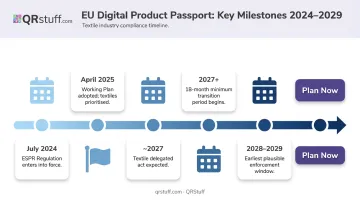
These dates reflect where the regulation currently stands. The Commission's Working Plan COM(2025) 187 confirms textiles/apparel as a top priority. The 2028 enforcement window is a reasonable planning assumption — not yet an officially fixed date — but treat it as firm when making production, sourcing, and labelling decisions.
One critical implication: a garment entering production in late 2025 or 2026 could still be in retail inventory when DPPs become required. Design decisions made now affect compliance exposure later.
What Data Does a Fashion DPP Need to Contain?
Final requirements will be set in the textile delegated act. But the EPRS/STOA June 2024 study — which proposes 16 categories of information for a textile DPP — and the JRC's 3rd milestone preparatory study give a strong signal of what's coming.
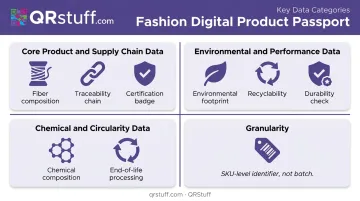
Core Product and Supply Chain Data
- Material composition — fiber types and exact percentages
- Supply chain traceability — fabric mills, cut-and-sew facilities, finishers, with country of operation
- Certifications and documentation: GOTS, OEKO-TEX, recycled content certificates, and audit reports
- Unique product identifier — linked to the EU DPP registry
Environmental and Performance Data
- Manufacturing footprint — likely using PEFCR (Product Environmental Footprint Category Rules) methodology for apparel
- Recyclability score, based on fiber composition and construction
- Durability/robustness score — performance after repeated laundering
- Recycled content with verified thresholds (Global Recycled Standard requires a minimum 50% recycled content for full certification)
Chemical and Circularity Data
- Substances of concern — REACH compliance disclosure
- End-of-life guidance: recycling instructions, take-back program availability, and disassembly information
Granularity
The DPP is expected to be issued at the product model level (per SKU), not for every individual item. However, each model will carry a unique identifier. For brands releasing hundreds of SKUs per season, that means hundreds of separate DPP records, each requiring complete, verified data. Data management workflows need to scale to match.
How Is the DPP Delivered? The Role of QR Codes on Product Labels
ESPR requires a physical data carrier on the product, connecting it to the digital passport. The regulation is technology-neutral on the specific format, but GS1 (the global standards body for product identification) identifies QR codes and Data Matrix codes (using GS1 Digital Link) as the practical implementation route for retail products.
Why QR Codes Make Sense for Fashion
- Printable on existing garment labels at minimal cost
- Scannable by any smartphone without a dedicated app
- Compatible with GS1 Digital Link, which encodes GTINs, batch numbers, and serial numbers in a structured URI format
- Already familiar to consumers from restaurant menus, packaging, and retail contexts
Static vs. Dynamic QR Codes
This distinction is central to DPP compliance.
A static QR code encodes a fixed URL directly into the code pattern. Once printed, it cannot be changed. If your passport data URL changes, or if the EU DPP registry shifts, or if new certification information needs to be added — the physical label becomes outdated.
A dynamic QR code uses a short redirect URL as an intermediary. The QR pattern on the label stays the same, but the destination it points to can be updated at any time from a dashboard — without recalling or reprinting garments.
For DPP compliance, dynamic QR codes are the practical choice because the regulations are still being finalized. Brands printing labels today don't yet know the exact URL structure the EU DPP registry will require, or what data fields will need to be surfaced. When those details change, dynamic codes mean the fix happens in software — not on a production line.
Platforms like QRStuff support this workflow directly: destination URLs can be updated after printing, and built-in scan analytics track how customers are accessing product passport information — broken down by location, device, and time period. For brands treating DPP labels as both a compliance requirement and a consumer touchpoint, that data shows which products are driving genuine engagement with sustainability content.
Practical Label Considerations
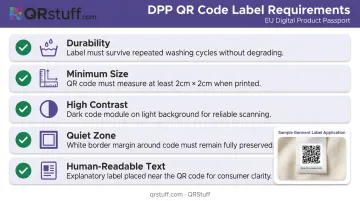
- Durability — labels must survive washing; test QR code legibility on your specific fabric and ink combination before production
- Minimum size — at least 2cm × 2cm for reliable scanning
- High contrast — dark code on light background; avoid placing codes on dark or patterned fabric without a white background field
- Quiet zone — never crop the white border surrounding the code; scanners need it to locate the code
- Human-readable text — add a brief label near the code explaining what it links to (e.g., "Scan for product sustainability information")
How to Prepare Your Fashion Brand for the DPP: A Step-by-Step Plan
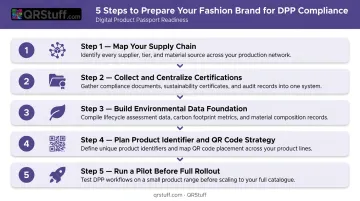
Step 1 — Map Your Supply Chain
DPP compliance requires documented visibility into every tier of your supply chain — not just tier-one suppliers. That means tracking:
- Fabric mills and yarn suppliers
- Trim suppliers and dye houses
- Cut-and-sew facilities
- Finishing operations
Each needs a country of operation and a clear record of what they contribute to the finished product.
Start now. Supplier data collection takes time, and in complex global supply chains, some tiers actively resist disclosure. Brands already doing this work for Fashion Transparency Index reporting or Higg data collection are ahead of the curve.
Step 2 — Collect and Centralize Material Certifications
Gather existing certifications from suppliers — GOTS, OEKO-TEX, Recycled Claim Standard (RCS), Global Recycled Standard (GRS) — and store them in a centralized, searchable system. These directly feed the material composition, recycled content, and chemical compliance fields the DPP will require. A disorganized certificate folder on someone's laptop is not a compliance system.
Step 3 — Build Your Environmental Data Foundation
The EU's Product Environmental Footprint Category Rules (PEFCR) for Apparel and Footwear provide the methodology likely to underpin the DPP's environmental metrics. Begin working with life cycle assessment (LCA) tools or data providers to measure product-level environmental footprint using this framework.
Getting a baseline now (even with estimated data) puts you well ahead of where you need to be when the delegated act drops.
Step 4 — Plan Your Product Identifier and QR Code Strategy
Every DPP-requiring product needs a unique identifier, ideally aligned with GS1 GTIN standards. Decide now whether you'll identify products at the model, batch, or item level (model-level per SKU is the current expectation, but check delegated act updates). Design your label workflow to generate unique QR codes per SKU at the point of label creation.
QRStuff supports GS1 Digital Link QR codes — encoding GTINs in a structured URI format that is both retail POS scannable (Sunrise 2027 compliant) and capable of linking to DPP data. For brands with large catalogs, the platform's bulk generation and enterprise API allow QR codes to be created programmatically per SKU within existing product information management or ERP workflows.
Step 5 — Run a Pilot Before Full Rollout
Pick a capsule collection or five to ten representative SKUs. Run the full DPP flow end-to-end: assign identifiers, create a passport data structure, generate QR codes, print labels, scan them, verify the data is accessible. This surfaces data gaps and workflow bottlenecks before a full season's production is in motion.
Why Starting Now Is a Strategic Advantage
Compliance is the minimum. The brands that move early get more.
Consumer Trust and Differentiation
Chloé uses digital IDs to trace items from field to finished product and support resale through Vestiaire Collective. PANGAIA has built a digital-passport-enabled ReWear resale platform in partnership with EON and Archive.
These brands are using product transparency as a direct consumer touchpoint. The DPP becomes a story on the label — not just a regulatory checkbox.
Anti-Counterfeiting for Premium Brands
The EUIPO reported that EU authorities seized over 112 million counterfeit items worth €3.8 billion in 2024. A SKU-level QR code linked to verified supply chain and material data is extremely difficult to replicate authentically — it becomes a built-in authentication mechanism for premium and luxury product lines.
The Cost of Waiting
Brands that delay face the same data collection challenge compressed into a shorter window, at higher urgency, with less time to fix supplier relationships that won't cooperate. A gradual build over two to three years is less disruptive and less expensive than a last-minute sprint — even if the sprint technically gets you across the line.
The data infrastructure you build for DPP compliance extends well beyond the regulation itself. It supports extended producer responsibility reporting, textile waste compliance, resale platform integration, and consumer-facing sustainability claims — making it a reusable business asset, not a one-time compliance cost.

Frequently Asked Questions
Does the EU Digital Product Passport apply to US fashion brands?
Yes. ESPR is market-access based, not headquarters based. Any brand placing apparel products on the EU market — including US brands selling via DTC websites, wholesale partners, or marketplaces with EU customers — falls within scope.
When does the EU Digital Product Passport become mandatory for fashion?
The textile-specific delegated act is expected around 2027. ESPR requires a minimum 18-month transition period after delegated acts are adopted, putting enforcement as early as 2028 or 2029. Timelines can shift, so brands should monitor ESPR updates rather than treating any date as fixed.
What information does a fashion DPP need to include?
Expected fields span material, environmental, and supply chain data, including:
- Material composition and fiber percentages
- Supply chain and facility-level traceability
- Environmental footprint (likely using PEFCR methodology)
- Recyclability and durability scores
- Recycled content and REACH chemical compliance
- End-of-life guidance
Final requirements will be confirmed in the textile delegated act.
How will consumers and regulators access the Digital Product Passport on a garment?
A physical data carrier — most likely a QR code on the product label — will link to the digital passport record. Anyone with a smartphone can scan it without a dedicated app to access the product's verified data.
What is the difference between a static and dynamic QR code for DPP compliance?
Static QR codes encode a fixed URL that cannot be changed after printing. Dynamic QR codes redirect through an editable intermediary, so the destination can be updated at any time without reprinting the label — making them far more practical when regulatory requirements and registry URLs are still being finalized.
Do small or independent fashion brands need to comply with the EU Digital Product Passport?
No confirmed blanket SME exemption exists for the DPP. Some separate ESPR provisions have SME carve-outs (such as the unsold goods destruction ban), but those don't extend to DPP requirements. Small brands selling in the EU should begin proportional preparation and monitor delegated act developments.