Introduction
QR codes have become a practical tool in clinical settings — faster patient check-ins, paperless intake forms, instant access to discharge instructions. But healthcare administrators face a real tension: the same feature that makes QR codes convenient (instant, frictionless access) is exactly what makes a careless implementation risky under HIPAA.
Most vendors won't tell you this upfront: a QR code cannot be HIPAA compliant or non-compliant on its own. The code is just a pattern that encodes a URL. Compliance is determined by what that URL connects to, which platform manages the redirect, and how patient data is handled at the destination.
According to HIPAA Journal's 2024 breach report, 725 large healthcare data breaches were recorded in 2024 alone, exposing an estimated 275 million records. That context matters when evaluating any new digital touchpoint in a healthcare environment.
This guide breaks down what HIPAA compliance actually requires for QR code workflows, which use cases need it, and what security features your platform must have. Where relevant, it draws on QRStuff's work with enterprise healthcare organizations.
Key Takeaways
- HIPAA compliance applies when QR codes connect to or collect Protected Health Information (PHI) — not for wayfinding, general education, or marketing
- The QR code itself is neutral; the platform, destination, and data handling determine compliance
- PHI-touching workflows require HTTPS destinations, access controls (SSO/MFA), audit logs, and a signed BAA
- Dynamic QR codes are the better choice for healthcare; destinations can be updated without reprinting
- Identifying the PHI boundary is the critical first step before deploying any healthcare QR code
Why Healthcare QR Codes Need Special Attention
What Counts as PHI
Under HIPAA, Protected Health Information is any individually identifiable health information that relates to a patient's past, present, or future health condition, treatment, or payment. HHS defines this broadly — it includes 18 specific identifiers, from names and email addresses to IP addresses and medical record numbers.
In practice, this means:
- A name combined with an appointment date = PHI
- An IP address linked to a condition or diagnosis = PHI
- A lab result URL accessible without authentication = PHI exposure
The Novant Health case illustrates how easily this boundary gets crossed digitally. The health system notified 1.36 million patients about unauthorized PHI disclosure via Meta Pixel code on its patient portal — capturing email addresses, appointment dates, and physician selections. A QR code routing patients to that same portal page creates an identical exposure pathway.
That exposure pathway carries a direct financial cost. Current OCR civil monetary penalties (effective January 28, 2026) are structured in four tiers:
The Financial Reality of Non-Compliance
| Culpability Level | Minimum Per Violation | Maximum Per Violation | Annual Cap |
|---|---|---|---|
| Did not know | $145 | $73,011 | $2,190,294 |
| Reasonable cause | $1,461 | $73,011 | $2,190,294 |
| Willful neglect, corrected | $14,602 | $73,011 | $2,190,294 |
| Willful neglect, not corrected | $73,011 | $2,190,294 | $2,190,294 |
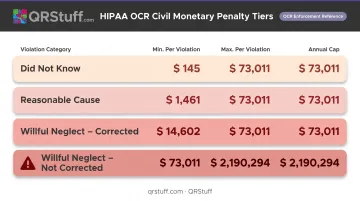
Ignorance doesn't reduce liability — penalties start at $145 per violation even when an organization had no knowledge of the breach. Violations are counted per affected individual, not per incident.
The BAA Requirement Nobody Skips
Any third-party vendor that processes or stores PHI on behalf of a covered entity must sign a Business Associate Agreement. This includes QR code platforms that touch PHI workflows.
Two enforcement cases show the cost of skipping this step:
- Raleigh Orthopaedic Clinic — $750,000 settlement for disclosing PHI to a vendor before a BAA was signed
- Center for Children's Digestive Health — $31,000 penalty for the same oversight with a records storage provider
In both cases, the systems themselves weren't insecure. The missing contract was the violation.
What "HIPAA-Compliant QR Code" Actually Means
The Three Layers of Compliance
For any QR code workflow that touches PHI, three layers must all be present:
- Data encryption — AES-256 at rest and TLS 1.2 or higher in transit at the destination (HIPAA's Security Rule at 45 CFR 164.312 makes encryption an addressable specification; NIST SP 800-52 and FIPS 197 define acceptable standards)
- Access controls — patients must authenticate before any PHI is displayed; unique user identification and authentication are required under 45 CFR 164.312(a) and 164.312(d)
- Audit logs — records of who accessed what data, when, and from where; required under 45 CFR 164.312(b)
All three must exist at the destination system, not just at the QR code platform level.
Dynamic vs. Static: Why It Matters for Security
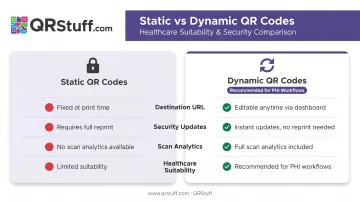
Static QR codes encode a URL directly into the pattern. Once printed, that URL is permanent. If the linked patient portal gets replaced, the domain changes, or a security vulnerability requires the page to be taken down, every printed static code becomes a dead or potentially unsafe link.
Dynamic QR codes store only a short redirect URL in the pattern. The actual destination is managed in a dashboard and can be updated without reprinting anything. In healthcare environments where portals are updated, security patches are applied, and forms change regularly, dynamic codes are the only operationally sound choice.
| Static QR Codes | Dynamic QR Codes | |
|---|---|---|
| Destination URL | Fixed at print time | Editable anytime via dashboard |
| Security patching | Requires reprinting all codes | Update destination instantly |
| Scan analytics | Not available | Full tracking included |
| Healthcare suitability | Limited — no flexibility | Recommended for PHI workflows |
The PHI Boundary: What Needs Full Compliance vs. What Doesn't
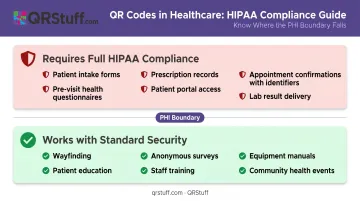
One reliable test: if scanning the code — or submitting the form it links to — results in collecting, displaying, or transmitting information that could identify a patient and relates to their health, treatment, or payment, it crosses the PHI boundary.
Generally does NOT require full HIPAA infrastructure:
- General health education content
- Anonymous satisfaction surveys
- Facility maps and wayfinding
- Healthcare marketing materials
- Staff training content
Requires full compliance stack:
- Anything with a patient's name + health data
- Intake forms collecting identifiers + diagnoses
- Lab results, prescription records, or treatment histories
- Patient portal access codes
- Appointment confirmations with patient identifiers
QR Code Use Cases in Healthcare: Mapped by Compliance Level
Use Cases That Require Full HIPAA Compliance
These workflows unavoidably involve PHI and require an encrypted platform, signed BAA, access controls, and audit logs:
- Patient intake forms collecting name, date of birth, insurance, and medical history
- Pre-visit health history questionnaires linked to a specific patient record
- Prescription and medication records accessible via patient-specific QR code
- Patient portal access — QR codes that log a patient directly into their health record
- Appointment confirmations containing patient identifiers and provider details
- Lab result delivery to authenticated patients
Use Cases That Work Well with Standard Security
These applications deliver real value without triggering PHI requirements. A platform with strong security certifications, dynamic code capability, and access controls handles these well:
- Facility wayfinding and interactive maps
- General patient education (condition overviews, procedure explainers)
- Anonymous post-visit satisfaction surveys
- Healthcare staff training materials
- Equipment operating manuals
- Community health event information
QRStuff fits naturally here. The platform carries SOC2 and GDPR certifications, supports password-protected codes and 2FA, and offers SSO via SAML 2.0 and OpenID Connect. Its Enterprise tier adds role-based permissions scoped by department, so healthcare organizations can manage clinical, marketing, and administrative access separately without overprovisioning.
The Gray Zone: Use Cases to Evaluate Carefully
These sit on the boundary and require case-by-case assessment:
- Telehealth booking links — depends on whether the booking form collects PHI
- Insurance verification uploads — PHI if linked to identity and health information
- Remote patient monitoring check-ins — PHI if connected to a patient record
- Post-discharge instruction sheets — PHI when personalized to a named patient's diagnosis or treatment plan
The deciding question is always the same: does completing this workflow result in identifiable patient health data being created, stored, or transmitted?
Security Features Every Healthcare QR Code Platform Must Have
Regardless of whether a specific use case requires HIPAA certification, healthcare organizations should hold QR code platforms to a higher standard than consumer tools.
Minimum Security Baseline
- Serve all linked content over HTTPS-only connections — no exceptions for patient-facing pages
- Apply TLS 1.2+ for data in transit and AES-256 for data at rest
- Block third-party ad tracking pixels on scan redirect pages; the HHS/FTC 2023 joint warning explicitly flagged Meta Pixel and Google Analytics as potential PHI disclosure vectors on patient-facing pages
QRStuff uses TLS 1.2 or higher for all data in transit and AES-256 encryption for data at rest, meeting these baseline standards.
Access Controls That Matter in Healthcare
- Integrate SSO with hospital identity systems using SAML 2.0 or OpenID Connect (compatible with Okta, Azure AD, and Google Workspace)
- Require MFA/2FA for all administrative access; QRStuff supports 2FA with security keys
- Scope role-based permissions by department, title, and individual code or project grouping
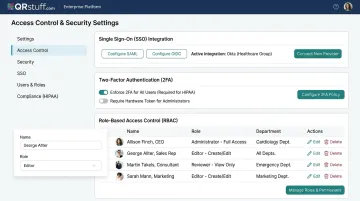
This matters practically: a clinical team should not have the same access to QR code management as a marketing team, and IT administrators should be the only ones modifying platform-wide security settings.
Audit Logs as Compliance Records
QRStuff's analytics capture each scan event with timestamp, device type, operating system, and geographic location at the city and country level, exportable as CSV or PDF in real time. This data serves compliance purposes, not just marketing.
When a security incident occurs, scan history can surface:
- Unexpected geographic locations indicating unauthorized access
- Unusual device types inconsistent with normal staff use
- Off-hours access patterns that warrant investigation
Under 45 CFR 164.312(b), audit control mechanisms are required for systems containing ePHI. That requirement extends to the QR platform layer.
Password-Protected Codes for Sensitive Non-PHI Content
For staff-only clinical protocols, restricted training materials, or internal research documents, password-protected QR codes add a practical access gate without requiring full HIPAA infrastructure. The content doesn't need to be patient data to warrant restricted access.
How to Implement QR Codes in Your Healthcare Setting
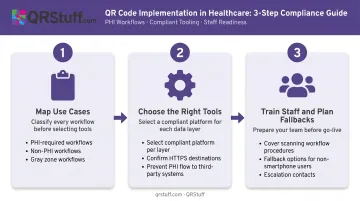
Step 1 — Map Every Use Case Against the PHI Boundary
Before generating a single code, list all intended use cases and classify each:
- PHI-required: needs encrypted platform, BAA, access controls, audit logs
- Non-PHI: strong security certifications and dynamic codes are sufficient
- Gray zone: evaluate the specific data collected at the destination
This classification determines which platform and compliance layer each workflow needs.
Step 2 — Choose the Right Tools for Each Layer
For PHI-touching workflows:
- Select a platform that offers a BAA, HIPAA certification, encryption, and audit logs
- Confirm the destination is an authenticated, HTTPS-only patient portal
- Ensure no PHI flows into third-party databases outside your EHR system
For non-PHI workflows (wayfinding, education, training, marketing):
- A SOC2 and GDPR-certified platform with dynamic codes, 2FA, SSO, and password protection covers the requirements
- QRStuff's Enterprise tier includes all of these features plus bulk generation, role-based permissions, and dedicated account management — built for healthcare systems managing codes across multiple facilities
Always use dynamic QR codes in both layers. Destinations update; static printed codes cannot follow — and reprinting clinical signage at scale is expensive and slow.
Step 3 — Train Staff and Plan for the 10%
QR adoption requires staff training on the complete workflow before deployment. Cover three areas at minimum:
- How the code connects to the form or portal
- What to do when a patient's phone can't scan it
- Who to contact if a destination link breaks
According to Pew Research Center's January 2024 survey, 10% of US adults do not own a smartphone — rising to 21% among households earning under $30,000 annually.
Every QR-driven workflow needs a paper, kiosk, or staff-assisted fallback. For patient-facing signage, a simple printed instruction ("Scan with your phone's camera, or ask staff for assistance") removes friction for the patients who need it most.
Frequently Asked Questions
What is a HIPAA-compliant QR code scan app?
A HIPAA-compliant QR code platform generates and manages codes under HIPAA's security and privacy rules — covering encrypted data handling, audit trails, access controls, and a signed BAA. Healthcare organizations can use these platforms for PHI-touching workflows without HIPAA liability. The platform itself must meet these standards, not just the destination it links to.
Do all QR codes used in healthcare need to be HIPAA compliant?
No — only codes that connect to, collect, or display Protected Health Information require full HIPAA compliance infrastructure. Wayfinding, anonymous surveys, patient education, and healthcare marketing typically don't involve PHI and can be handled with strong standard security practices like SOC2-certified platforms with encryption and access controls.
What healthcare information can be safely shared via QR code without full HIPAA infrastructure?
General health education, facility maps, anonymous feedback forms, and marketing materials are generally safe without full HIPAA compliance. Codes linking to patient-specific records, intake forms with identifiers, or personalized treatment details require a compliant platform with a signed BAA.
What security features should a healthcare QR code platform have?
At minimum: HTTPS-only destinations, AES-256 encryption at rest, TLS 1.2+ in transit, SSO and MFA for admin access, role-based permissions, and audit logs. For PHI use cases, add a signed BAA and confirmed HIPAA certification from the vendor. No third-party ad tracking pixels on redirect pages.
Can dynamic QR codes be used for patient check-in?
Yes — and they're the preferred choice. Dynamic codes can be updated when the linked form or portal changes without reprinting any signage, and their scan analytics help administrators measure adoption and identify issues. Static codes, by contrast, require physical reprinting every time the destination URL changes.
What is a Business Associate Agreement (BAA) and when do I need one?
A BAA is a legally required contract between a covered healthcare entity and any vendor that handles PHI on its behalf. Without one, the organization is in violation regardless of the vendor's security practices — the Raleigh Orthopaedic $750,000 settlement is a direct example of this risk.