Introduction
Manufacturing recorded 353 fatal occupational injuries in 2024, with contact incidents, exposure events, and falls accounting for the majority. Behind many of those incidents sits a common thread: workers couldn't access the right safety information at the right moment.
QR codes have become a practical fix for this problem. They're now attached to CNC machines, chemical storage areas, PPE stations, and emergency exits across facilities worldwide. Scan a code, get the procedure — that's the idea.
In practice, a poorly deployed QR code system can be worse than no system at all. A degraded label that won't scan, a code pointing to an outdated LOTO procedure, or an unsecured link on the shop floor each create their own category of risk.
The technology only protects workers when the deployment behind it is disciplined.
This guide covers the specific best practices manufacturing safety teams need to deploy and maintain QR code systems that workers can actually rely on.
Key Takeaways
- Dynamic QR codes let you update safety procedures instantly, keeping documentation current without reprinting
- Industrial-grade labels (polyester, polycarbonate, or metal-backed) are non-negotiable in harsh environments
- Every code needs a text label stating its purpose; unlabeled codes get ignored or misused
- Restrict sensitive documentation behind access controls — factory floors are not secure environments
- Monitor scan data regularly — a sudden drop in safety checklist scans is an early warning sign worth investigating
QR Code Safety Guidelines for Manufacturing
QR code safety in manufacturing covers three distinct domains:
- Physical deployment safety (where and how codes are placed relative to hazards)
- Content integrity (ensuring linked procedures are accurate, current, and accessible)
- Digital access control (managing who can reach sensitive documentation)
Safety isn't established at the moment of printing. It requires ongoing placement audits, content reviews, and consistent worker protocols. A QR code label, like any safety signage, needs ongoing maintenance — not just initial installation.
General Safety Precautions
Two baseline rules apply to every QR code placed on a factory floor:
1. Every code must have a plain-text label stating its purpose.
A QR code with no context gets ignored. Workers in high-pressure environments won't stop to experiment with an unmarked code. Labels like "Scan for LOTO procedure" or "Scan for SDS" tell workers exactly what they're accessing before they scan , which is the only way the code earns consistent use.
2. Every code must link to verified, current content before deployment.
Never place a code pointing to a draft document, an expired checklist, or a URL that hasn't been tested on both iOS and Android under real floor conditions.
A code that fails on the floor is equivalent to no safety information at all. It's worse, in fact: it creates the impression that information was provided when it wasn't.
Safety During QR Code Setup and Deployment
Attaching labels to active machinery requires the same isolation and clearance protocols as any maintenance activity: equipment off, energy isolated, placement documented.
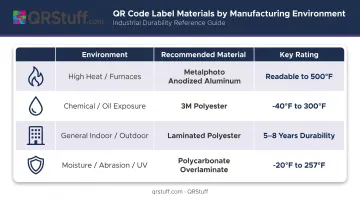
Label material selection is where most facilities underinvest. Match the material to the environment:
| Environment | Recommended Material | Key Rating |
|---|---|---|
| High heat (furnaces, welding) | Metalphoto anodized aluminum | Readable to 500°F standard; 800°F image-intensified |
| Chemical/oil exposure (CNC, hydraulics) | 3M thermal-transfer polyester (7871/7872/7873) | Rated -40°F to 300°F; tested against engine oil, hydraulic fluid, diesel |
| General indoor/outdoor use | Brady B-302 laminated polyester | 5–8 years expected outdoor durability; 1,000 abrasion cycles |
| Moisture, abrasion, moderate UV | Polycarbonate overlaminate (3M FL01N) | Rated -20°F to 257°F |
Code sizing and standoff distance matters physically, not just technically. OSHA 1910.145 requires accident-prevention tags to be readable from at least 5 feet. A QR code that requires a worker to lean over a machine guard or enter a pinch-point zone to scan it has introduced a new hazard. Size codes for the expected scan distance, and define safe scanning positions before any label is printed.
Use dynamic QR codes for all safety-critical content. QRStuff's dynamic codes let you update the destination URL instantly through the dashboard, without touching the physical label. When an SOP changes, an MSDS is revised, or a LOTO procedure is updated, the label on the equipment stays in place and the content updates in real time.
Under paid plans, these codes don't expire as long as the subscription is active. For facilities managing dozens or hundreds of procedures across multiple assets, this eliminates the compliance gap that static codes create every time documentation changes.
Safety While Operating QR Code Systems
Scanning protocols must be defined before deployment goes live. Workers should never scan QR codes while operating machinery, handling hazardous materials mid-task, or standing in a zone requiring full situational awareness. For each code placement, identify the safe scanning position and mark it physically if the environment warrants it.
Monitor scan analytics to catch problems early. QRStuff's analytics dashboard surfaces per-code scan data broken down by time period, device type, and location. A sudden drop in scans on a safety checklist or inspection code is a warning : broken link, damaged label, unclear purpose, or worker non-compliance. Investigate before the next shift.
Document a fallback procedure for scan failures. A damaged label during a live task is not a hypothetical. Workers need a defined alternative (a posted paper backup, a supervisor contact, a known file path) so that label failure never leaves someone without access to critical instructions.
Digital Security and Access Control for Manufacturing QR Codes
QR codes on a factory floor are physically accessible to anyone in the facility — and that exposure creates two distinct security risks most safety teams overlook until something goes wrong.
Tampering and Spoofing
The FBI's IC3 documented cases of cybercriminals physically tampering with QR codes to redirect users to malicious destinations including credential theft pages, fraudulent payment portals, and malware downloads. On a factory floor, the equivalent threat is an accidental label swap or deliberate substitution that sends workers to incorrect chemical handling instructions or wrong emergency procedures.
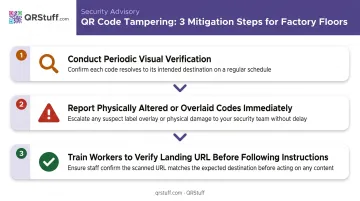
Mitigation steps:
- Conduct periodic visual verification checks to confirm that codes on equipment still resolve to the intended destination
- Report any code that looks physically altered or overlaid immediately
- Train workers to check that the URL they land on matches the expected destination before following any instructions
Access Control and Role-Based Permissions
Not all QR codes carry the same sensitivity. Apply access control accordingly:
- Open access: General safety instructions, SDS for common materials, emergency exit directions
- Restricted access: Proprietary SOPs, regulatory compliance documentation, internal audit records
QRStuff's Enterprise plan supports role-based access control with granular permissions: specific QR code access grants, project-level controls, and department-level restrictions. An operator can reach the maintenance checklist for their assigned equipment without touching the compliance record library.
For manufacturing environments running centralized identity management, the platform is SOC2 compliant and supports enterprise SSO via SAML 2.0 and OpenID Connect — keeping QR code access inside your existing authentication infrastructure.
Decommissioned Equipment
When a machine is retired, relocated, or repurposed, its QR codes must be physically removed or redirected immediately. A code pointing to a LOTO procedure for a machine that no longer exists — or has been reconfigured — is an active compliance liability. Build equipment decommissioning into your QR code change management process.
Common QR Code Safety Mistakes to Avoid in Manufacturing
Codes on moving or vibrating surfaces. A QR code on a vibrating housing distorts and becomes unscannable. Worse, a worker trying to scan it may be standing near pinch points or rotating parts. Codes belong on fixed, non-hazardous surfaces at safe standoff distances only.
Updating destination documents without verifying the link still resolves. Changing the file at the destination doesn't confirm the QR code still works. A silent redirect failure means workers get an error — or outdated instructions — exactly when accuracy matters most. Dynamic codes with monitored analytics flag broken links before workers ever encounter them.
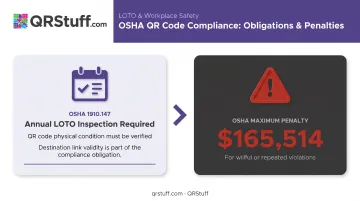
Treating QR code deployment as a one-time IT task. OSHA 1910.147 requires LOTO energy-control procedures to be inspected at least annually, with documented certification. When a QR code is the access point for that procedure, its physical condition and link validity are part of that compliance obligation — not a separate IT concern.
Facilities that separate the two create audit trail gaps with real consequences. OSHA's maximum penalty for a willful or repeated violation is $165,514.
Assuming all workers can scan without issues. Gloves, shared devices, low light, and dirty screens all cause scan failures. Train workers on the scan protocol, the fallback procedure, and what each code links to before going live. QRStuff's analytics will show you which codes workers are actually using — and which ones they've stopped trying.
Conclusion
QR codes reduce manufacturing safety risk only when the system behind them is maintained with the same rigor applied to any other safety-critical signage. A degraded label, a broken link, an unsecured destination, or a missing fallback procedure each carry real consequences — for workers and for compliance.
Build QR code audits into your regular safety inspection cycles. Review label condition, verify link resolution, check scan analytics for usage drops, and confirm that access controls still reflect current roles and equipment status. Running that process consistently across dozens or hundreds of codes requires the right infrastructure. QRStuff's audit logging, real-time scan analytics, and dynamic code management give safety teams visibility into every active code on the floor — but the schedule and accountability belong to the safety program, not the platform.
Every code on your floor is a link in a safety chain. When that link breaks — even once, at the wrong moment — the cost can't be undone by a software update. Consistent maintenance is what keeps it from breaking.
Frequently Asked Questions
What are some ways to ensure QR code safety?
Use dynamic codes so content can be updated without reprinting, select industrial-grade label materials matched to your specific environment, apply access controls to sensitive documentation, and audit both physical label condition and link validity on a regular schedule aligned with your safety inspection cycle.
What is the ISO specification for QR codes?
QR codes are standardized under ISO/IEC 18004:2024, which defines symbol characteristics, data encoding, error correction, and quality requirements. For manufacturing environments where label damage is likely, error correction levels Q (25% restoration) or H (30% restoration) are recommended over the default L or M levels.
What label materials work best for QR codes in harsh manufacturing environments?
Polyester, polycarbonate overlaminates, and Metalphoto anodized aluminum outperform standard paper in industrial settings. Metalphoto handles temperatures up to 500°F and 7,000 abrasion cycles; 3M thermal-transfer polyester covers chemical and oil exposure; laminated polyester suits general indoor/outdoor use with 5–8 years expected durability.
Can QR codes be tampered with or spoofed on the factory floor?
The codes themselves carry no encryption — a fraudulent label can physically replace or overlay a legitimate one, redirecting workers to incorrect procedures or malicious destinations. Conduct periodic visual verification checks and require authentication for any QR codes linking to sensitive safety documentation.
Should manufacturing QR codes use static or dynamic links for safety procedures?
Dynamic codes are strongly recommended for safety-critical content. When procedures change, the destination updates immediately without reprinting — static codes pointing to outdated procedures create direct compliance liability. On QRStuff's paid plans, dynamic codes don't expire as long as the subscription remains active.
How often should QR code links and labels be verified in a manufacturing setting?
Align verification with your existing safety inspection schedule. Higher-risk placements near hazardous equipment or emergency exits warrant more frequent checks. Use manufacturer durability specs to set replacement intervals, and treat link validation as part of every inspection — not a separate task.