Introduction
Printed brochures face a fundamental problem: the moment they leave the press, they're frozen. Prices change, offers expire, and products evolve — the brochure doesn't. Meanwhile, customers expect instant access to deep information, and marketers need proof that their print spend is actually working.
Most businesses treat QR codes on brochures as a simple "add a link" afterthought — and in doing so, miss most of the value. A well-implemented QR code transforms a static handout into a measurable, updatable, multimedia touchpoint that can deliver video tours, intake forms, pricing pages, and product demos without adding a single extra page to your print run.
Here's what that looks like in practice. This article covers three specific operational advantages of QR code-powered interactive brochures: richer content delivery, scan-level campaign tracking, and the cost flexibility that dynamic codes provide.
Key Takeaways
- QR codes link printed brochures to videos, spec sheets, forms, and landing pages without cluttering the design
- Dynamic QR codes let you update linked content anytime without reprinting, protecting both your budget and your credibility
- Every scan generates trackable data: timestamp, location, device type, and unique vs. repeat visitors
- QR-powered brochures last longer, cost less to maintain, and deliver real performance data marketers can act on
- Industries from real estate to hospitality are already running measurable, multi-location brochure campaigns this way
What Are QR Code-Powered Interactive Brochures?
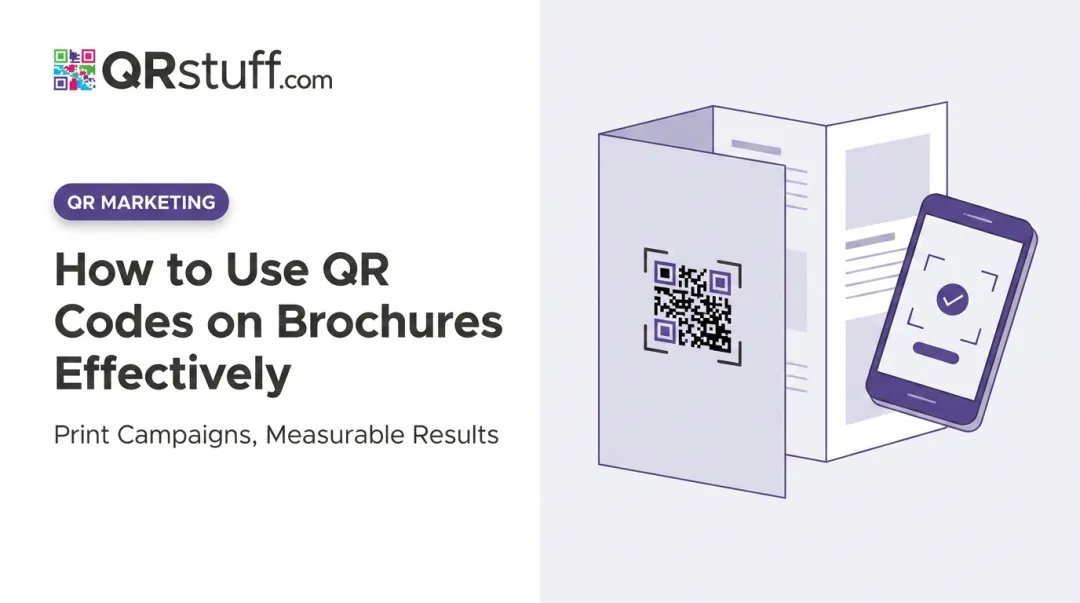
A QR code-powered interactive brochure is any print (or digital) brochure that includes one or more scannable codes linking readers to content that wouldn't fit on the page — videos, landing pages, PDFs, booking forms, product catalogs, or multilingual versions of the same material.
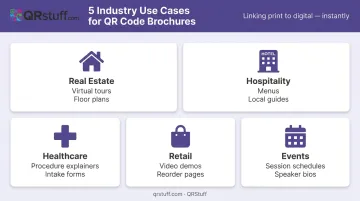
The format spans nearly every industry:
- Real estate: property listings linking to virtual tours and floor plan PDFs
- Hospitality: hotel welcome booklets connecting guests to dining menus and local guides
- Healthcare: patient information sheets pointing to procedure explainers and intake forms
- Retail: product brochures linking to size guides, video demos, and reorder pages
- Events and trade shows: conference guides directing attendees to session schedules and speaker bios
With a QR code embedded, the brochure stops being the endpoint of communication. The printed piece captures attention; the code takes the reader directly into a brand's full digital presence.
Key Advantages of QR Code-Powered Interactive Brochures
The advantages below focus on operational impact: reduced costs, measurable engagement, extended brochure lifespan, and better marketing decisions. Not abstract "digital transformation" claims — concrete outcomes businesses can track.
Advantage 1: Deliver Unlimited Content Without Expanding the Page
Print space is finite and expensive. Every additional panel costs money and risks visual clutter. A single QR code solves this by connecting readers to an unlimited depth of digital content without changing the brochure's footprint.
A real estate agent's two-panel handout can include a QR code linking to a full video walkthrough, floor plan PDF, and mortgage calculator. A healthcare provider can point patients from a single-sheet summary to procedure explainers, consent forms, and post-visit care instructions. A B2B company can link a clean product overview to a full technical spec sheet, case study library, and demo booking page.
This removes the "information vs. design" tradeoff that plagues most print projects. Marketers no longer have to choose between a visually clean piece and one with enough detail to actually support a buying decision.
That content depth matters. According to Wyzowl's 2026 Video Marketing Statistics, 85% of consumers said they were convinced to buy a product or service after watching a video, and 63% preferred watching a short video over reading text to learn about a product.
When a brochure QR code links directly to a product explainer or walkthrough, it delivers the format that actually moves people toward a decision.
For B2B specifically, Gartner research found that 75% of B2B buyers preferred a sales experience without a representative involved, and 64% of buyers familiar with a product preferred a fully digital buying journey. QR-linked content supports exactly this, letting prospects go deep on their own terms without waiting for a follow-up call.
KPIs this affects:
- Lead quality and qualification rate
- Content engagement rate and time-on-page for linked assets
- Conversion rate from brochure campaigns
- Reduction in inbound "basic information" inquiries from prospects
When this matters most: Complex or high-consideration purchases (real estate, healthcare, B2B services), multilingual audiences, regulated industries where content must live off the printed page, or any campaign where brochure real estate is tight.
Advantage 2: Real-Time Scan Tracking Turns Brochures Into Measurable Campaigns
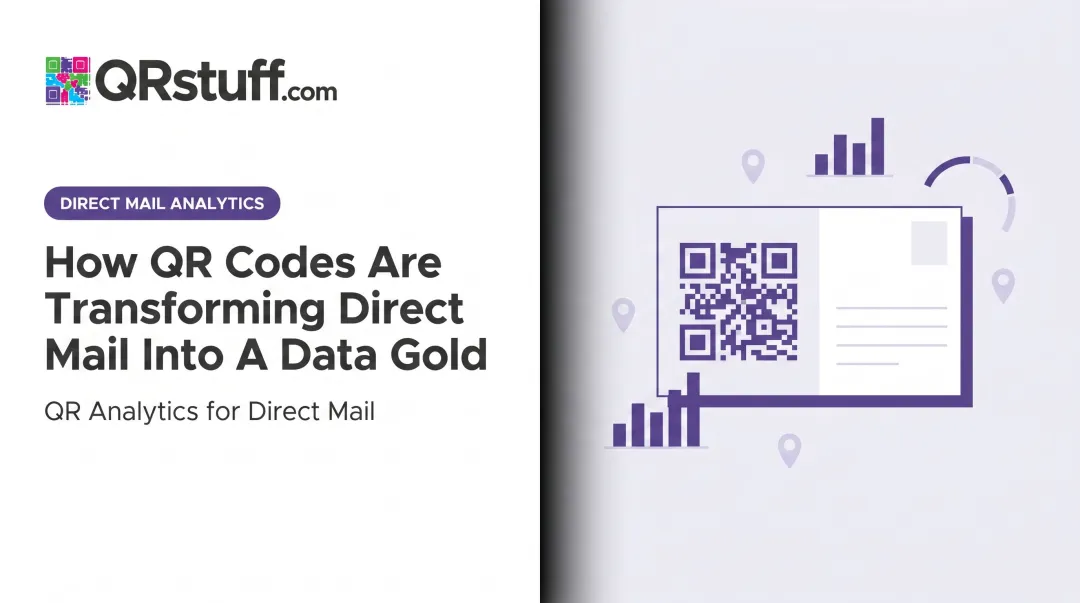
Traditional print offers no feedback loop. You spend money, distribute materials, and hope something happened. QR codes change this entirely: every scan generates data capturing when, where, how often, and on what device the code was used.
Consider a marketer distributing brochures at three different trade show booths. With QR analytics, they can see which location drove the most scans, at what time of day, and from which device types — during the event, not three weeks later when the data is useless.
Bitly's 2025 survey of 250 marketers found that only 31% monitored the post-scan journey and just 16% tied QR codes directly to revenue. Most teams aren't yet extracting full value from the tracking data they already have access to.
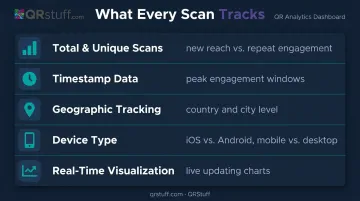
QRStuff's analytics dashboard addresses this with data points built for brochure campaigns:
- Total and unique scans — distinguishing new audience reach from repeat engagement
- Timestamp data — exact scan times for identifying peak engagement windows
- Geographic tracking at country and city level, essential for multi-location campaigns
- Device type breakdown — iOS vs. Android, mobile vs. desktop
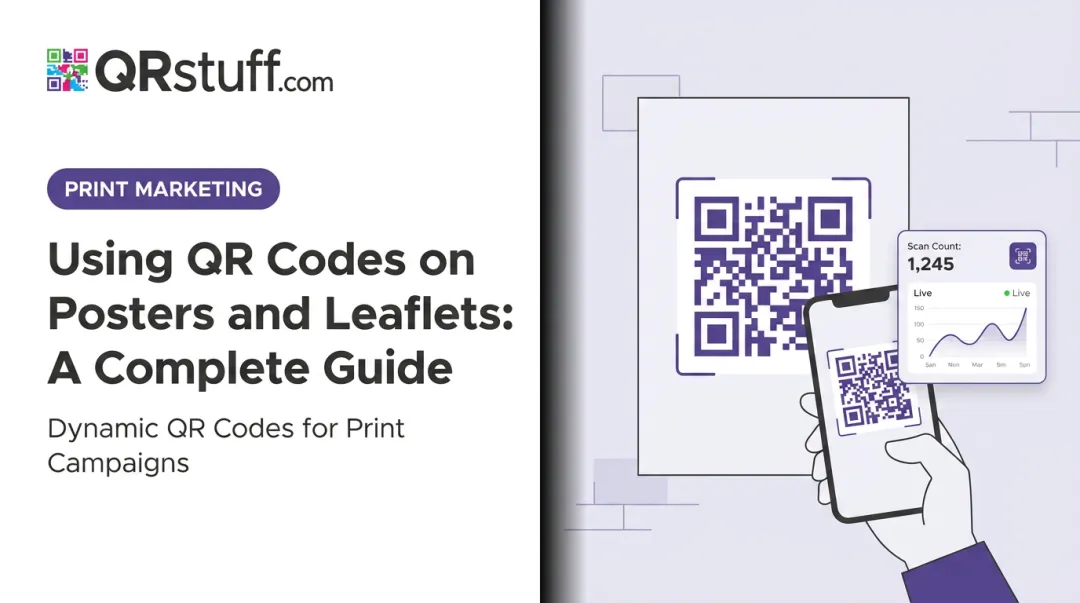
- Real-time visualization — line and bar charts that update as scans happen
For multi-location campaigns, QRStuff supports campaign tagging, letting you filter and compare performance across different distribution points, brochure variants, or events directly in the dashboard. Each QR code is tracked independently, so a campaign using 14 property codes (as one QRStuff real estate user documented) can report on each listing's engagement separately.
KPIs this affects:
- Scan rate and geographic scan distribution
- Device type breakdown for landing page optimization
- Peak engagement time for campaign timing decisions
- A/B performance between brochure design or messaging variants
- Campaign ROI attribution across distribution points
When this matters most: Multi-location events, trade shows with multiple booth distributions, recurring annual campaigns where year-over-year comparison adds value, and any situation where budget accountability for print spend matters.
Advantage 3: Dynamic QR Codes Extend Brochure Life and Eliminate Reprint Costs
Static QR codes embed the destination URL directly into the code. Change the URL and the code breaks, which means reprinting. Dynamic QR codes work differently: they use a short redirect URL, so the printed code always stays the same while the content it points to can be updated anytime through a platform dashboard.
A restaurant prints brochures for the year. With a dynamic QR code, they can update the linked menu every season without touching the printed piece. A retailer can redirect a product brochure to a current promotion page when inventory changes. A B2B company can swap out the linked case study PDF as new results come in. None of these changes require a reprint.
The cost of print marketing is substantial. Winterberry Group research tracked U.S. brands projecting direct mail ad spend at $37.3 billion in 2024, with postage alone accounting for roughly half the cost of a typical direct mail piece. At that scale, eliminating unnecessary reprint cycles directly protects margin.
Beyond cost, there's a credibility issue. A reader who picks up a brochure in Q3 and scans a QR code that leads to an expired offer, discontinued product, or outdated pricing page loses trust immediately. Dynamic codes prevent this by keeping linked content current regardless of when the brochure was printed.
QRStuff's dynamic QR codes support this directly — destinations can be changed at any time through the platform dashboard without modifying the printed code. The Full Suite plan (£15/month) supports up to 250 dynamic codes, making it practical for businesses managing brochures across multiple product lines or locations simultaneously.
KPIs this affects:
- Print cost per campaign cycle
- Brochure useful lifespan
- Reprint frequency
- Campaign flexibility — number of content pivots made mid-campaign without reprinting
- Content freshness rate
When this matters most: Businesses with frequently changing offers (restaurants, retail, events), long print runs meant to stay in circulation for months, regulated industries where content must be updated as rules change, and organisations managing brochure distribution across multiple locations.
What Happens When Brochures Stay Static
Print-only brochures without QR codes share the same structural failure points, regardless of industry or design quality:
- Prospects reach a dead end. There's no path to deeper content, no contact form, no next step. Interested readers who don't call immediately are simply lost.
- Print budgets stay guesswork. Without scan data, teams can't identify which designs, distribution points, or events actually drive results.
- Reprint costs compound. Every price change, seasonal update, or product revision requires a new print run. For SMBs with tight margins, this erodes ROI quickly.
- Stale content damages credibility. A brochure printed in Q1 with outdated pricing or an expired promotion works against you every time someone picks it up months later.
Each of these problems traces back to the same root cause: the brochure has no way to communicate beyond its own printed surface. QR codes change that by turning a static page into a live connection.
How to Get the Most Value from QR Code-Powered Brochures
QR codes on brochures deliver their full value when three conditions are met: intentional content, clear calls to action, and ongoing performance review.
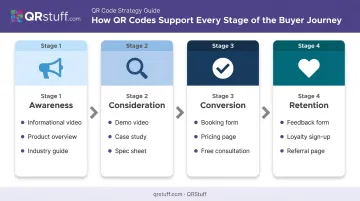
Match the Destination to the Reader's Stage
Avoid linking to a generic homepage. Each QR code should serve a specific purpose:
- Awareness-stage materials → informational video, product overview, industry guide
- Consideration-stage materials → demo video, case study, comparison page, spec sheet
- Conversion-focused materials → booking form, pricing page, free consultation link
- Retention materials → feedback form, loyalty sign-up, referral page
Use a Clear, Specific CTA Next to Every Code
Scans increase when readers know exactly what they'll get before scanning. Bitly recommends CTA phrases of three to five words, and specificity outperforms generic prompts every time. Examples that work:
- "Watch the 60-second tour"
- "Download the spec sheet"
- "Book your free consultation"
- "See today's menu"
Avoid: "Scan here" or "Learn more" — these give readers no reason to act.
Review Analytics Monthly and Apply Findings Forward
Use QRStuff's dynamic QR codes so linked destinations can be updated without reprinting. Then review scan analytics on a monthly basis:
- Distribution locations — identify which placements drove the most scans
- Peak scan times — use timing data to inform future campaign scheduling
- Device breakdowns — confirm landing pages are mobile-optimized
- Unique vs. repeat scan ratios — gauge audience reach vs. re-engagement
- Campaign adjustments — apply findings to the next run with better placements, stronger CTAs, and more relevant content
Businesses that repeat this cycle — distribute, measure, update, improve — get more out of every brochure run than those that set QR codes and forget them.
Conclusion
QR code-powered interactive brochures combine print's physical presence with digital depth, measurability, and flexibility. The three advantages compound when applied with intention: richer content without expanding the page, real campaign data from every scan, and a printed piece that stays relevant long after it's distributed.
The compounding value comes from iteration. Teams that review scan data, update linked content, and refine their approach campaign after campaign build a measurable advantage over competitors still distributing static print. Dynamic QR codes make that loop practical — update the destination, track the response, repeat.
Frequently Asked Questions
Frequently Asked Questions
Why do people put QR codes on digital brochures and flyers?
QR codes bridge print and digital by letting a brochure link readers to richer content — videos, forms, product pages — that a printed page can't contain. They also make campaigns trackable and the linked content updatable, which static print alone can't offer.
What type of QR code is best for brochures?
Dynamic QR codes are the right choice for brochures. They allow the linked destination to be updated without reprinting and support full scan tracking — something static QR codes can't do, since they're permanently fixed to a single URL at creation.
Can I update the content a QR code links to without reprinting my brochures?
Dynamic QR codes make this possible. The printed code stays the same while the destination URL can be changed at any time through the QRStuff dashboard — no changes to the physical brochure required.
How do QR codes on brochures help measure marketing performance?
Each scan generates data including timestamp, geographic location, and device type. This lets marketers attribute engagement to specific distribution points, compare performance across events or locations, and build a data foundation for optimizing future campaigns.
What should a QR code on a brochure link to?
Match the destination to where the reader is in their journey: product videos or spec pages for awareness, booking forms or pricing pages for conversion, and feedback forms or loyalty sign-ups for retention. Always pair the code with a specific, visible CTA.
Are QR codes on brochures environmentally friendly?
QR codes reduce paper waste by replacing supplementary printed materials (inserts, updated pricing sheets, multi-language versions) with digital links. Dynamic QR codes go further by eliminating reprints entirely when content changes.