That gap is exactly why QR codes have moved from pandemic novelty to permanent fixture across food and beverage. They solve real operational problems: outdated printed menus, customer demand for product transparency, wasted reprinting budgets, and slow ordering workflows.
This guide covers the full picture — in-restaurant use cases, food packaging applications, marketing strategies, and a practical implementation framework for F&B businesses of any size.
Key Takeaways
- Restaurants use QR codes for digital menus, contactless ordering, and payments — cutting wait times and printing costs
- Food and beverage brands embed QR codes on packaging to share ingredient details, sourcing stories, and sustainability data
- QR codes power loyalty programs, promotions, and feedback collection — letting brands reward repeat visits and gather insights at the point of sale
- Dynamic QR codes let operators update destination content without reprinting — and track every scan with real-time analytics
- GS1 Sunrise 2027 is pushing the entire food industry toward QR codes as the new standard barcode format
The Role QR Codes Play Across Food & Beverage
QR codes in F&B operate across two distinct contexts, each with different goals:
- Dining and hospitality (restaurants, bars, cafés, resort pools, food halls) — focused on speed, experience, and operational efficiency
- Consumer packaged goods (CPG) (grocery products, beverages, packaged foods) — focused on transparency, traceability, and regulatory compliance
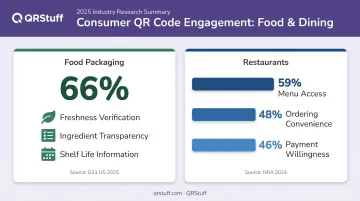
The demand is there on both fronts. According to GS1 US's 2025 consumer survey, 66% of consumers said they would scan a QR code on food packaging for information like freshness, ingredients, and shelf life. In restaurants, the National Restaurant Association's 2024 Technology Landscape Report found that 59% of full-service customers would access a menu by QR code, with 48% willing to order and 46% willing to pay via QR code.
GS1 Sunrise 2027: Why This Matters Now
Beyond restaurants and packaging, a structural industry shift is underway. GS1 Sunrise 2027 is the global initiative to transition retail point-of-sale systems from traditional 1D UPC barcodes to 2D barcodes — including QR codes — by the end of 2027. The program is already active in pilots across 48 countries representing 88% of world GDP.
For F&B brands, this means a single QR code on packaging will soon handle both checkout scanning and consumer-facing product information. Procurement and packaging teams that haven't started planning for this transition are already behind schedule.
QR Codes in Restaurants: Menus, Ordering, and Payments
Digital Menus: How They Actually Work
A digital menu QR code is simpler than it sounds. A customer scans the code at their table using their phone's built-in camera — no app download needed — and a mobile-optimised menu opens in their browser. That's it.
The operational value comes from dynamic QR codes, which use a redirect mechanism rather than encoding the destination directly into the code. The physical code never changes, but where it points can be updated instantly through a platform dashboard. A breakfast menu in the morning becomes a dinner menu at night — printed once, updated as needed.
QRStuff's dynamic QR codes work exactly this way, available from the Lite plan upward. A restaurant printing table tents once can swap menus, update prices, or flag sold-out items in real time — without touching a single sheet of paper.
Ordering and Payments
The efficiency gains extend well beyond menus. QR-enabled self-ordering lets customers:
- Browse and customise orders directly from their phone
- Submit orders straight to the kitchen without flagging a server
- Pay at the table when they're ready, not when staff are available
First Watch deployed bill-level QR payments across 420 corporate locations and saw 125,000+ customers use it in a single week, saving an estimated 30 seconds per transaction — adding up to more than 1,000 combined hours saved across customers and staff in that week alone.
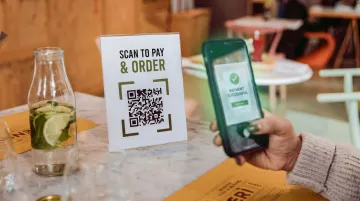
Servers freed from order-taking can focus on hospitality and managing more tables. For high-traffic venues (beer gardens, resort pools, stadium concessions), that reallocation often means handling 20–30% more covers without adding headcount.
Strategic Placement
QR codes work hardest when they're placed where customers naturally look:
| Placement | Primary Use Case |
|---|---|
| Table tents / coasters | Dine-in menu access and ordering |
| Window displays | Pre-visit menu browsing |
| Takeout box stickers | Post-order loyalty or feedback |
| Delivery vehicles | Brand awareness and repeat ordering |
| Cup sleeves / receipt | Review prompts and social follows |
For multi-location chains, QRStuff's Enterprise tier supports bulk generation of location-specific codes, role-based dashboard access, and white-label capabilities — useful for maintaining brand consistency across dozens or hundreds of venues.
Accessibility note: QR codes can link to PDF menus with larger text or screen-reader-compatible formats, making dining more accessible for customers with visual impairments — a benefit most operators don't consider until after launch.
QR Codes on Food and Beverage Packaging
Solving the Label Space Problem
A standard food label has a fixed amount of space. Ingredients, allergens, nutritional data, storage instructions, certifications, origin stories — all of it competes for the same few square centimeters. QR codes give brands a way out of that constraint.
Instead of cramming information onto a label, brands encode a link to a dedicated product page carrying everything a consumer might want to know. The physical packaging stays clean. The digital experience can be as rich as needed.
Traceability and Transparency
Food traceability is where packaging QR codes deliver their most tangible value. Nestlé deployed this at scale in 2020, using QR codes on Zoégas coffee packaging linked to IBM Food Trust blockchain data. Consumers could trace coffee origin, farmer details, harvest data, and certifications from a single scan.
Fonterra launched a similar program in 2017. QR codes on Anmum dairy products in China gave consumers access to:
- Manufacturing dates and batch numbers
- Milk source information
- Full distribution-channel records
These programs aren't marketing gimmicks. They address a genuine consumer expectation: 77% of consumers say product information is important when making a purchase, according to GS1 US.
Sustainability and Recycling
Packaging QR codes are also being used to close the recycling information gap. SmartLabel , the Consumer Brands Association's digital labelling platform , has integrated Recycle Check, allowing consumers to scan a product's QR code, enter their ZIP code, and receive localised recycling instructions for that specific packaging. Rather than generic "check locally" guidance, shoppers get actual instructions for their area.
Beyond recycling, QR codes are also finding functional roles in product operations. SodaStream Professional uses them on bottles for product identification and customization at professional dispensers, extending the use case well past consumer information.
Anti-Counterfeiting
For premium categories such as wine, spirits, specialty foods, and high-end dairy, product authentication is a real concern. EU customs authorities seized around 40,000 litres of illicit alcoholic beverages in a single coordinated operation in 2024. QR codes linked to brand-controlled verified product data give consumers a way to confirm authenticity before purchase, particularly valuable in markets where counterfeiting is active.
GS1 Digital Link: The Packaging Standard to Know
GS1 Digital Link is the technical standard that enables a single QR code to carry a product's GTIN (the identifier used at checkout) while simultaneously linking to consumer-facing product information. QRStuff generates GS1 Digital Link-compliant QR codes through its platform, available at the Enterprise tier, making it relevant for brands preparing for Sunrise 2027 compliance.
QR Codes for F&B Marketing and Customer Engagement
Loyalty and Promotional Campaigns
QR codes on packaging and at tables are effective promotional tools because they create a direct, measurable action.
Coca-Cola's Sip and Scan program is the most recognizable example: users scan codes from participating products to unlock prizes, offers, and personalized experiences through the brand's mobile app. The program ties physical product purchases to digital engagement, creating a feedback loop that drives repeat buying.
For smaller operators, the same principle applies at lower cost: a QR code on a takeout box linking to a "10% off your next order" landing page, or a table tent code that registers a loyalty point on scan.
Rich Content and Brand Storytelling
Print packaging has a hard ceiling on what it can communicate. A QR code does not. Brands can use packaging codes to deliver:
- Video content — chef demos, farm origin documentaries, brewery tours
- Sourcing narratives — detailed stories about ingredient origins and producer relationships
- Certifications and credentials — sustainability badges, organic certifications, fair-trade documentation
- Seasonal or limited-edition stories — content that changes with product releases
Because dynamic QR codes let brands update destinations without reprinting, seasonal content stays current even after packaging goes to press.
Feedback and Reviews
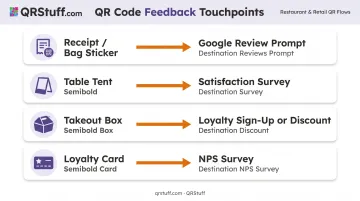
A QR code on a receipt, takeout box, or table tent is a low-friction path to post-purchase feedback. Rather than relying on customers to find a review platform independently, operators can place a direct link exactly where the customer's attention already is — at the end of the experience.
Common placements and destinations include:
- Receipt or bag sticker → Google Review prompt
- Table tent → short satisfaction survey
- Takeout box → loyalty sign-up or repeat-order discount
- Loyalty card → NPS survey tied to visit frequency
Scan data from each placement also shows which touchpoints are actually driving responses — giving operators first-party insight rather than relying solely on third-party aggregator summaries.
How to Create and Deploy QR Codes for Your F&B Business
Static vs. Dynamic: Always Choose Dynamic
| Static QR Code | Dynamic QR Code | |
|---|---|---|
| Destination editable? | No | Yes — anytime |
| Scan analytics | None | Full (time, location, device, unique vs. repeat) |
| Best for | Permanent, unchanging content | Menus, packaging, campaigns |
| Risk | Obsolete destination = broken experience | None — update the link, keep the code |
For almost every F&B application — menus, packaging, promotions — dynamic is the correct choice. QRStuff's dynamic codes start at the Lite plan ($4/month), with analytics that cover scan time, geographic location (city and country level), device type, and unique versus repeat scan counts.
Design Best Practices
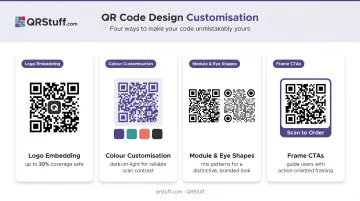
QRStuff offers detailed customization for F&B operators who want their codes to feel on-brand rather than generic:
- Logo embedding — upload a logo in PNG or SVG format; the platform scales it and adjusts error correction to maintain scannability (logos can safely cover up to 30% of the code surface)
- Colour customisation — match brand colours using a custom colour picker or gradient effects; always maintain a dark foreground on a light background
- Module and eye shapes — choose from different structural patterns to create a distinctive visual identity
- Frame text / CTAs — add text like "Scan to Order," "Scan for Ingredients," or "Scan to Collect Points" directly to the code frame
QRStuff recommends a minimum size of 2cm × 2cm for tabletop use, and emphasizes maintaining the quiet zone (the white border around the code) — never crop it, as scanners need it to locate and read the code.
Material and Placement for F&B Environments
F&B environments are harder on printed materials than most. Consider:
- Outdoor and wet areas (poolside, food trucks, delivery vehicles): use UV-resistant, waterproof vinyl — QRStuff notes that outdoor QR codes should be printed on weatherproof material to remain scannable long-term
- Table surfaces: flat, non-reflective materials at natural eye level; avoid folds or seams that distort the pattern
- Packaging: front panel placement for maximum consumer visibility; test scannability under store lighting conditions before full print runs
- Contrast check: test your code under dim restaurant lighting as well as bright retail environments — what scans well outdoors may struggle under warm ambient lighting indoors
Frequently Asked Questions
Are food and beverage QR codes safe to use?
QR codes are simply links to web content — they carry no inherent risk. Consumers should scan codes from trusted brands and venues. Businesses should use a platform that is GDPR and SOC2 compliant, like QRStuff, ensuring scan data is protected and destination URLs are legitimate.
What information can a QR code on food packaging contain?
A packaging QR code can link to far more than a physical label allows, including:
- Full ingredient lists and allergen details
- Farm-to-shelf sourcing and traceability data
- Nutritional information and dietary guidance
- Recycling instructions and sustainability content
- Promotional offers, brand videos, and authenticity verification
Do I need a special app to scan QR codes on food products?
No. Most modern smartphones on iOS and Android can scan QR codes natively through the built-in camera app. No separate download is needed, which is why QR codes work as a consumer-facing tool at scale.
What is the difference between a static and dynamic QR code for a restaurant menu?
A static code links to a fixed URL that cannot be changed after printing. A dynamic code allows the destination to be updated at any time through a dashboard — and provides scan analytics including time, location, and device data. For restaurant menus, dynamic codes are the practical choice for any business that updates pricing or offerings regularly.
Can QR codes on food packaging replace traditional barcodes?
GS1 Sunrise 2027 is transitioning retail POS systems to accept 2D barcodes — including QR codes — alongside traditional UPC barcodes, with full readiness targeted by end of 2027. A single GS1 Digital Link QR code will handle both checkout scanning and consumer-facing product information.
How do I update my restaurant menu QR code without reprinting?
Dynamic QR codes use a redirect mechanism — the printed code stays unchanged, but you update the destination URL through your platform dashboard at any time. With QRStuff, this is available from the Lite plan upward.