That's a problem, because these two formats behave very differently. They create different amounts of friction, capture different types of data, and suit different campaign goals. Choosing the wrong one doesn't just cost response rate points — it can mean spending weeks running a campaign with no actionable attribution.
This article breaks down exactly how each CTA format works in a direct mail context, where each performs best, and how to decide which belongs on your next piece.
Key Takeaways
- QR codes are single-scan CTAs that drive traffic to landing pages, video, forms, or offers — with real-time scan analytics built in
- SMS keyword CTAs (Text OFFER to 55678) capture phone numbers directly but add 3–4 manual steps that can reduce response
- eMarketer projects 99.5 million US smartphone users will scan QR codes by 2025, driven by native camera scanning removing the app-download barrier
- SMS shines when immediate phone-number capture and text-based follow-up are the goal, particularly in home services and real estate
- Strongest campaigns use both: QR code as the primary CTA, SMS keyword as a fallback for audiences who prefer texting
QR Codes vs. SMS for Direct Mail: Quick Comparison
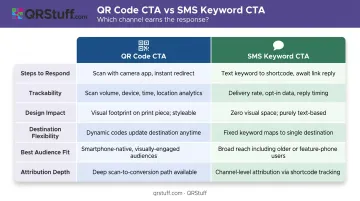
Here's how the two CTAs stack up across the factors that matter most for direct mail campaigns:
| Factor | QR Code CTA | SMS Keyword CTA |
|---|---|---|
| Steps to respond | 1 (point and scan) | 3–4 (open app, type keyword, send) |
| Trackability | Scan volume, unique scans, time, device, location | Opt-in confirmation, phone number capture |
| Design impact | Occupies visual space; replaces long URLs | Requires legible keyword + shortcode text |
| Destination flexibility | URL, video, PDF, form, coupon, pre-filled SMS | Routes into messaging workflow or CRM |
| Best audience fit | Younger, mobile-first audiences familiar with scanning | Older demographics or users skeptical of unfamiliar tech |
| Attribution depth | Ties directly to piece-level ROI via unique codes per variant | Keyword-level ROI; requires unique keywords per mail version for split testing |
What Are QR Code CTAs in Direct Mail?
A QR code CTA in direct mail is a printed, scannable code that triggers an instant digital action the moment a recipient points their smartphone camera at it. No app required — both iOS and Android devices scan natively through the standard camera app.
Static vs. Dynamic: Why the Distinction Matters
Not all QR codes work the same way in a print context:
- Static QR codes encode the destination directly into the pattern. Once printed, the destination is fixed permanently — and if the landing page changes or the offer expires, you can't update it without reprinting.
- Dynamic QR codes redirect through a short URL that lives on a server. The printed code never changes, but the destination can be updated at any time after printing , which is critical for campaigns running over several weeks where offers or pages may need adjusting.
For direct mail specifically, dynamic codes are the practical choice. Platforms like QRStuff support post-print destination updates without reprinting the mailer, and a 99.9% uptime guarantee means a code printed today will reliably resolve months from now.
What QR Codes Can Link To
A single printed code can point to far more destinations than SMS can match:
- Landing pages or product pages
- Video testimonials or demo reels
- PDF brochures or spec sheets
- Event RSVP or lead capture forms
- Coupon or offer redemption pages
- Pre-filled SMS threads (more on this below)
The Analytics Advantage
Dynamic QR codes give direct mail the kind of attribution that physical channels historically couldn't provide. QRStuff's analytics dashboard logs:
- Total scans and unique scans
- Exact scan time and date
- Device type and operating system (iOS vs. Android)
- Geographic location at country and city level
For EDDM (Every Door Direct Mail) saturation campaigns or multi-version mailer tests, generating a unique QR code per geographic batch means you can attribute performance to specific drops, neighborhoods, or design variations, rather than treating the campaign as a single undifferentiated result.
Print Best Practices
- Minimum size: At least 2cm × 2cm (0.8" × 0.8") for simple URLs; larger for complex data or viewing distance
- Contrast: Dark code on light background — never inverted colors
- Quiet zone: Never crop the white border surrounding the code; scanners need it to read the pattern
- File format: Export SVG or EPS for professional printing to maintain clarity at any scale
- Surrounding copy: Always include a benefit-driven instruction: "Scan to get your free quote" performs better than a bare code with no context
QRStuff supports custom colors, logo embedding, and branded shapes so the code itself becomes a design element rather than an afterthought on the mail piece.
What Are SMS CTAs in Direct Mail?
SMS CTAs in direct mail take two distinct forms, and conflating them leads to poor CTA design decisions.
Keyword-based SMS: The printed piece instructs the recipient to "Text OFFER to 55678." The recipient manually opens their SMS app, types the keyword, and sends it to the shortcode. An automated reply captures their mobile number and triggers a workflow or opt-in confirmation.
Scan-to-text: A QR code opens the recipient's native SMS app with a phone number and message already filled in. One tap sends it. This is a hybrid mechanism — QR friction profile, SMS lead capture outcome.
These are different tools with different friction levels and different use cases.
Where SMS Keywords Have Genuine Strengths
- Open rates: CTIA reports a 98% open rate for text messages, compared to far lower rates for email. Messages land in the highest-trust inbox on the device.
- Direct lead capture: A successful keyword opt-in captures a verified mobile number immediately — no form, no email, no intermediary step.
- Sales process alignment: For businesses whose entire sales process runs through phone or text follow-up, having the number in-hand from the first response is more valuable than a web visit.
Limitations That Affect Direct Mail Performance
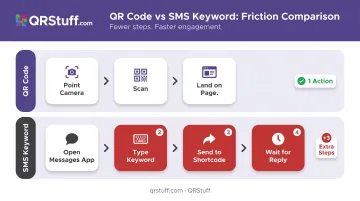
- Keyword CTAs require 3–4 distinct manual actions — open app, type keyword, send — versus one scan for a QR code
- Shortcode strings are visually unappealing on premium print pieces
- Carrier filtering can delay or block automated replies
- Campaign-level attribution is limited unless each mailer version uses a unique keyword
Use Cases for SMS CTAs
Keyword-based SMS works best for:
- Home services (HVAC, roofing, pest control) where the follow-up is a phone call
- Real estate lead capture where the agent wants the prospect's number immediately
- Healthcare inquiries where phone-number capture is the priority over web traffic
Scan-to-text bridges both approaches: one scan opens a pre-filled message, one tap sends it. For campaigns where QR friction and SMS lead capture both matter, this hybrid works well. QRStuff supports this natively — the SMS data type pre-populates both the phone number and message text, so the recipient doesn't type anything manually.
Any SMS keyword CTA must meet TCPA requirements. CTIA's 2023 messaging guidelines require clear consent language, opt-out instructions, and program identification on the mail piece itself — not just in the reply message.
QR Codes vs. SMS: Which CTA Performs Better and When?
No definitive benchmark settles this debate across every campaign type. But the data does point to one reliable predictor of response: friction.
The Friction Gap
Baymard's 2024 research found that 18% of users abandon checkout because the process is too long or complicated. The same principle applies to direct mail CTAs: every additional step between intent and action reduces conversion.
QR codes require one action. SMS keywords require three or four — open messages, type the keyword, send it, then wait for a reply prompt — That gap matters, especially for cold audiences who haven't opted in to anything yet and have low motivation to work through friction.
When QR Codes Have the Edge
- Campaign goal is driving to a digital destination (landing page, video, form)
- You need campaign-level attribution and behavioral data
- The audience is smartphone-native and scan-familiar
- The offer benefits from a richer digital experience than a text reply can provide
Statista data shows marketing-related QR code usage is highest among 18–29 year olds, with adoption declining in older age brackets. If your audience skews younger, QR codes are the lower-friction default.
When SMS Keywords Hold Their Own
- The sales process lives in text or phone follow-up, making the phone number more valuable than a web click
- The campaign targets audiences skeptical of scanning but comfortable texting
- Immediate lead qualification through a conversational SMS workflow is the priority
If none of those conditions apply, the table below maps each campaign goal to the CTA most likely to reduce drop-off.
Practical Decision Framework
| Campaign goal | Recommended CTA |
|---|---|
| Drive traffic to landing page or offer | QR code |
| Capture phone number for sales follow-up | SMS keyword |
| Track performance by geographic batch | QR code (unique code per batch) |
| Immediate conversational lead qualification | Scan-to-text (QR → pre-filled SMS) |
| Mixed demographic audience | Both (primary QR + secondary SMS) |
When to Use Both QR Codes and SMS on the Same Mailer
Combining both CTAs on a single mailer works — but only when the design hierarchy is handled correctly.
The Primary + Secondary Structure
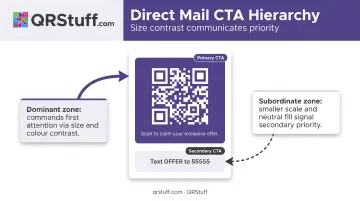
One mailer can carry a QR code as the primary, lower-friction CTA and an SMS keyword as a secondary option. The layout should make this hierarchy visually obvious:
- QR code: Prominent placement, large enough to scan easily, surrounded by benefit copy ("Scan to get your free estimate")
- SMS keyword: Smaller, clearly secondary ("Prefer to text? Text ESTIMATE to 55678")
Both response paths should lead to equivalent workflows. If the QR code drives to a lead form and the SMS keyword triggers a qualification sequence, both should ultimately put the prospect in the same pipeline.
When the Dual-CTA Approach Makes Sense
- EDDM saturation mailers targeting mixed demographics in a single ZIP code — you can't control who receives the piece, so giving recipients a choice of response path widens the window
- Real estate prospecting where the list includes both younger buyers and older homeowners who may have different comfort levels with scanning
- Home services campaigns with urgency variation — some recipients will scan immediately, others may text days later
One Rule to Enforce
Two CTAs only reduce indecision when the hierarchy is clear. Equal visual weight on both options creates a choice paralysis problem. The QR code leads; the SMS keyword catches the remainder. Give both equal prominence and you'll split attention without doubling conversions.
Conclusion
The decision comes down to campaign goal, not CTA preference. If measurable digital engagement and behavioral analytics are the objective, QR codes are the stronger default — particularly dynamic QR codes that give marketers piece-level attribution and post-print destination flexibility. If immediate phone-number capture for a high-touch sales process is the goal, SMS keywords earn their place. When demographics are mixed, combining both is a practical strategy, not a compromise.
Both formats are tools. Their effectiveness depends on offer clarity, print quality, destination experience, and whether you actually track and optimize based on what the data shows. That last part — tracking and optimizing — is where QRStuff fits in. The platform supports dynamic QR codes with real-time scan analytics, 40+ destination types, and bulk generation for high-volume campaigns, giving direct mail the measurable feedback loop it's historically lacked.
Frequently Asked Questions
Is a QR code a call to action?
A QR code is the mechanism for delivering a CTA, not the CTA itself. The surrounding copy — "Scan to claim your offer" — is the actual call to action. Together, the code and the instruction function as a complete CTA unit on the mail piece.
Can a QR code direct to an email?
Yes. A QR code can open a pre-addressed email draft in the recipient's email app, which works well for B2B direct mail or service inquiry scenarios. For consumer direct mail, however, SMS opt-ins and landing pages typically drive higher engagement.
What is an SMS CTA in direct mail?
Two types exist: keyword SMS (the recipient texts a word to a shortcode) and scan-to-text (scanning a QR code opens a pre-filled SMS). Both are valid SMS CTAs, but scan-to-text significantly reduces friction compared to the manual keyword approach.
Which CTA has higher response rates — QR codes or SMS?
QR codes generally benefit from lower friction, especially now that native smartphone scanning is universal. SMS keyword CTAs can outperform in high-intent verticals — home services, real estate — where capturing the phone number directly is more valuable than driving a web click.
Can you use both a QR code and an SMS CTA on the same mailer?
Yes, and it's a practical strategy for mixed-demographic campaigns. Design hierarchy matters: QR code as the primary CTA, SMS keyword as a secondary alternative. Make sure both paths feed into the same workflow.
How do you track QR code vs. SMS CTA performance in direct mail?
Dynamic QR codes provide built-in analytics — scan volume, location, device type, and time of scan — accessible in real time. QRStuff includes exportable CSV scan logs and campaign tagging for multi-version analysis. SMS shortcode tracking relies on your messaging platform's reporting, with opt-in confirmation and phone number capture as the core data points.