Connected beverage packaging is straightforward in concept: a physical package carries a scannable QR code that links to a dynamic digital destination — a product page, an AR experience, a loyalty portal, a sustainability report. The physical object stays the same; the experience behind it can change in real time.
QR codes currently hold 42% of the connected packaging technology market, representing roughly $7.35 billion in value as of 2024. And 66% of consumers say they would scan a QR code on packaging for product information — a number that's only grown as smartphone cameras scan natively without any additional app.
This guide covers what experiences QR codes unlock for beverage brands, real-world campaign examples, sustainability and compliance applications, and a practical implementation framework.
Key Takeaways
- QR codes transform beverage packaging from a static container into an active digital channel
- Brands like Coca-Cola, Heineken, and Absolut are already running AR experiences, digital gifting, and loyalty activations directly from on-pack QR codes
- Dynamic QR codes let brands swap content after printing — critical for seasonal campaigns and compliance updates
- Scan analytics deliver first-party data on consumer geography, device type, and engagement timing
- QRStuff supports craft brewery deployments through enterprise-scale bulk generation, including GS1 Digital Link compliance
What Experiences Can QR Codes Create on Beverage Packaging?
The range is wider than most brands initially consider. A QR code on a bottle can do far more than point to a product page.
Interactive Content and AR
Scan a Coca-Cola Starlight can and an AR concert appears, with the performer projected from the packaging into your environment. But high-end AR is just one end of the spectrum. Cocktail recipes, brewery tours, founder stories, and tasting guides are all equally viable — delivered via a code smaller than a postage stamp.
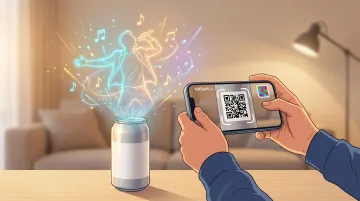
For beverage brands, this matters because the physical label has fixed real estate. A QR code effectively gives brands unlimited space: video content, interactive guides, downloadable resources, all accessible the moment a consumer picks up a drink.
Personalized Promotions and Loyalty Rewards
QR codes can link directly to:
- Time-limited promotional offers tied to a specific SKU or batch
- Loyalty point redemption portals where scanning earns rewards
- Personalized discount codes generated dynamically per region or campaign
- Contest entry forms that collect first-party consumer data
Pernod Ricard's Jameson Connects platform lets consumers access events and exclusive content by scanning a code on the bottle's neck, converting a routine purchase into a repeatable loyalty touchpoint.
Product Authentication and Provenance
Counterfeiting is a genuine commercial threat. WHO estimates that 25% of global alcohol consumption is unrecorded, covering illicit and informally produced products. Europol's OPSON XIII operation seized 850,000 litres of beverages from European markets, including 60,000 litres of counterfeit wine.
QR codes linked to batch certificates, digital origin records, or blockchain-backed provenance logs give consumers instant verification. For premium spirits, fine wine, and export-market products, a scannable certificate of authenticity is both a consumer trust signal and a commercial differentiator.
GS1 Digital Link provides the standards framework for this. A single QR code can encode a product's GTIN alongside batch and expiry data, making it scannable at retail POS while also surfacing full provenance records for consumers.
Accessibility and Inclusive Packaging
In 2022, RNIB and Coca-Cola Great Britain piloted NaviLens codes on Christmas multipack cans. NaviLens codes allow blind and partially sighted shoppers to detect and read label information via audio through the NaviLens app. Over 2 million people in the UK live with sight loss. In the US, an estimated 93 million adults face high risk of serious vision loss.
QR codes that surface label information in accessible formats (audio descriptions, high-contrast digital layouts) let brands address inclusive design and regulatory compliance simultaneously. The reputational signal is just as valuable: it demonstrates that accessibility isn't an afterthought.
Gamification and Community Building
Beyond one-time activations, QR codes can build ongoing brand relationships through:
- Limited-edition digital collectibles tied to seasonal releases
- Social sharing challenges with user-generated content prompts
- Community forums or brand hub access
- Scan-to-enter competitions gated to verified purchasers
The common thread: every scan creates a reason to come back.
Real-World Examples: How Beverage Brands Are Using QR Codes
Coca-Cola Starlight
Coca-Cola's Starlight limited-edition CSD used a QR code on the can and bottle to trigger an AR concert experience. Consumers pointed their phone at the packaging and a virtual performance — featuring Ava Max — played out in their environment. The campaign showed that a standard soft drink format could deliver a full entertainment moment without adding cost per consumer interaction.
No public scan metrics were released, but the mechanic itself is well-documented as a proof point for beverage AR activation at scale.
Heineken Blockchain Provenance Pilot
Heineken's Brand Blond pilot placed a QR code on beer bottles that gave consumers access to hop cultivation data — origin location, vintage year, water footprint, and carbon metrics — all recorded on a private Hyperledger Fabric blockchain.
The pilot was an early demonstration of what supply chain transparency looks like at the consumer level. Rather than vague sustainability claims on a label, consumers could trace an ingredient's journey with their phone.
Absolut Vodka Phygital Gifting
Absolut's 2024 phygital bottle introduced unique QR codes on 700ml bottles designed for gifting. When the recipient scanned the code and pointed their phone at the bottle, a personal AR message from the gift-giver appeared. The format turned an existing product into a personalized communication platform — no physical customization required — while also linking consumers to responsible drinking guidance and local-market ingredient information on the label itself.
Coca-Cola and NaviLens Accessibility
Coca-Cola GB's NaviLens pilot on Christmas can multipacks — covering 24x330ml and 30x330ml formats — shows how machine-readable code technology can serve accessibility directly. The NaviLens optical code, readable at distance without precise aiming, let visually impaired consumers identify products using a smartphone. The collaboration with RNIB made it both a functional tool and a public commitment to inclusive packaging.
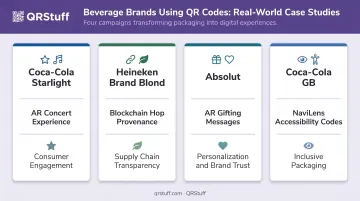
How these use cases compare at a glance:
| Brand | QR Application | Primary Goal |
|---|---|---|
| Coca-Cola Starlight | AR concert experience | Consumer engagement |
| Heineken Brand Blond | Blockchain hop provenance data | Supply chain transparency |
| Absolut | AR gifting messages + compliance info | Personalization & brand trust |
| Coca-Cola GB | NaviLens accessibility codes | Inclusive packaging |
Beyond Marketing: QR Codes for Sustainability and Compliance
Sustainability Transparency
Physical labels can't carry lifecycle data, carbon footprints, local recycling instructions, or water usage metrics. There's simply no room. QR codes solve this directly. Danone planned to use QR codes on Silk cartons for local recycling guidance via How2Recycle Plus. Heineken's blockchain pilot delivered water and carbon data from the same code used for provenance.
For brands facing scrutiny over environmental claims, a QR code linking to verified, dynamically updated sustainability data is more defensible than a static on-pack statement. The FTC's Green Guides are designed precisely to flag misleading environmental claims. Linking to real data rather than marketing copy directly reduces that exposure.
Regulatory and Nutritional Compliance
The EU's Regulation 2021/2117 allows wine brands to provide full nutrition declarations electronically, identified via the package — a clear regulatory pathway for QR-based e-labels in the wine category. Beer and spirits operate under different obligations, but the regulatory shift toward digital disclosure is consistent across categories.
The practical advantage is significant. Compliance content hosted in the cloud can be updated when formulations or regulations change — no label reprint required. For brands managing multiple markets, that means:
- Nutrition data and allergen information updated instantly across all SKUs
- Ingredient lists adjusted per regional regulatory requirements
- Single code infrastructure serving different disclosure rules by geography
How to Implement QR Codes on Your Beverage Packaging
Static vs. Dynamic QR Codes — A Critical Choice
For beverage brands, this choice directly affects how much flexibility you have after labels are printed — and how much reprinting costs you when campaigns change.
| Feature | Static QR Code | Dynamic QR Code |
|---|---|---|
| Destination URL | Fixed at print | Editable anytime |
| Scan analytics | None | Full tracking |
| Seasonal campaigns | Requires reprint | Update in dashboard |
| Compliance updates | Requires reprint | Update in real time |
| Cost over time | Cheaper upfront | Lower total cost at scale |
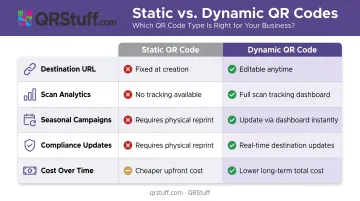
For beverage packaging, dynamic is almost always the right choice. A holiday campaign can go live on December 1st and revert to a standard product page on January 2nd — same printed label, updated destination.
QRStuff supports dynamic QR codes with real-time destination editing, 40+ content type destinations, and GS1 Digital Link compatibility, covering everything from craft brewery labels to enterprise production runs.
Design and Placement for Beverage Packaging
Print specs that directly affect whether a code scans reliably in the real world:
- Minimum size: GS1 recommends 14.6mm x 14.6mm including quiet zone. A safe working guideline for beverage labels is 2cm x 2cm (approximately 0.8 inches square)
- Dots must be at least 70% darker than the background — light-on-dark inversions cause scan failures on older devices
- The white quiet zone must be maintained at minimum 4x the width of a single data square
- Avoid curved seams, folds, or reflective finishes that distort the code pattern
- Use SVG or EPS vector files for professional printing; PNG at minimum 300 DPI for raster
The motivation gap is just as important as the technical specs. A QR code with no context gets ignored. Pair every code with a benefit-led call to action: "Scan for your free cocktail guide" outperforms a bare code every time.
What to Link To
The destination determines whether a scan creates a positive or negative brand impression. Whatever you link to, it needs to clear four bars:
- Mobile-optimized: Every scan happens on a smartphone
- Fast-loading: Slow pages actively damage brand perception
- Immediate payoff: Deliver the promised experience in the first screen — don't make consumers search for it
- Updatable: Use cloud-hosted or dynamic destinations so content stays current without reprinting
Get these right and the QR code becomes a genuine touchpoint. Get them wrong and you've trained customers not to scan again.
Measuring Impact: QR Code Analytics for Beverage Brands
Dynamic QR codes on beverage packaging do something traditional labels never could: they generate real consumer behavior data every time someone scans.
What the Data Captures
QRStuff's analytics dashboard tracks:
- Total and unique scans — distinguishing new audience reach from repeat engagement
- Geographic data — country and city level, informing regional campaign targeting
- Device type — iOS vs. Android, mobile vs. desktop, influencing landing page optimization
- Time patterns — daily, weekly, and custom views showing peak engagement windows
- Real-time visualization — data populates as scans happen, not on a delayed reporting cycle
A brand that discovers most scans happen between 7pm and 10pm on Fridays has a clear signal to time promotional activations for those windows. A SKU showing concentrated scans in one city might indicate an unexpected market that justifies regional campaign investment.
Analytics export to CSV, Excel, or PDF, and QRStuff's API feeds scan data directly into existing CRM or BI systems — no manual data handling required.
Compliance Considerations
Since dynamic QR codes capture location and device data, brands should ensure linked experiences meet GDPR requirements. QRStuff is both GDPR-compliant and SOC2-compliant, which matters most when QR codes gate loyalty programs or personalized promotions. Any landing page collecting personal information should include appropriate consent mechanisms and privacy notices.
Frequently Asked Questions
How do you scan a QR code on a drink?
Open your smartphone's native camera app, point it at the code on the bottle or can, and tap the link that appears on screen. No separate app is required on any modern iOS or Android device.
Are QR codes on beverage packaging traceable?
Dynamic QR codes are fully traceable. Brands can see total scans, unique scans, timing, location, and device type. Static QR codes offer no tracking capability, which is why most beverage brands using QR codes for marketing choose dynamic versions.
What content can you put behind a QR code on a beverage bottle?
The range is broad and all content is updatable without reprinting the label:
- Product pages, brand videos, and batch provenance records
- Cocktail recipes, allergen information, and sustainability reports
- Loyalty portals and time-limited promotions
- AR experiences triggered directly from the packaging
Do QR codes on beverage packaging expire?
The QR code itself doesn't expire, but its destination can be deactivated. On QRStuff's Full Suite and Enterprise plans, dynamic QR codes remain active and editable indefinitely with no preset scan limits, provided the subscription stays current.
How small can a QR code be on a beverage label and still scan reliably?
GS1 guidelines specify a technical minimum of 14.6mm x 14.6mm including quiet zone. A conservative practical guideline for beverage labels is 2cm x 2cm (0.8 inches square), though print quality, data density, and label substrate all affect the real-world floor.
Can small or independent beverage brands afford QR codes on packaging?
QR codes are among the most accessible connected packaging technologies available. QRStuff's Full Suite plan supports 250 dynamic QR codes with full analytics, batch processing, and custom branding — a workable entry point for craft and independent producers, not just enterprise operations. Check the QRStuff pricing page for current plan rates.