QR codes often get framed as a trendy add-on. The actual business case is more practical: they make physical marketing measurable, keep printed materials relevant without reprinting, and reduce the steps between a customer's attention and the action you want them to take.
This article focuses on what QR codes actually do in practice — the outcomes businesses track, the costs they avoid, and how to apply them in ways that build value over time.
Key Takeaways
- QR codes connect physical materials to digital destinations instantly — no typing required
- Dynamic QR codes let you update destination content after printing, cutting reprinting costs
- Built-in scan analytics bring digital-style attribution to print, OOH, and direct mail campaigns
- Reducing steps in the customer journey directly increases the likelihood of completing an action
- Businesses that embed QR codes consistently across channels see stronger engagement and measurable ROI over time
What Are QR Codes?
A QR code is a scannable square that stores a data payload — a URL, vCard, payment link, Wi-Fi credentials, file, or event page. When a smartphone camera reads it, the user is taken directly to that destination without typing anything.
Smartphones handle the scan natively — no app required. For a customer mid-meal, mid-aisle, or mid-event, that kind of instant access is the difference between taking action and moving on.
Where QR Codes Are Used
QR codes appear anywhere a physical surface meets a need for digital action:
- Product packaging — ingredient details, warranties, authenticity verification
- Restaurant tables — menus, ordering, bill payment
- Retail displays — product demos, loyalty sign-ups, mobile checkout
- Direct mail — campaign-specific landing pages with response tracking
- Business cards — digital contact files, LinkedIn profiles, booking links
- Event signage — registration, schedules, check-in
In every case, the code does one job: remove the step between where someone is standing and where a business needs them to go.
Key Advantages of QR Codes for Business and Marketing
The advantages below focus on outcomes businesses actively track: marketing ROI, engagement rates, cost efficiency, and campaign flexibility.
Advantage 1: Real-Time Campaign Tracking and Attribution
Print advertising has always had an attribution problem. A flyer goes out, a billboard runs, a direct mail piece lands — and there's no clean way to know what, if anything, it produced.
QR codes change this. Each scan records when it happened, where it happened, what device was used, and — when paired with UTM parameters — what the user did on the destination page. Physical media finally gets the same accountability as digital campaigns.
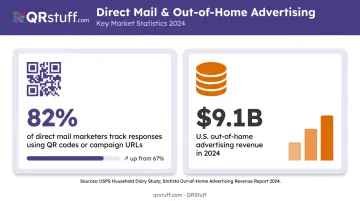
The shift is already underway. The ANA's 2023 Response Rate Report found that 82% of direct mail marketers who track response use online tracking mechanisms such as QR codes or campaign-specific URLs — up from 67% in the prior study. And with U.S. out-of-home advertising revenue surpassing $9.1 billion in 2024, the need to attribute physical media spend has never been more pressing.
What QRStuff's analytics dashboard tracks:
- Total scans and unique scans (new vs. returning users)
- Scan time and date — including hourly breakdowns for peak engagement analysis
- Device type and operating system (iOS vs. Android, mobile vs. desktop)
- Geographic location at country and city level
- Referring website or app (for digitally shared codes)
- Campaign tags for filtering and comparing multiple placements
When these metrics are pulled together, marketers can compare scan rates by placement, time window, creative, or region — and reallocate spend based on what's actually working. A real estate agent using QRStuff summed it up simply: "The tracking tells me which listings are getting scans, which helps with my seller updates."
KPIs this directly affects: scan rate, cost-per-engagement, campaign conversion rate, geographic reach, time-based engagement peaks, unique vs. repeat user data.
When it matters most: Multi-location campaigns, seasonal promotions, and any situation where budget decisions need to be justified with data rather than intuition.
Advantage 2: Updatable Content Without Reprinting
Static print materials have a fixed shelf life. When an offer expires, a URL changes, or a campaign pivots — everything in circulation becomes outdated. The only fix is reprinting.
Dynamic QR codes solve this by separating the physical code from the destination it points to. The printed code stays the same. What it links to can be changed at any time, instantly, from a dashboard — unlimited times, with no changes to the physical material.
In practice, this means:
- A restaurant removes a sold-out item from its QR menu without touching a printer
- A retailer redirects a holiday flyer code to a new product launch in January
- A DTC brand swaps the destination on its thank-you card QR code when running seasonal campaigns — without reprinting the card
Ben Nakamura, founder of a small DTC brand using QRStuff, described this directly: "Our thank-you card has a QR linking to the unboxing guide. Dynamic, so we can swap the destination when we run seasonal campaigns."
This matters operationally too. With producer prices up 3.3% in 2024 according to the Bureau of Labor Statistics, reprinting costs for recurring campaigns are not trivial — especially across multiple locations or large-format materials like banners and signage.
Dynamic QR codes on QRStuff are available across all subscription tiers. The Full Suite ($15/month) includes 250 dynamic codes with unlimited scans and no expiration. Enterprise ($185/month) scales to 1,000 codes with API access and bulk generation for larger operations.
KPIs this directly affects: print cost savings, campaign turnaround time, error correction rate, content freshness, A/B testing without reprinting.
When it matters most: Seasonal promotions, multi-campaign print runs, or any material that's expensive to replace — banners, packaging, large-format signage.
Advantage 3: Frictionless Customer Engagement Across Channels
Every step between a customer's attention and the action you want them to take is a drop-off point. Typing a URL, searching for a product page, finding a form — each one reduces the likelihood of follow-through.
A QR code replaces all of that with one scan.
This applies across contexts: a shopper scanning packaging to watch a product demo, an attendee scanning a badge to access the event schedule, a restaurant customer scanning a table card to leave a Google review. Each action takes seconds with no manual steps.
The destination experience determines whether the scan actually converts. Baymard's e-commerce research puts the average cart abandonment rate at 70.19%, with checkout usability improvements capable of lifting conversion rates by 35%. That principle applies directly here: a QR code that leads to a slow page, a broken link, or a confusing form wastes the scan entirely.
Nielsen Norman Group's 2024 QR usability guidance adds a useful frame: users need clear context about what they're scanning before they scan it. "Scan for today's menu" outperforms "Scan me" every time. The destination should be obvious from the call-to-action paired with the code.
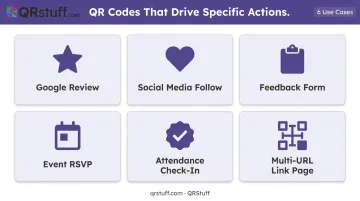
QR code types commonly used to drive specific actions:
- Google Review codes — direct customers to your review page in one tap
- Social media codes — Instagram, Facebook, LinkedIn for instant follows
- Feedback form codes — survey collection at the point of experience
- Event/RSVP codes — attendee registration without manual form searches
- Attendance codes — check-in for events, classes, or training sessions
- Multi-URL / social link pages — single scan for multiple destinations
KPIs this directly affects: conversion rate from physical materials, engagement rate, time-to-action, repeat scan rate, app downloads, social media follower growth.
Best applied in: in-store displays, live events, and product packaging — anywhere customer attention peaks briefly and the path to action needs to be immediate.
What Happens When QR Codes Are Ignored or Underused
The cost of not using QR codes isn't always obvious, but it accumulates in predictable ways.
Attribution goes dark. Without a trackable mechanism on print or OOH materials, there's no way to know whether those placements drove any action. Budget decisions default to intuition or past convention instead of current performance data — a costly blind spot as ad spend increases.
Print costs compound. Every expired offer, broken URL, or campaign pivot requires reprinting. Across multiple locations and campaign cycles, those costs grow, compounded by rising print production costs that show no sign of leveling off.
Friction kills conversions. Customers asked to type a URL, search for a product page, or locate a form on their own are far less likely to follow through. Each extra manual step cuts conversion rates — and those losses rarely show up anywhere obvious in your reporting.
Scale creates inconsistency. As businesses grow across locations, campaigns, and channels, untracked physical materials become harder to manage. Without a feedback loop, there's no way to pinpoint what's working, what's broken, or where customers are dropping off.
How to Get the Most Value from QR Codes
QR codes deliver real returns when applied with consistency and intent, not when dropped onto materials as an afterthought.
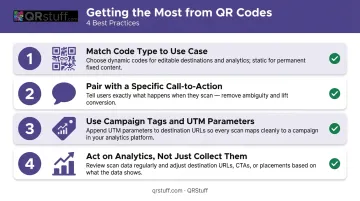
Four practices make the biggest difference:
- Match the code type to the use case. Use dynamic codes for anything that might change — campaigns, menus, seasonal offers. Use static codes for permanent destinations like Wi-Fi credentials or product pages. QRStuff supports 40+ types, from vCards and payment links to Google Reviews and event pages.
- Pair every code with a specific call-to-action. "Scan for today's menu," "Scan to claim your offer," "Scan for the floor plan." Vague instructions reduce scans. Specific ones drive them.
- Use campaign tags and UTM parameters. QRStuff's dashboard lets you assign campaign tags to compare performance across placements, creatives, and channels. Connecting scan data to Google Analytics via UTM parameters gives a full picture from scan to conversion.
- Act on your analytics, not just collect them. Which placements drive the most scans? What time of day? Which locations? Businesses that use this data to iterate improve campaign performance with each cycle.
Conclusion
QR codes offer something most physical marketing channels can't: measurable performance, updatable content, and a direct path from print to action — all without rebuilding your campaign from scratch.
None of these advantages require large budgets or complex infrastructure. A QR code on a flyer, a table card, or a product package delivers real value when it's set up with intent, linked to a clean destination, and reviewed with actual data.
The ROI builds over time. Businesses that apply QR codes consistently across campaigns accumulate scan data, reduce print waste, and improve engagement with each iteration. QRStuff supports this across 40+ code types — dynamic codes with editable destinations, real-time scan analytics, and bulk generation for campaigns at any scale.
The businesses seeing consistent results aren't using more QR codes — they're using them more deliberately, with clear destinations, tracked outcomes, and a plan to act on what the data shows.
Frequently Asked Questions
What is the main benefit of using QR codes in marketing?
QR codes bridge physical materials and digital actions, making campaigns measurable and interactive. Instead of hoping customers type a URL or find a page on their own, a single scan takes them directly to the intended destination — and records that they did.
What is the difference between a static and dynamic QR code?
Static QR codes encode the destination directly into the pattern — once printed, the content cannot change. Dynamic QR codes use a redirect, so the destination can be updated at any time from a dashboard without changing or reprinting the physical code.
How can I track how many people scan my QR code?
Any dynamic QR code includes built-in scan analytics — no extra setup required. QRStuff's dashboard tracks total and unique scans, device type, scan time, and geographic location at city level. CSV export and UTM parameter support also allow integration with Google Analytics for conversion tracking.
Are QR codes cost-effective for small businesses?
Yes — dynamic codes eliminate reprinting costs when campaigns change, which is where the real savings add up. QRStuff's Free Suite includes 10 dynamic codes to start, and the Lite Suite at £4/month lifts expiration limits and increases capacity to 50 dynamic codes with full analytics access.
What types of businesses benefit most from QR codes?
Restaurants, retail, hospitality, healthcare, real estate, and events consistently see measurable results. Common applications include digital menus, product information, patient check-ins, property listings with virtual tours, and contactless event registration: essentially anywhere a physical touchpoint needs to drive a specific digital action.
Can QR codes be customized to match my brand?
Yes. QRStuff's paid plans include full customization: logo embedding, brand colors, gradients, module shapes, eye styles, and frame options. Branded QR codes signal context and trust to users before they scan, which is a practical reason to go beyond the default black-and-white pattern.