The shift isn't just about adoption. It's about sophistication. Brands now use QR codes to collect first-party data, personalise post-scan experiences, and tie offline spend to measurable digital outcomes. That's a different conversation entirely from "add a QR code to the brochure."
This article covers five trends driving that transformation — dynamic infrastructure, AI personalisation, first-party data collection, branded design performance, and omnichannel integration — plus what's accelerating them and where the technology heads next.
Key Takeaways
- Dynamic QR codes are replacing static ones as the default marketing tool — content updates, scan tracking, and A/B testing happen without reprinting
- AI personalisation enables the same physical code to serve different content based on time, location, and device
- First-party data collected through scan flows is becoming a primary alternative as third-party cookies phase out
- Branded QR design signals trust, reduces scan hesitation, and is now a measurable performance variable
- Omnichannel integration positions QR codes as the physical-to-digital connector across packaging, events, print, and in-store
Dynamic QR Codes Are Becoming Marketing Infrastructure
From One-Off Tool to Reusable Asset
Static QR codes encode a destination permanently into the pattern. Change your landing page, and the code is useless — you reprint. Dynamic codes work differently: they use a short redirect URL, so the visual pattern never changes even when the destination does.
In practice, a retailer can print QR codes on shelf talkers in January, point them at a Valentine's promotion, then redirect to spring clearance — without touching the physical materials. One QRStuff customer put it plainly: "Our thank-you card has a QR linking to the unboxing guide. Dynamic, so we can swap the destination when we run seasonal campaigns."
That flexibility is what separates dynamic codes from one-use print assets — and why marketers are building campaigns around them rather than printing new ones each time.
What Dynamic Management Enables
- Seasonal content updates — restaurants redirect to daily specials or limited-time menus without reprinting table cards
- Inventory-responsive promotions — retailers point codes at in-stock products and update when items sell out
- Post-event redirects — event marketers swap live registration links for post-event recordings after the date passes
- A/B testing — alternate destinations can be tested against each other using the same printed code
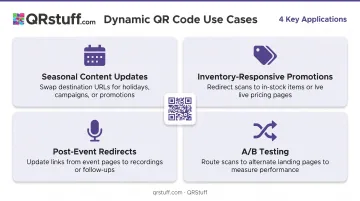
QRStuff's dynamic QR codes handle all of this through a central dashboard. When a code is scanned, the platform records the event — time, device, location — before redirecting to the destination. That redirect layer is what makes analytics possible without reprinting.
Dynamic codes are available from the Lite Suite tier upward, with no destination update limits. The Free tier includes 10 dynamic codes with a 30-day expiry; paid plans have no expiry and support unlimited destination changes.
AI-Powered Personalisation Is Transforming the Scan Experience
One Code, Multiple Pathways
The same physical QR code can now serve different content based on the context of each scan — time of day, geographic location, device type, or signals from previous interactions. That's a meaningful shift from static destination to adaptive experience.
A coffee shop code that shows a breakfast deal at 8am and a happy hour promotion at 5pm is a simple version. More sophisticated implementations adjust product recommendations based on the device detected, or route users to region-specific landing pages without any manual switching.
The underlying mechanism is dynamic redirect logic triggered by real-time conditions. This doesn't require custom development. QR management platforms now support conditional redirect rules as a standard feature, often alongside existing scan analytics.
Why Personalisation Matters for Scan Performance
BCG's 2024 consumer research found that 80% of consumers are comfortable with personalised experiences, and that personalised offers can generate 3x higher ROI than mass promotions. While those figures aren't QR-specific, they point clearly to what happens when post-scan content is relevant versus generic.
The practical implication: a QR code that dumps everyone onto the same homepage misses conversion opportunities. Conditional routing changes that outcome. Examples of what this looks like in practice:
- A mobile user in New York sees a city-specific offer instead of a generic landing page
- A returning scanner gets a loyalty prompt rather than a first-visit introduction
- A tablet user browsing a showroom floor receives a product comparison view optimised for larger screens
Mid-market brands can access this capability without enterprise development budgets. Dynamic QR platforms — including QRStuff's Full Suite and Enterprise tiers — support conditional redirect logic as part of their standard feature set, not as a custom build.
QR Codes Are Emerging as First-Party Data Engines
The Cookie Context
Third-party cookie deprecation has reshaped how marketers collect data. IAB's 2024 State of Data report found 95% of industry decision-makers expected continued signal loss, with 71% actively increasing first-party datasets and projecting 35% average first-party data growth over the following 12 months.
QR codes fit directly into that strategy. Every scan generates owned behavioral data — time, location, device type, unique versus repeat scanner status — without relying on third-party platforms or browser tracking.
Structuring Scans as Data Touchpoints
The real leverage comes from what happens after the scan. Post-scan flows turn anonymous interactions into consent-based, first-party records:
- Loyalty sign-ups triggered at point of sale
- Product registration flows embedded in packaging codes
- Preference surveys linked from post-purchase QR codes
- In-store sign-up prompts on checkout signage
Each of these turns an anonymous scan into a known relationship.
What QRStuff Captures Per Scan
QRStuff's analytics dashboard records the following for every dynamic QR code scan:
| Data Point | Detail Level |
|---|---|
| Scan time and date | Exact timestamp |
| Device type | Mobile vs desktop, iOS vs Android |
| Geographic location | Country and city |
| Unique vs repeat scans | Distinguishes new and returning scanners |
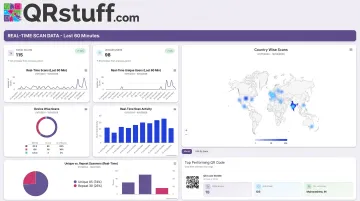
Data is available in real time and exportable to Excel or PDF. It connects to Google Analytics via UTM parameters, and enterprise users can pull it programmatically through API into existing BI systems.
QRStuff processes scan data in compliance with GDPR, capturing aggregated and anonymized behavioral signals without storing personally identifiable information of individual scanners.
Branded QR Design Is Now a Performance Variable
Why Generic Codes Get Ignored
Consumer familiarity with QR codes is high. So is skepticism. A 2026 survey found 53% of respondents avoid scanning QR codes from unrecognised sources. In environments where people encounter dozens of codes, a plain black-and-white square offers no visual reason to trust or act.
Branded QR codes address this directly. Incorporating a logo, brand colors, and consistent visual framing communicates legitimacy before the user decides whether to scan. It signals that the code belongs to a brand they recognize, not an anonymous link to an unknown destination.
Design Principles That Preserve Scannability
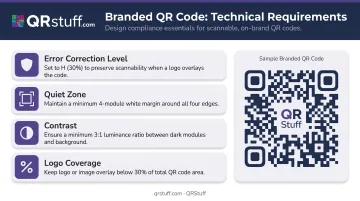
Customisation has limits. These aren't aesthetic preferences — they're technical requirements:
- Error correction level: QR codes support four levels (approximately 7%, 15%, 25%, and 30% restoration capacity). Logos require higher correction — typically Level H — to compensate for covered modules
- Quiet zone: A clear margin of at least four module-widths around the code is required for reliable scanning
- Contrast: Strong foreground-to-background contrast is required. Subtle color pairings consistently cause scanner failures across devices
- Logo coverage: Logos can safely cover up to around 30% of the code surface when error correction is set appropriately
These requirements are easy to overlook when prioritizing aesthetics. QRStuff handles the technical side automatically — raising error correction when a logo is added — and supports custom colors, gradients, shapes, frames, and templates across all subscription tiers, including the free plan. Before mass distribution, test printed codes on multiple devices under different lighting conditions.
QR Codes Are Anchoring Omnichannel Marketing Strategies
QR codes have moved from isolated campaign elements to connectors across full customer journeys. A scan on product packaging might initiate a loyalty sign-up. A scan at an event captures a lead. A scan from a print ad drives a time-limited landing page.
When all three feed into a unified analytics view, the QR code links physical touchpoints to digital outcomes across the entire strategy.
Marketing Week reported in 2025 that 37% of British consumers are more likely to buy a product linked to a digital experience, and 36% had interacted with connected technologies in supermarkets in the previous 30 days. The appetite for physical-to-digital moments exists — QR codes are the most frictionless way to deliver them.
Bitly's 2025 data confirms that marketers already deploy QR codes across email (47%), product packaging (46%), and events (43%). At that scale, code creation isn't the hard part — consistent governance across channels is.
Managing QR at Scale
Running QR across multiple channels without centralized management creates real risk: outdated destinations, inconsistent branding, broken links. QRStuff addresses this through:
- Group codes by campaign, department, or channel using project-based organization
- Filter and compare performance across initiatives using campaign tagging in a single dashboard
- Control team access without losing visibility through role-based permissions
- Generate thousands of codes in a single batch for product lines or event materials
For large-scale omnichannel deployments, QRStuff's Enterprise tier supports API-driven creation, management, and analytics retrieval. It's how enterprises like Walmart, Coca-Cola, and Marriott manage QR programs spanning thousands of SKUs, locations, and campaigns from a single platform.
What's Driving These QR Code Marketing Trends
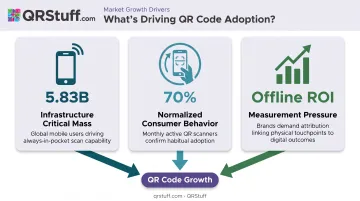
Three converging forces explain why QR code adoption has moved from gradual to rapid.
Infrastructure reached critical mass. DataReportal reported 5.83 billion unique mobile users in April 2026, with smartphones representing approximately 89% of handsets. Native camera scanning on both iOS and Android removes the app-download barrier that slowed earlier adoption. The hardware and software conditions for mass QR engagement are already in place.
Consumer behavior has normalized. Post-pandemic contactless interaction shifted QR from novelty to expectation across restaurants, healthcare, retail, and events. Uniqode's 2026 consumer research found 70% of consumers scan QR codes at least monthly — habitual behavior, not occasional curiosity.
Measurement pressure is real. Marketers need to justify offline spend. QR codes provide direct attribution from physical media to digital outcomes: scan volumes, post-scan conversions, geographic distribution, device split. That attribution capability is increasingly decisive when justifying print, OOH, or packaging budgets.
Beyond these three drivers, technology has lowered the barrier to sophisticated QR programs. AI tools make personalization accessible to mid-market brands. Dynamic QR platforms make real-time content management a subscription feature rather than a development project.
Future Signals for QR Code Marketing
QR code marketing is moving past adoption. The competitive gap is now forming around depth of integration — how much data a code carries, how fast destinations update, and how well scan behaviour feeds back into broader analytics.
Digital Product Passports
The European Commission has confirmed QR codes as a primary data carrier for ESPR-mandated product transparency requirements. GS1's Sunrise 2027 initiative is pushing retail readiness for QR codes using GS1 Digital Link standards — encoding not just URLs but GTINs, batch numbers, expiry dates, and serial numbers.
This infrastructure is already in motion. Over 106,000 products from more than 1,000 brands generate approximately 22 million consumer interactions annually through SmartLabel, an early version of this model.
Near-term scenarios to watch:
- QR codes becoming standard on all consumer packaging as digital product transparency mandates take effect across the EU and beyond
- AI-personalised scan experiences reaching SMBs through platform features, no custom development required
- Scan analytics becoming a primary attribution metric alongside email opens and ad click-through rates
- Deeper WebAR integration as browser-based AR removes app-store friction from immersive scan experiences
Brands that establish dynamic QR infrastructure now — with updatable destinations, scan analytics, and consistent design — will have a meaningful head start when product transparency mandates make connected packaging the baseline expectation rather than the differentiator.
Conclusion
QR code marketing has entered a genuinely strategic phase. The five trends covered here — dynamic infrastructure, AI personalization, first-party data collection, branded design performance, and omnichannel integration — aren't separate developments. Each one reinforces the next: dynamic codes enable personalization, analytics feed first-party data, branded design builds trust, and omnichannel deployment creates scale.
The competitive gap between brands using QR codes as campaign afterthoughts and those treating them as measurable marketing infrastructure is widening. Auditing your current QR strategy against these five areas is a practical starting point — particularly around whether your codes are dynamic, whether your analytics are capturing scan-level data, and whether your design is doing the trust work required in scan-saturated environments.
That's exactly where QRStuff comes in. From dynamic code management and real-time analytics to branded customization and enterprise-scale bulk generation, it's built for the kind of strategic QR deployment this guide describes — and it's already in use by Fortune 500 companies across retail, hospitality, and consumer goods.
Frequently Asked Questions
What is the biggest QR code marketing trend right now?
The shift to dynamic QR codes as long-term marketing infrastructure is the dominant trend. Unlike static codes, dynamic codes allow real-time content updates, campaign flexibility, and scan analytics without reprinting physical materials. Bitly's 2025 data shows 93% of marketers increased QR usage in the prior year, with analytics ranked as the most important strategic feature.
How are dynamic QR codes different from static ones for marketing?
Static codes permanently encode one destination into the visual pattern ; change the URL and the code is obsolete. Dynamic codes use a redirectable short URL, so marketers can update destinations, rotate promotions, and track scan performance in real time without altering or reprinting the physical code.
Can QR codes help replace third-party cookie data?
Every dynamic QR scan generates first-party behavioral data — device type, location, time, and unique versus repeat scanner status — that brands own directly. Post-scan flows like loyalty sign-ups or preference surveys layer in explicit, consent-based data on top of that baseline.
Are branded QR codes really worth the extra design effort?
Yes. With 53% of consumers avoiding codes from unrecognised sources, visual trust signals matter before a scan happens. Branded codes incorporating logos, colors, and familiar visual framing reduce hesitation and signal legitimacy. The design investment is modest; the scan-rate impact is measurable.
What industries are seeing the strongest QR code marketing growth?
Retail, hospitality and restaurants, healthcare, and event marketing lead adoption. All four benefit from QR's ability to bridge physical environments with digital information flows, loyalty systems, and contactless experiences and all involve the high-frequency consumer interactions where scan convenience matters most.
How do I measure the ROI of a QR code marketing campaign?
Track total and unique scans, post-scan conversions via UTM parameters, and cost per verified action (sign-up, purchase, registration). Dynamic QR dashboards consolidate scan data by geography, device, and time, giving you a direct line between offline touchpoints and digital ROI.