The stakes are real. US consumers belong to an average of more than 15 loyalty programs, yet actively participate in fewer than half. Businesses running plastic card programs are losing members to card loss, friction, and complete invisibility into what's actually working. Meanwhile, 63% of consumers already enrolled in their most recent loyalty program via a mobile app or website, according to the 2024 EY Loyalty Market Study.
This article covers the five trends reshaping how loyalty programs are built — and why the businesses moving first are compounding advantages that will be hard to close later.
Key Takeaways
- Traditional plastic loyalty cards fail through card loss, zero data capture, and enrollment friction that steadily erodes membership
- Five trends are driving the shift: dynamic QR codes, app-free enrollment, behavior-based personalization, digital wallet integration, and gamification
- Smartphone ubiquity, post-pandemic QR normalization, and consumer demand for frictionless experiences are accelerating all five
- 79% of Americans are more likely to join a loyalty program that doesn't require carrying a physical card
- Businesses adopting QR-based loyalty accumulate first-party behavioral data that sharpens targeting with every scan
The Problem with Plastic: Why Traditional Loyalty Cards Are Losing Ground
Physical loyalty cards fail in predictable ways. They get left at home on the exact day a customer wants to redeem a reward. They end up at the bottom of a bag, scratched beyond scanning. They get tossed during a wallet clean-out. The result isn't just a frustrated customer — it's a dropped member who simply stops participating.
The operational burden on the business side is just as significant:
- Manual point tracking creates staff overhead and error risk at the point of sale
- Card reprinting costs range from $75–$1,000 for initial design and printing, plus $300–$1,500 for distribution, and $3–$10 per replacement card for lost or damaged ones
- No behavioral data beyond the transaction itself — no visit frequency, no channel preferences, no lapse signals
- No real-time visibility into which rewards are driving return visits
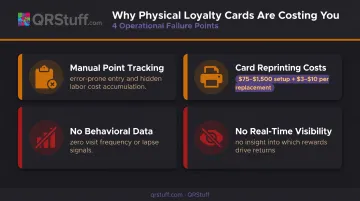
The medium itself is the problem. A plastic card is a passive object — it requires the customer to remember it, carry it, and present it correctly every single visit. QR codes solve the same job while removing nearly every friction point on both sides of the counter.
Five Key Trends Defining the Rise of QR Code Loyalty Programs
Trend 1: Dynamic QR Codes Are Replacing Static Punch Cards
Static punch cards and static QR codes share the same fundamental flaw: once printed, they're fixed. Change the offer, change the destination, or make an error — and you're reprinting everything.
Dynamic QR codes break that constraint entirely. The code itself stays the same; only the destination changes. Update a seasonal offer, redirect a campaign, or fix a broken link — without touching a single printed material. For loyalty programs where promotions rotate and reward thresholds shift, this flexibility is the difference between an adaptable program and an expensive reprint cycle.
Platforms like QRStuff offer dynamic QR codes with built-in scan tracking — capturing total scans, unique scans, device type, scan timing, and geographic location — all without requiring any third-party integration. Businesses can embed these codes on receipts, packaging, and in-store signage, then monitor loyalty engagement directly from the analytics dashboard.
Real-world adoption reflects this. McDonald's runs a points-based loyalty system where members present a 4-digit code or scan at the counter and kiosk — code-based earning at enterprise scale, across thousands of locations. Dynamic QR codes already account for 64% of QR code payment market revenue, indicating the infrastructure is mature and commercially proven.
Trend 2: App-Free Enrollment Is Removing the Biggest Barrier to Participation
Ask a customer to download a dedicated app before they can earn their first loyalty point, and 58% will decline the sign-up entirely. That's not indifference to loyalty — it's friction intolerance. The download step introduces perceived commitment that most casual customers won't accept on a first visit.
QR-based enrollment bypasses this. The flow is simple:
- Customer scans a code at checkout or on a receipt
- A web page loads — no app store visit, no account setup wall
- They enter a name and phone number (76% of customers are more likely to join when only minimal information is required)
- Their personal loyalty QR code arrives via SMS or email
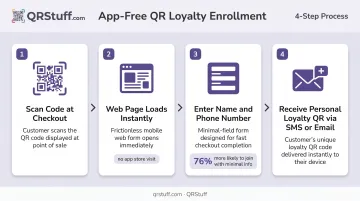
Extensive data collection at sign-up cuts participation by nearly as much as requiring an app download. The trend toward minimal-friction, app-free entry is gaining ground across both SMBs and franchise chains because it meets customers where they already are — on their phone, in a browser.
Trend 3: QR Scan Data Is Enabling Personalized, Behavior-Based Rewards
Every scan of a loyalty QR code records a timestamp, location, device type, and whether it's a unique or repeat visit. Collected across thousands of interactions, this transforms a generic "spend $10, get a stamp" program into something far more targeted.
73% of consumers say the ability to select or influence their own rewards is very important — yet personalization satisfaction currently lags at just 60%, according to Deloitte's 2024 Consumer Loyalty Survey. That gap is where scan data creates value.
Practical applications include:
- Lapsed customer offers triggered automatically when scan frequency drops below a threshold
- High-frequency VIP perks unlocked once a customer hits a visit milestone
- Location-based optimization — identifying which store locations drive the most loyalty engagement and weighting promotions accordingly
- A/B testing reward offers by comparing redemption rates across different QR codes
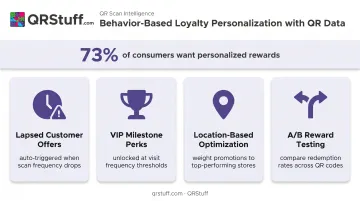
QRStuff's analytics dashboard surfaces exactly this kind of comparative data: scan performance by code, location breakdowns at country and city level, and custom date range reporting — all exportable as CSV for deeper analysis.
Trend 4: Digital Wallet Integration Is Making Loyalty Cards Permanently Accessible
The last remaining friction point for QR loyalty programs used to be findability — customers had to locate their loyalty code in an SMS thread or email every time they visited. Digital wallet integration removes that entirely.
Loyalty QR codes stored in Apple Wallet or Google Wallet behave like boarding passes: visible on the lock screen, accessible without opening any app, and immune to being buried in an inbox. ACI Worldwide reports that mobile wallet use for non-payment items — including digital tickets and loyalty cards — rose 92% since 2019, with 63% of Gen Z now storing non-payment items in their wallets.
The marketing upside goes further than convenience. Wallet-stored passes can trigger location-based push notifications:
"You're 2 minutes from our store — you're one stamp away from a free reward."
That's a passive card becoming an active re-engagement channel. QRStuff supports Apple Wallet and Google Wallet integration, allowing businesses to offer customers a one-tap save option at enrollment — turning digital loyalty into something customers genuinely keep with them.
Trend 5: Gamification Is Turning Loyalty Into an Experience, Not Just a Transaction
A punch card rewards spending and nothing else. Gamified loyalty changes what customers do between visits — and why they come back.
QR-enabled programs can now incorporate:
- Bonus point days triggered by specific scan events
- Mystery reward reveals upon redemption
- Milestone unlocks at visit frequency thresholds
- Tiered status levels that change what a customer's QR code unlocks
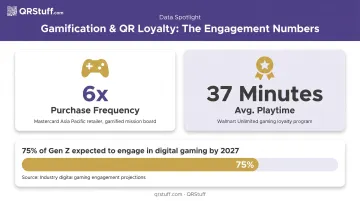
The results are measurable. Mastercard reports that a gamified mission board at an Asia Pacific retailer produced 6x purchase frequency among participants versus non-participants in the first 12 months. Walmart's Unlimited gaming loyalty program averaged 37 minutes of playtime per user. With approximately 75% of Gen Z expected to engage in digital gaming by 2027, mechanics that reward interaction — not just spend — will define the next generation of loyalty programs.
What's Driving the Plastic-to-Digital Loyalty Shift
Several compounding forces are pushing businesses toward QR-based loyalty — and they cut across industries and business sizes alike.
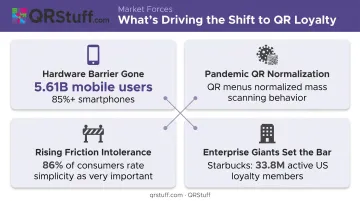
Four forces are driving the shift:
- The hardware barrier is gone. Unique mobile users reached 5.61 billion globally in early 2024, with smartphones making up 85%+ of handsets. Native QR scanning is built into every modern camera — no separate app required. The infrastructure friction that slowed adoption before 2020 no longer exists.
- Pandemic normalization did the training. COVID-19 forced mass QR deployment for menus, check-ins, and payments. By 2023, QR code menu usage in US restaurants was registering in national survey data. Consumers who scan codes for food orders don't hesitate to scan them for rewards.
- Friction intolerance is rising. Deloitte found 86% of respondents rate simplicity as important or very important in loyalty programs. BCG found 35% of US loyalty members planned to cancel some memberships — complexity accelerates that churn.
- Enterprise giants set the baseline. Starbucks Rewards reached 33.8 million active US members in Q4 FY2024. McDonald's runs QR-based earning across thousands of locations. When category leaders operate at this scale, smaller brands face customers who expect the same experience — meeting that bar is now table stakes.
How These Trends Are Impacting the Loyalty Landscape
Operational Impact
Digital QR loyalty programs eliminate several workflows that plastic programs require by default:
- Card printing runs and reprint cycles
- Manual point entry at the register
- Paper-based redemption tracking
- Card replacement administration
The Forrester Total Economic Impact study on Mastercard's SessionM loyalty platform estimated $11.6 million in marketing-execution savings over three years, with 35% less reliance on third-party data acquisition and 18% lower paid-media spend. While that's an enterprise-scale figure, the structural savings — no physical card inventory, no reprint cycles, no manual reconciliation — apply at every business size.
A QR-based program serves one location or one hundred with the same infrastructure. QRStuff's Enterprise tier, for example, supports multi-location deployment from a single account, with project folders to organize codes by location or campaign and bulk generation to create location-specific codes at scale.
Business Impact
The strategic value of QR loyalty data is rising as third-party tracking erodes. According to IAB's State of Data 2024, 71% of brands are actively increasing first-party data collection, with average expected growth of 35% in 12 months — and 95% of US data decision-makers expect continued signal loss from legislation and eventual cookie deprecation.
QR loyalty programs are a consented, first-party data channel by design. Customers voluntarily share contact information to receive their loyalty code — that data belongs to the business, not a third-party platform. Scan analytics then tie specific offers directly to return visits and revenue, giving businesses ROI visibility that plastic card programs never provided.
EY found that 58% of consumers say loyalty programs have increased their spending with a brand. Capturing that spend lift, though, requires being able to measure it — and plastic cards never could.
Customer Impact
From the customer's perspective, QR loyalty is simply easier. Rewards are always on their phone, never lost, updated in real time, and increasingly tailored to their actual behavior. Miss a physical stamp card and you miss the reward — there's no recovery path.
The opt-in nature of digital enrollment also produces a higher-quality member base. Customers who actively share contact information to receive a loyalty code are more committed than customers who passively accept a card at checkout. Deloitte found that 75% of Gen Z and millennial consumers say a high-quality digital experience is essential for loyalty programs — not preferred, essential.
Future Signals: What's Next for QR Code Loyalty Programs
QR loyalty infrastructure is evolving fast. Three shifts in the next one to three years will reshape how businesses attract and retain customers:
- AI-personalized reward triggers: Loyalty platforms are beginning to use machine learning to identify lapse risk and deploy targeted QR-linked offers automatically — shifting from reactive to predictive retention management
- Cross-brand coalition loyalty: QR codes are becoming the link between programs where a single scan earns points redeemable across multiple partner brands. PAYBACK's digital card — combining points, coupons, and payment across partners — already had 16 million+ users in Germany by 2025
- NFC and QR convergence: As tap-to-pay hardware becomes standard at retail POS, the distinction between QR-scan loyalty and NFC tap loyalty will disappear at the point of sale. Businesses already running dynamic QR infrastructure will migrate to combined formats with minimal rebuilding
Conclusion
Loyalty programs are moving from a passive card-in-wallet model to an active, insight-driven digital channel. QR codes are what make that transition accessible to businesses of every size — not just the enterprise brands that can afford dedicated app development. The shift is driven by what customers already expect and what businesses genuinely need: lower admin overhead, first-party behavioral data, and measurable return on every reward issued.
The compounding advantage belongs to businesses that move first. Every scan adds to a behavioral dataset that refines targeting, identifies lapse risk earlier, and makes the next campaign more effective than the last. And once a competitor has six months of behavioral data on your shared customers, it's not a gap that's easy to recover from.
For businesses ready to make the switch, QRStuff provides the dynamic QR code infrastructure to launch and scale a digital loyalty program — including real-time scan analytics, custom branding, Apple and Google Wallet integration, and GDPR and SOC2-compliant security. Paid plans cover small businesses through to enterprise deployments across multiple locations. See pricing and plans on QRStuff.
Frequently Asked Questions
What is the most popular loyalty program?
Starbucks Rewards (33.8 million active US members) and Amazon Prime are consistently cited as top performers. What they share: digital access, tiered rewards, and personalization that keeps customers coming back.
How do QR code loyalty programs work?
Customers receive a unique QR code via SMS, email, or digital wallet and present it at checkout to earn or redeem points. Staff or a POS device scans the code, which instantly updates their loyalty balance in a cloud-based system — no physical card needed.
Do customers need to download an app to use a QR code loyalty card?
No — this is one of the key advantages. The QR code is delivered directly to the customer's phone via text or email, accessible in any browser. Customers can also save it to Apple Wallet or Google Wallet for lock-screen access without opening any app.
Are QR code loyalty programs better than plastic punch cards?
Yes — no lost cards, real-time data tracking, personalization, and lower operational costs all favor digital. The participation numbers back it up: 79% of Americans say they're more likely to join a loyalty program that doesn't require carrying a physical card.
How can businesses track the performance of a QR code loyalty program?
Dynamic QR codes capture scan data in real time — including total scans, unique users, scan timing, location, and device type. QRStuff's analytics dashboard turns this into actionable metrics: enrollment rates, redemption frequency, and which rewards or locations drive the most engagement.
What types of businesses benefit most from QR code loyalty programs?
Any business with repeat customers benefits — cafes, restaurants, retail stores, salons, gyms, and hotels are all strong fits. The ROI is especially strong where visit frequency and average order value are key growth levers, since scan data makes it possible to optimize for both directly.