That moment captured something bigger than a clever uniform gimmick. It showed that a jersey — already the most visible real estate in sport — could become a direct channel between athlete and fan.
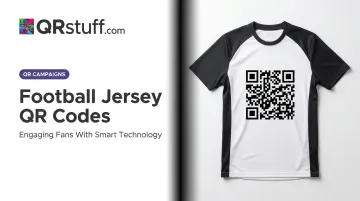
Football teams are now treating jerseys as interactive touchpoints. This article breaks down why that shift is happening, the best use cases driving real engagement, campaigns that made headlines, and how to build your own jersey QR code strategy.
Key Takeaways
- Football jersey QR codes turn uniforms into scannable fan experiences with no app required
- Top use cases include player profiles, NIL campaigns, sponsor activations, exclusive content, and social causes
- UCF, FC Bayern, the Indiana Pacers, and Miller Lite have all run successful jersey QR campaigns
- Dynamic QR codes are essential — they let you update the destination without reprinting the jersey
- Placement, contrast, minimum 2 × 2 cm size, and mobile-optimized landing pages determine scan success
Why Football Teams Are Adding QR Codes to Their Jerseys
Stadiums are full of fans staring at their phones. According to Deloitte's in-stadium research, 82% of sports fans use their mobile phones in some way during live professional sporting events. Meanwhile, Deloitte's 2023 sports fan insights report found that 77% of fans would use mobile devices to watch replays if available in-venue, and 77% already do at least one additional digital activity while watching sports.
That attention has historically gone nowhere useful for teams. QR codes on jerseys change that — the jersey itself becomes the bridge.
The Data Advantage
Every scan generates real-time intelligence: when it happened, where, on what device, and how many unique fans engaged. For teams and sponsors, this kind of behavioral data is what turns jersey placement from a visibility metric into something with a measurable return.
That shift matters most for sponsors. Instead of estimating impressions from a logo placement, they get actual interaction data — scan volume, geographic reach, device breakdown — tied to a specific jersey or campaign moment.
The Sponsorship Dimension
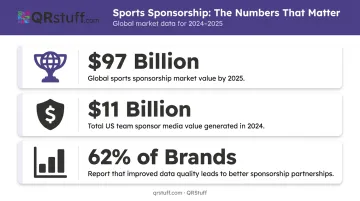
The global sports sponsorship market was projected to reach $97 billion by 2025, according to Deloitte. The numbers behind that growth tell the same story:
- US team sponsorships generated $11 billion in sponsor media value in 2024
- 62% of brands say improved data is the key to better sports partnerships
- Jersey QR codes answer both — a sponsor badge becomes a scannable activation with trackable ROI instead of passive logo real estate
Top Use Cases for QR Codes on Football Jerseys
Player Profiles and NIL for Student Athletes
Scanning a player's jersey QR code can pull up their full profile — stats, bio, social media links, and merchandise. For college and high school athletes, this doubles as a monetization and brand-building tool under NIL (Name, Image, and Likeness) rules.
UCF's 2022 Spring Game is the clearest example. Each player's QR code linked to their UCF athletics bio page, complete with social channels and merchandise links. Head coach Gus Malzahn even wore a code on his polo. The campaign generated national coverage across CBS Sports, Sports Illustrated, and Fox 35 — entirely organic reach from a jersey design decision.
Cartersville High School in Georgia took a similar approach, producing Nike Vapor Pro jerseys with individual QR codes for senior players, oriented around recruiting visibility for college scouts.
Sponsor and Brand Activations
QR codes convert passive sponsor placement into active fan interactions. Instead of a logo fans glance at and forget, a scannable badge sends them to promotions, contest entries, giveaways, or exclusive offers.
FC Bayern Munich's 2024/25 men's jersey features an Allianz sleeve badge that doubles as a QR code, the first of its kind in Bundesliga history. Scanning it directs fans to the Allianz × FC Bayern Hub for exclusive promotions and experiences.
Miller Lite went a different direction for Super Bowl LVIII. They distributed 1,000 QR-coded jerseys to fans, turning spectators into walking brand activations. Fans who scanned the jerseys could win beer money, and the five most-scanned wearers won beer for a year.
The campaign tied measurable digital engagement directly to fan-worn merchandise — a model other brands have since looked to replicate.
Exclusive Fan Content and Rewards
Scan-gated content creates urgency and rewards the fans who show up.
The Indiana Pacers became the first major professional sports franchise in the United States to debut a QR code-like patch on regular-season and postseason jerseys, through a partnership with Fishers-based tech startup Spokenote. Fans who scanned the patch unlocked exclusive content directly tied to live game moments at Gainbridge Fieldhouse. The activation won the 2024 NBA Changemaker of the Year Award.
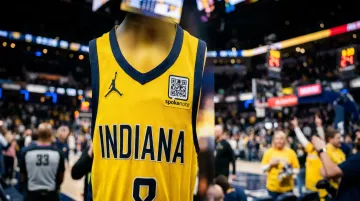
Content delivered through jersey QR codes can include:
- Locker room footage and player interviews
- Behind-the-scenes match-day clips
- Sweepstakes entries and contest votes
- Season highlight reels
Social Awareness Campaigns
High jersey visibility makes them an unusually powerful platform for causes.
Two campaigns show how different the approach can look:
| Club | Campaign | Linked Content |
|---|---|---|
| Brentford FC (Oct 2022) | Restart a Heart, with Resuscitation Council UK | Two-minute CPR instruction video |
| Tromsø IL (Dec 2021) | Human rights awareness, with Amnesty International | Information on Qatar labor abuses ahead of 2022 World Cup |
Both campaigns earned press coverage — AP and DW News covered the Tromsø kit; the Brentford activation drew widespread UK media attention — without a paid media budget behind them. That's the practical case for cause-driven jersey QR codes: the story travels further than the jersey itself.
Campaigns That Made Headlines
Four campaigns show what jersey QR codes can actually accomplish — and how varied the strategies can be:
| Campaign | What Happened |
|---|---|
| UCF 2022 Spring Game | Players wore individual QR codes instead of numbers; codes linked to player bios and NIL merchandise; national media coverage followed |
| FC Bayern × Allianz | First QR-coded sponsor badge in Bundesliga history on the 2024/25 sleeve; unlocks the Allianz × Bayern Hub with exclusive fan promotions |
| Indiana Pacers × Spokenote | First US major pro sports franchise with a jersey QR patch; exclusive live-game content delivery; won the 2024 NBA Changemaker of the Year Award |
| Miller Lite Super Bowl LVIII | 1,000 fan-worn QR jerseys turned spectators into brand promoters; most-scanned wearers won prizes |
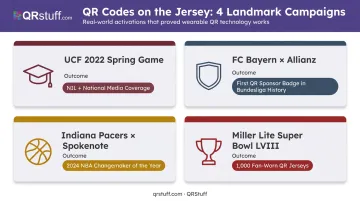
The common thread across every high-performing campaign: the QR code delivered something worth scanning — exclusive content, a prize, or a personal connection to the player. Generic homepage links don't move the needle.
Best Practices for Designing and Placing QR Codes on Football Jerseys
Placement
The most reliable locations are:
- Back of the jersey — near or replacing the number, maximum visibility for spectators and cameras
- Sleeve — FC Bayern's approach; visible during play without obstructing the primary design
- Chest patch area — common for sponsor badge integrations
Avoid placing codes across seams, fabric folds, or areas that stretch significantly during play. Distortion breaks scans even when the file is technically perfect.
Size and Contrast
Uniqode's 2026 printing guide recommends 2 × 2 cm as the practical minimum for close-range scanning, with a useful distance rule: QR code size in inches should equal scanning distance in inches divided by 10, plus 20–30% for real-world conditions like low lighting or curved surfaces.
For jerseys viewed from seats rather than arm's length, that calculation matters. A code meant to scan from 10 feet needs roughly 12 inches of QR area.
Size sorted, contrast is next — and it's non-negotiable. Use dark code on a light jersey, or light code on a dark jersey. Mesh fabric, sweat, and natural curvature all reduce effective contrast, so always test the finished garment, not just the digital file.
Design and Dynamic Codes
Custom QR codes — with team colours, logos, or shapes like Brentford's heart — work well provided error correction stays intact and finder patterns remain unobstructed. Over-customising to the point where contrast drops or modules become unclear is where scannability breaks.
Dynamic QR codes are the only sensible choice for jersey deployments. A static code encodes the destination permanently — if the URL changes, the jersey becomes useless. Dynamic codes use a redirect, so the destination can be updated between seasons, games, or campaigns without reprinting.
QRStuff's dynamic QR codes are built for this kind of application. Teams can update linked content at any point without touching the printed jersey:
- Swap a pre-season schedule for playoff information
- Rotate sponsor offers mid-campaign
- Refresh player profile content after a transfer window
Real-time analytics track scan volume, device type, and geographic data by campaign — giving both teams and sponsors the performance data they need to evaluate ROI.
Landing Page Quality
The QR code is only as good as what it points to. The destination must be:
- Mobile-optimised and fast-loading
- Delivering immediate value (an offer, a video, a profile) — not a generic homepage
- Tested across multiple devices and screen sizes before jerseys are printed
Test across at least three phone models and in realistic lighting conditions before committing to print. Run a pilot with a limited jersey run before a full-season rollout.
How to Create a Football Jersey QR Code with QRStuff
QRStuff supports 40+ QR code data types relevant to jersey deployments — URL, vCard, social media profiles (Instagram, TikTok, YouTube, Facebook), video files, and Social Link Pages that consolidate multiple profiles into a single scan. Here's the process:
- Choose your data type based on campaign goal — a URL for a player bio page, a Social Link Page for NIL profiles, or a Video File for exclusive content delivery
- Select dynamic format — this is the setting that enables post-print URL editing and real-time scan tracking
- Customize the design: apply team colors, upload a logo for the center, and select module shapes that match jersey aesthetics. QRStuff automatically applies high error correction when a logo is included
- Download in vector format — SVG or EPS files scale to any size without pixelation, making them the correct choice for fabric printing. PNG at 300 DPI minimum works for smaller applications
- Test before printing — scan across multiple phone models and lighting conditions; test at realistic fan distances if the code will be read from seats
- Update the destination as needed — through the QRStuff dashboard, you can update the linked content at any time without touching the physical jersey
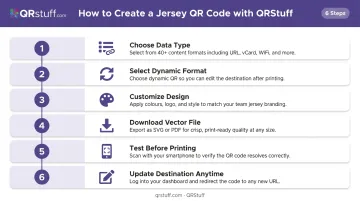
Two platform capabilities matter most once the jersey goes live:
- 99.9% uptime guarantee (actual track record: 99.968% since 2008) — handles simultaneous scans from thousands of fans during game-day spikes without failure
- GDPR-compliant analytics — scan data is collected as anonymized, aggregated information (device type, location, time) with no personally identifiable fan data stored
For teams generating individual codes per player at scale, QRStuff's Enterprise tier includes API access and unlimited batch processing. Upload a spreadsheet where each row represents one player and the platform generates the full roster's codes at once.
Frequently Asked Questions
Can I get a QR code on a shirt?
Yes. QR codes can be screen-printed, heat-transferred, or applied to fabric using DTG printing. Printed jersey QR codes work reliably when minimum size and contrast requirements are met. Dynamic QR codes are recommended so the linked content can be updated without reprinting the garment.
How do I scan a jersey QR code?
Open your smartphone's native camera app, point it at the code, and tap the notification link that appears. The linked content opens in your browser immediately, with no separate app required.
What content can a football jersey QR code link to?
Common destinations include player profile pages, sponsor promotions, exclusive video content, social media profiles, merchandise stores, and campaign pages. Codes that perform best link to something with instant value: a discount, a highlight reel, or a player profile fans actually want to read.
Should I use a static or dynamic QR code on a jersey?
Dynamic QR codes are strongly recommended. The destination URL can be changed after printing, which is essential when sponsors change, seasons turn over, or player content needs updating mid-season.
Where is the best place to put a QR code on a jersey?
The back of the jersey (near or replacing the number), the sleeve, and the chest patch area are the most practical and most visible placements. Avoid seams, fabric folds, or areas that stretch during play, as distortion breaks scannability.
What size should a QR code be on a jersey?
The minimum recommended size for reliable close-range scanning is 2 × 2 cm, according to Uniqode's 2026 printing guide. For jerseys scanned from a distance — such as from stadium seating — apply the distance rule: code size in inches equals scanning distance in inches divided by 10, then add 20–30% margin for real-world conditions. Always test the printed garment before game day.