The problem? Most restaurant owners pick a platform based on a quick Google search, only to discover it lacks dynamic editing, caps out on scans, or produces dead links the moment a menu changes. According to Ipsos, 65% of diners used QR code menus in 2025, up from 42% in 2022 — which means broken or outdated codes now frustrate more guests than ever before.
This guide covers the best QR code generator platforms for restaurant use in 2026, what sets each one apart, and the criteria used to evaluate them.
Key Takeaways
- QR codes in restaurants go beyond menus — they drive WiFi access, review generation, social follows, and more
- The best platforms support dynamic codes (update content without reprinting), scan analytics, and branded customization
- QRStuff leads for restaurant versatility: 40+ QR types, real-time analytics, and 99.968% historical uptime
- Strong alternatives: QR Tiger (design-focused), Beaconstac/Uniqode (enterprise chains), QRCodeKIT (independent cafés), Flowcode (brand-conscious venues)
- Choose a platform with dynamic codes, unlimited scans, design flexibility, and pricing that scales across locations
Why Restaurants Need QR Code Generators — Not Just QR Menu Apps
A QR menu app (like RestoLabs or TableQR) handles ordering workflows, POS integration, and payment processing. A QR code generator platform does something different — it creates, manages, and tracks every QR touchpoint across your operation.
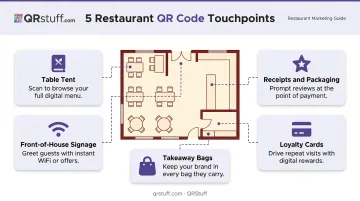
Those touchpoints add up quickly. Across a typical restaurant, QR codes now appear on:
- Table tents (digital menus)
- Front-of-house signage (WiFi credentials)
- Receipts and packaging (Google Review prompts)
- Loyalty program enrollment cards
- Takeaway bags and seasonal promotional materials
Each of these needs to work reliably, stay on-brand, and be updatable without reprinting. That's the core value a dedicated QR code generator delivers. The National Restaurant Association's 2024 technology report found 59% of full-service customers would pull up a menu via QR code, with 48% willing to order and 46% willing to pay that way. A broken or outdated code at any of those moments is a missed transaction.
Best QR Code Generator Platforms for Restaurants in 2026
Platforms below were selected based on: dynamic code support, QR type breadth, analytics depth, design customization, pricing transparency, uptime reliability, and security compliance. Each entry covers key restaurant features, current pricing tiers, and the operator type it suits best.
QRStuff
Founded in 2008 and trusted by 495,000+ businesses worldwide — including Marriott International — QRStuff supports 40+ QR code types and is built around the use cases restaurants actually need: menus, WiFi sharing, Google Reviews, social media, loyalty, and packaging.
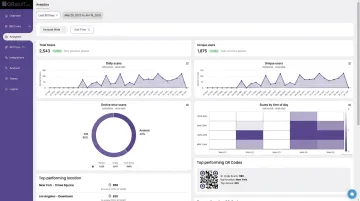
Dynamic codes let owners swap destinations instantly through a simple dashboard — no reprinting, no technical knowledge required. Analytics track scans by country, city, device type (iOS/Android), and time of day, with real-time data populating as scans happen. Custom branding — logo embedding, color matching, corner shapes, gradient fills — is available from the entry-level Lite Suite at $10/month.
The platform's 99.9% uptime SLA (with a documented historical rate of 99.968% since 2008) matters particularly for restaurants where a broken menu link during a Friday dinner rush is an operational problem.
| Category | Details |
|---|---|
| Key Restaurant Features | 40+ QR types (menus, WiFi, vCard, social, PDF, payments, Google Reviews, events); dynamic codes with instant URL editing; real-time analytics (country/city, device, OS, time-of-day); bulk creation (500 codes/batch on Full Suite); password-protected codes; API access on Enterprise |
| Pricing | Free Suite (10 dynamic codes, expires in 30 days); Lite Suite $10/month (50 dynamic codes, no expiration); Full Suite $25/month; Enterprise $250/month — verify current pricing at qrstuff.com |
| Best For | Restaurants of all sizes needing a single, reliable platform for every QR use case — from one location to hundreds |
QR Tiger
QR Tiger suits marketing-focused restaurant teams that want design-friendly QR creation without dedicated design resources. Its Canva integration lets staff embed dynamic QR codes directly into menus, promotional graphics, and social assets — a practical time-saver for small teams.
A folder-based organizational system helps multi-location operators keep campaigns tidy, and bulk CSV generation supports up to 3,000 URLs per file. The free plan includes 3 dynamic codes, but each caps at 500 scans and displays a QR Tiger logo popup — not suitable for permanent guest-facing use.
| Category | Details |
|---|---|
| Key Restaurant Features | Dynamic and static QR codes; Canva integration; folder management for multi-location; social media, PDF, video, and WiFi QR types; bulk CSV generation (up to 3,000 URLs) |
| Pricing | Free plan (3 dynamic codes, 500 scans each, branded popup); paid plans available — verify current pricing at qrcode-tiger.com |
| Best For | Small-to-mid-size restaurant groups and marketing teams wanting design workflow integration and location-level organization |
Beaconstac (Uniqode)
Beaconstac, now operating as Uniqode, is the enterprise choice. Its analytics dashboard goes deeper than most: scan heatmaps, device and OS breakdowns, time-based trends, and Google Analytics 4 integration for connecting QR performance to broader web traffic data.
The platform's geolocation redirect feature — which routes scans to different landing pages based on the user's location — is particularly useful for chains running region-specific promotions. Bulk creation and batch operations handle high-volume deployments across hundreds of locations. The tradeoff: a steeper learning curve and premium pricing that makes it a poor fit for independent operators.
| Category | Details |
|---|---|
| Key Restaurant Features | Advanced analytics dashboards; GA4 integration; bulk QR creation with batch operations; geolocation redirect; password protection; folder and campaign management |
| Pricing | No permanent free plan — limited trial only; verify current enterprise and team-tier pricing at beaconstac.com |
| Best For | Restaurant chains, franchise groups, and hospitality enterprises running high-volume, multi-location QR campaigns with detailed reporting requirements |
QRCodeKIT
QRCodeKIT is built with independent food operators clearly in mind. Its free plan includes 2 dynamic QR codes that don't expire (within the 100 scans/month limit) — one of the most generous free tiers for small restaurants testing digital menus.
The platform is ISO certified and GDPR compliant, and its dedicated "menu QR code" type lets operators link to a website, upload a PDF, or build a mobile-friendly landing page directly. A standout feature: Cleo, an AI-powered conversational menu assistant that turns a QR scan into an interactive menu experience rather than just a PDF download.
| Category | Details |
|---|---|
| Key Restaurant Features | 2 free dynamic QR codes (no expiration within limits); PDF menu upload; AI menu assistant (Cleo); artistic QR design customization; scan analytics (scans, devices, geographic data) |
| Pricing | Free plan (2 dynamic codes, 100 scans/code/month); paid plans available — verify current pricing at qrcodekit.com |
| Best For | Independent restaurants, cafés, and bakeries looking for an accessible, affordable dynamic menu QR solution with smart design options |
Flowcode
Flowcode appeals to restaurants where the QR code itself is part of the brand experience. Its design capabilities — animated codes, gradient fills, branded frames, custom CTA text — go further visually than most competitors. Dynamic editing is available on lower-tier plans, and Flowpage provides a mobile-first landing page that tracks engagement metrics beyond the initial scan.
The platform supports URLs, vCards, WiFi, PDF, email, SMS, and HTML QR types according to Capterra's 2026 listing, and is GDPR and CCPA compliant. Pricing escalates quickly for advanced features — worth checking the current pricing page before committing.
| Category | Details |
|---|---|
| Key Restaurant Features | Visually branded QR codes (animations, gradients, custom frames, CTA text); dynamic editing on lower plans; GDPR and CCPA compliant; Flowpage mobile landing pages; WiFi and PDF support |
| Pricing | Free plan (2 dynamic codes, up to 500 scans); pricing scales for advanced features — verify current pricing at flowcode.com |
| Best For | Fine dining establishments, boutique cafés, and hospitality brands where visual identity and guest data privacy are the primary priorities |
How We Chose These Platforms
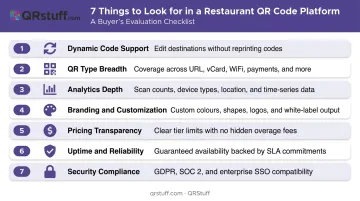
Every platform was assessed against seven criteria directly tied to how restaurants operate:
- Dynamic code support — can menu URLs, WiFi credentials, or promotional links be updated without reprinting?
- QR type breadth — does the platform cover WiFi, PDF, vCard, social, payments, and review links?
- Analytics depth — can operators track scans by location, device, time, and unique vs. repeat users?
- Branding and customization — can every code match the restaurant's visual identity?
- Pricing transparency and scalability — are plans clearly priced and scalable as locations expand?
- Uptime and reliability — is there an SLA or documented track record?
- Security compliance — does the platform meet GDPR and/or SOC2 standards?
The most common mistake restaurant operators make: choosing a free or static-only generator that works at launch, then hitting a wall when a menu changes, a promotion ends, or a second location opens.
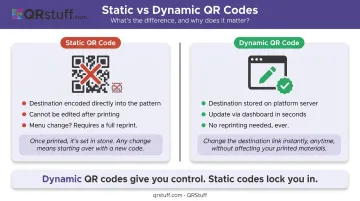
Static QR codes encode their destination directly into the pattern — once printed, they cannot be edited. A menu URL change means reprinting every table tent, every takeaway bag, every piece of signage. Dynamic codes eliminate this problem entirely.
That distinction also shapes how to interpret this list: these platforms are QR code generation and management tools, not QR menu ordering systems. Many restaurants use both — a generator for code management across all touchpoints, and a separate ordering platform for table-side transactions.
Conclusion
Choosing a QR code platform is an operational decision, not just a technical one. Restaurants that invest in dynamic, branded, analytics-enabled QR codes spend less on reprints, create smoother guest experiences, and gain real data on which tables, campaigns, and touchpoints are driving engagement.
When evaluating platforms, think beyond today's menu. Ask whether the tool can support a second location or a loyalty program rollout a few months from now. The tools that earn their subscription cost are the ones that grow with you — without forcing a platform switch every time your needs change.
For restaurants that need one platform to handle every QR use case (menus, WiFi, review prompts, social media, loyalty, packaging) QRStuff has been trusted by hospitality brands worldwide since 2008. With 40+ QR code types, real-time analytics, 99.9% uptime backed by an SLA, and branding tools available from the entry-level plan, it scales from a single café to a multi-location group without a platform switch.
Frequently Asked Questions
What is the most trusted QR code generator?
QRStuff, Beaconstac (Uniqode), and QRCodeKIT rank among the most trusted options, each backed by GDPR compliance, documented security certifications, and established enterprise client bases. QRStuff has served 495,000+ businesses since 2008, including Fortune 500 companies, with a 99.9% uptime SLA and SOC2 compliance.
How do I generate a QR code for a restaurant?
Choose a platform, select the appropriate QR type (URL for a digital menu, PDF for a static file, WiFi for guest credentials), customize with your brand colors and logo, download in high resolution, and place on table tents or signage. Use a dynamic QR code so you can update the destination without reprinting if your menu or links change.
What are common mistakes restaurants make with QR codes?
The most frequent errors: using static codes that can't be updated when menus change, linking to slow-loading PDFs instead of mobile-optimised pages, placing codes in poor lighting or at awkward scan angles, and not testing codes across multiple devices before printing. Each of these leads to guest frustration and staff interruptions.
Do QR codes for restaurants expire?
Static QR codes never expire. Dynamic codes depend on the platform: on QRStuff's paid plans (Lite, Full, and Enterprise), they remain active as long as the subscription does. Free-tier dynamic codes typically expire after 7–30 days, and some platforms cap them at monthly scan limits.
Can I update my restaurant's QR code menu without reprinting?
Yes — this is the core benefit of dynamic QR codes. The printed code stays identical while the destination URL or file is updated through the platform dashboard instantly. On QRStuff, it's a simple URL swap in the interface with no technical knowledge required, and changes take effect immediately.
What's the difference between a QR code generator and a QR menu platform?
A QR menu platform (such as RestoLabs or TableQR) combines ordering workflows, POS integration, and payment processing into a restaurant-specific app. A QR code generator (such as QRStuff or QRCodeKIT) creates and manages the codes themselves across any use case: menus, WiFi, reviews, loyalty. Many restaurants use both: a generator for code management and a separate system for table-side ordering.