Introduction
A decade ago, QR codes were a novelty — the kind of thing you'd see on an energy drink can and ignore. Today, they're how a restaurant updates its menu at 6 PM without reprinting anything, how a CPG brand proves its sustainability commitments directly on the packaging, and how a sales rep hands over their contact details at a trade show without touching a business card.
The problem most businesses face isn't awareness — it's scope. They know QR codes exist. They've probably used one for a menu or a landing page. Most haven't gone further than that.
QR code scans surpassed 26 billion globally in 2023 — and that growth is being driven by businesses finding new applications well beyond basic links. This article covers 17 specific use cases across marketing, customer experience, payments, and communication, with concrete examples to help you identify which applications will move the needle for your business.
Key Takeaways
- QR codes bridge physical touchpoints to digital destinations across retail, hospitality, healthcare, education, and more
- The strongest business applications fall into three categories: marketing and brand growth, customer experience and operations, and payments and direct communication
- Dynamic QR codes let you update destinations and track scans after printing — something static codes can't do
- Free and low-cost plans mean any business can launch QR codes quickly and track real results through scan analytics
Why QR Codes Are a Business Multiplier
QR codes solve one specific problem well: they eliminate the friction between a physical touchpoint and a digital action. A customer sees your billboard, your package, or your storefront — and instead of typing a URL or searching an app store, they scan and land exactly where you want them.
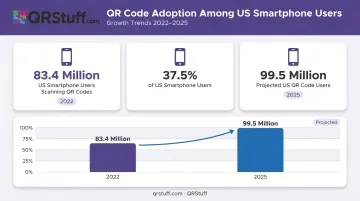
The consumer habit is already there. According to eMarketer/Insider Intelligence, 83.4 million US adult smartphone users scanned a QR code in 2022, representing 37.5% of US smartphone users — a figure projected to reach 99.5 million by 2025. Scanning has become a reflex, not a novelty.
Retail, quick-service restaurants, and hospitality lead adoption — but the underlying logic applies wherever a business needs to bridge a physical moment with a digital response. The 17 use cases below show exactly how that plays out across industries.
QR Code Use Cases for Marketing and Brand Growth
QR codes make every piece of offline marketing interactive and measurable. A static flyer becomes a lead capture tool. A product package becomes a content hub. Here are six specific applications.
1. Drive Offline Traffic to Your Website or Landing Page
URL QR codes on billboards, print ads, flyers, and packaging pull consumers directly into a digital funnel — no typing required. The key advantage for marketers is what happens after the print run.
Dynamic URL QR codes let you swap the destination without reprinting. Run a seasonal campaign, change the landing page when it ends, and the printed code keeps working. QRStuff allows destination edits at any time across all paid plans, making campaign pivots cost-free.
2. Promote Social Media Profiles
Rather than directing customers to a single platform, a Social Link QR code creates a hub that connects to all of your brand's profiles simultaneously — one scan, every channel.
Best placement options:
- Table tents and receipts in restaurants
- Packaging inserts and hang tags in retail
- Storefront window decals
- Trade show booth signage
This approach grows followers from in-store foot traffic without requiring staff involvement.
3. Increase Mobile App Downloads
An App Download QR code automatically detects the user's device and routes iOS users to the Apple App Store and Android users to Google Play — no app store searching required. Place it on packaging, in-store signage, or print ads, and the download path is one tap.
The ROI angle: scan analytics reveal which physical locations or placements drive the most app installs, letting you allocate marketing spend to what's actually working.
4. Smart Product Packaging
Labels have limited real estate. QR codes on packaging give brands a second layer of content — ingredient deep-dives, how-to videos, sustainability reports, recipe ideas, or regulatory documents — without cluttering the design.
That demand is reflected in the numbers. Research and Markets values the global QR code labels market at $1.984 billion in 2024, projected to reach $4.538 billion by 2034 at an 8.4% CAGR. GS1's Sunrise 2027 initiative is already standardizing 2D barcode readiness across retail point-of-sale systems.
Real-world example: Unilever added accessible QR codes to Persil packaging to provide audio-described product information for blind and partially sighted users — a use case that goes beyond marketing into inclusion.
5. Share Discount Coupons and Promotions
Coupon QR codes redirect users to a dynamic offer page with validity dates, redemption terms, and a claim button — no paper distribution required.
Consumer behaviour supports the shift: Inmar Intelligence reports that load-to-card digital offers accounted for 53.9% of all coupon redemptions in 2025, while traditional free-standing inserts contributed just 2.3%. Brands that haven't made the shift are leaving redemptions on the table.
6. Measure and Optimize Offline Marketing ROI
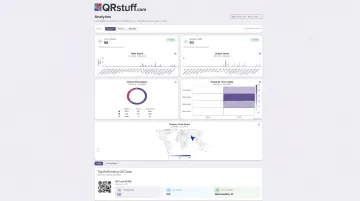
Offline advertising has always had a measurement problem. QR codes solve it. Every scan generates data: total scans, unique users, device type, geographic location, and time-of-day breakdown.
QRStuff's analytics dashboard provides all of these data points in real time, with city- and country-level geographic tracking, CSV export for deeper analysis, and Google Analytics integration. Marketers can finally compare a billboard in Chicago against one in Austin — and reallocate accordingly.
QR Code Use Cases for Customer Experience and Operations
These use cases reduce staff burden, speed up service, and give customers instant access to what they need. No waiting, no typing, no calling.
7. Digital Menus and Contactless Ordering in Restaurants
Table-top QR codes replace physical menus — customers scan, view items, place orders, and pay from their own devices. The National Restaurant Association's 2024 Technology Landscape Report found that 59% of full-service customers would access a menu by QR code, and 48% would use one to place an order.
The operational benefit is underappreciated: menu updates — new items, price changes, seasonal specials — happen in real time without reprinting a single code. QRStuff's dynamic QR codes support this directly, allowing restaurants to push changes to the linked destination the moment a decision is made.
8. Share Business Information and Help Customers Find You
Two distinct use cases work together here:
- Business Information QR codes consolidate address, hours, phone number, and website into one scannable destination — useful on storefronts, print ads, or vehicle wraps
- Location QR codes open Google Maps with the destination pre-filled, eliminating manual address entry — ideal for trade show materials, brochures, or direct mail
Both remove steps between a customer's interest and finding you.
9. Simplify WiFi Access for Customers
WiFi QR codes let guests connect instantly — no asking staff, no squinting at a printed password card. One scan handles it.
QRStuff's WiFi QR code type supports WPA, WPA2, WEP, and open networks, with configurable SSID visibility. The dual benefit: it improves guest experience while ensuring only in-person visitors can scan the code to access the network.
Relevant industries: Hotels, cafes, retail stores, medical waiting rooms, co-working spaces.
10. Collect Customer Feedback and Boost Online Reviews
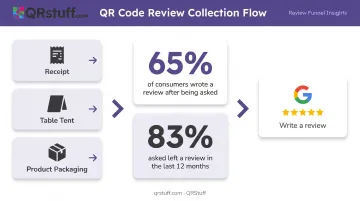
Most customers don't leave reviews voluntarily. Ask them directly, and the numbers change dramatically. BrightLocal's 2024 Local Consumer Review Survey found that 65% of consumers wrote a review after being asked, and 83% of people asked to leave a review did so in the last 12 months.
A QR code on a receipt, table tent, or product packaging — linking directly to a Google Review submission page — is that direct ask, placed at the right moment. QRStuff offers a dedicated Google Review QR code type (not just a generic URL code) that routes customers straight to the review submission screen.
11. Share Calendar Events and Virtual Meeting Links
QR codes on event invitations, trade show booths, or email signatures let attendees add events to their calendar or join a virtual meeting with a single scan. No copy-paste errors, no "wait, what's the meeting ID?"
QRStuff supports dedicated Zoom Meeting QR codes and Calendly scheduling codes for this use case. For recurring meetings with changing links, dynamic codes let you update the destination without redistributing new codes.
12. ID Tags for Pets and Asset Tracking
A QR code on a pet collar links to the owner's contact information — a simple consumer application with direct parallels in enterprise operations.
At scale, QRStuff supports bulk QR code generation for asset management across:
- Equipment tagging and inventory labeling
- Property management with ownership records and maintenance logs
- Inspection checklists linked to each physical asset
Dynamic codes mean records update without replacing physical tags. The Enterprise tier includes API integration with ERP and CMMS systems for organizations managing large asset inventories.
QR Code Use Cases for Payments, Communication, and Networking
These use cases remove friction from transactions and conversations — whether a customer is paying, a rep is networking, or a business is sharing documentation.
13. Enable Contactless QR Code Payments
Merchants display a payment QR code; customers scan to complete the transaction digitally. No card terminal, no cash handling.
The scale of this use case is significant. Juniper Research forecasts that global QR code payment value will grow 50%, from $5.4 trillion in 2025 to more than $8 trillion by 2029.
QRStuff generates payment QR codes for PayPal, Venmo, Bitcoin, and generic payment URLs. The platform creates the code; the actual transaction processes through the chosen payment platform.
14. Share Contact Information with Digital Business Cards
A vCard QR code on a business card redirects to a digital profile. With QRStuff's dynamic vCard option, it encodes contact details that save directly to a phone's address book.
The practical advantage over traditional cards: contact information can be updated after the code is printed. Job change, new number, new office — update the record once, and everyone who scans the existing card gets current details. No reprint required.
The digital business card market reflects this growing adoption. Mordor Intelligence values it at $199.39 million in 2025, projected to reach $331.78 million by 2031.
15. Educate Customers with Documents and Media
PDF, video, and image QR codes on product packaging, instruction sheets, or training materials give users instant access to content that can't fit on a label.
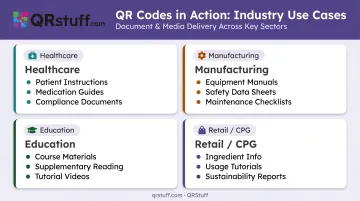
Use cases by industry:
- Healthcare: Patient instructions, medication guides, compliance documents
- Manufacturing: Equipment manuals, safety data sheets, maintenance checklists
- Education: Course materials, supplementary reading, tutorial videos
- Retail/CPG: Extended ingredient information, usage tutorials, sustainability reports
QRStuff supports direct file uploads for PDFs, videos, and images, with dynamic codes allowing file replacements without reprinting materials.
16. Multi-Channel Communication: SMS, Email, and WhatsApp
Pre-filled message QR codes let customers initiate a conversation with a single scan. The message body, recipient number or address, and subject line are all configured before the code is generated — so the customer just confirms and sends.
QRStuff supports this for SMS, email, and WhatsApp (including WhatsApp Business). Useful for:
- Support inquiry triggers on product packaging
- Lead capture from trade show signage
- Order follow-up prompts on receipts
17. Linking All Use Cases: Multi-URL and Conditional Routing
For businesses managing multiple channels, QRStuff's Social Link Pages type creates a single QR code linking to multiple destinations: social profiles, key pages, or resources, all through one central hub. For international campaigns, conditional routing takes this further, directing users to localized content automatically based on their device's language settings.
Conclusion
Across every use case in this guide, the pattern holds: QR codes close the gap between a physical moment and a digital action. Whether that action is placing an order, downloading an app, leaving a review, or initiating a payment, a well-placed code removes the step that stops people.
The right use case depends on your business goal, not just the medium you're working with. A restaurant needs real-time menu updates. A retailer needs packaged product engagement. A sales team needs contactless contact sharing. Start with the goal, then pick the QR code type that solves it.
QRStuff supports 40+ QR code types with dynamic editing, real-time analytics, GDPR and SOC2 compliance, and bulk generation at scale — from free codes for individuals testing the platform to Enterprise plans for Fortune 500 teams running millions of codes at scale. Start for free and explore the full range of use cases.
Frequently Asked Questions
What are the most popular uses for QR codes?
Restaurant menus, product packaging, contactless payments, social media promotion, and app downloads lead adoption. Usage spans retail, hospitality, healthcare, and education — anywhere businesses need to connect a physical touchpoint to a digital action instantly.
Why use a QR code generator?
A QR code generator creates machine-readable codes linked to any digital destination. Business-grade generators add dynamic editing, scan analytics, and design customization — capabilities that free, one-off tools simply don't offer.
What is the difference between static and dynamic QR codes?
Static codes are fixed at creation and cannot be changed. Dynamic codes allow the destination URL or content to be updated at any time without reprinting, and they support real-time scan tracking. For most business applications, dynamic codes are the more useful option.
How do I track who is scanning my QR codes?
Dynamic QR code platforms track total scans, unique users, device type, geographic location, and time-of-day data. QRStuff's dashboard presents this in real time, with CSV export and Google Analytics integration available.
Can I update a QR code after it's already been printed?
Only dynamic QR codes support post-print editing. The printed code stays the same; the destination URL or linked content changes in the platform dashboard. This eliminates reprinting costs when campaigns evolve or information changes.
Are QR codes safe for payments and sensitive data?
Use platforms with HTTPS enforcement, GDPR and SOC2 compliance, and password-protection capabilities. QRStuff meets both GDPR and SOC2 standards and supports two-factor authentication, password-protected codes, and enterprise SSO for sensitive content and transaction-linked codes.