: Ensuring Patient Safety](https://file-host.link/website/qrstuff-qjtbbl/assets/blog-images/0fe2787e-9bc9-4313-a179-d845b4f5cda5/1780334963371855_53d32075f19a4cc2b4005d2136822e9d/360.webp)
Introduction
Patient misidentification is one of healthcare's most persistent (and preventable) safety failures. An ECRI Institute analysis of over 7,600 wrong-patient events found that 72.3% occurred during clinical encounters, with consequences ranging from delayed care to a patient receiving 10 times their intended medication dose.
The operational fallout is real: adverse drug events, wrong-site procedures, liability exposure, and — in the worst cases — patient deaths. The Joint Commission lists contributing factors including staff fatigue, distractions, and the limitations of existing identification tools.
QR codes on hospital bracelets don't eliminate human error by themselves. But when correctly implemented, they close the information gap that makes misidentification so dangerous — giving clinical staff instant, accurate access to a patient's full medical profile at every care touchpoint. How that implementation happens determines whether the technology actually holds up under real clinical conditions.
Key Takeaways
- QR codes on hospital bracelets link to a digital patient profile containing allergies, medications, diagnoses, and emergency contacts
- Dynamic QR codes allow record updates without reprinting the bracelet — critical when patient information changes mid-stay
- Print quality, access controls, and staff training protocols are all required for safe deployment — none can be skipped
- Password protection and encryption are required — unprotected QR codes expose patient data and violate privacy regulations
- Hospitals need fallback protocols for scan failures and offline scenarios
How QR Codes on Hospital Bracelets Work
A QR code on a hospital bracelet functions as a scannable patient identity tag. When authorized clinical staff scan it — using a smartphone camera or a compatible handheld scanner — it retrieves a linked digital record. That record typically contains the patient's full name, date of birth, hospital number, known allergies, current medications, active diagnoses, blood type, and emergency contacts.
Static vs. Dynamic: A Clinically Significant Difference
Not all QR codes work the same way in a hospital setting.
| Type | Updatable After Printing? | Best For |
|---|---|---|
| Static QR code | No — data is fixed at creation | Permanent reference materials |
| Dynamic QR code | Yes — destination can be edited anytime | Hospital bracelets, active patient care |
Static QR codes embed data permanently. If a patient's medication changes or a new allergy is identified, a static code still shows the original information — the same limitation as a traditional engraved wristband. Dynamic QR codes link to an editable online record, so the bracelet stays current without a reprint.
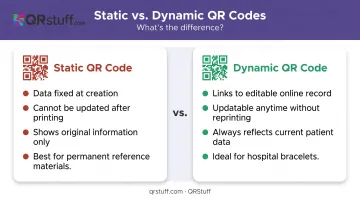
For hospital bracelets, that real-time editability isn't a convenience — it's what keeps the bracelet's data synchronized with the patient's actual care record throughout their stay.
Scanning Infrastructure
Any standard smartphone camera (iOS or Android) can read a QR code without a dedicated app. Clinical settings may also use handheld scanning terminals — a 2022 pediatric study of 260 hospitalised children used exactly this approach for wristband identification.
One important caveat: scanning capability alone doesn't satisfy identification requirements. Staff must still follow verification protocols after retrieving the displayed record.
Patient Safety Benefits of QR Code Hospital Bracelets
Closing the Information Gap
Traditional printed wristbands hold minimal data — typically a name, date of birth, and patient number. That's enough to confirm identity but not enough to prevent treatment errors.
QR codes change this. A single scan displays a full clinical profile. Given that more than 1.5 million people visit US emergency departments for adverse drug events annually, with nearly 500,000 requiring hospitalization, having allergy and medication data visible before treatment is administered can prevent the kind of errors that escalate into serious harm.
Protecting Patients Who Cannot Speak for Themselves
AHRQ PSNet identifies very young and cognitively impaired patients as particularly vulnerable because they cannot identify themselves to healthcare providers. This includes:
- Unconscious or sedated patients
- Patients with dementia or cognitive impairment
- Infants and young children
- Patients in post-operative recovery
For these groups, a scannable bracelet removes dependence on patient recall or family availability. The Joint Commission requires distinct identification methods for newborns specifically — QR-linked records provide one reliable layer of that system.
Real-Time Updates Throughout the Care Journey
Patient information doesn't stay static during a hospital stay. Diagnoses are updated, medications are adjusted, procedures are completed. With dynamic QR codes, linked records can be edited without issuing a new bracelet.
This matters because acting on outdated printed information is a genuine clinical risk. Staff scanning a bracelet at 11pm should see the same current data as the team who admitted the patient at 8am — not a snapshot of what was true at admission.
Multi-Point Verification Across Care Touchpoints
Keeping data current is only part of the equation. That data also needs to reach every care team consistently. The Joint Commission's 2025 National Patient Safety Goals require verified patient identification before:
- Medication administration
- Blood product administration
- Specimen collection
QR bracelets support all three by giving every touchpoint the same verified data source, reducing the risk that a miscommunication between shifts or departments leads to cascading errors.
Patient Safety Guidelines for QR Code Hospital Bracelets
Safe QR bracelet use requires discipline across three stages: setup, active clinical use, and ongoing maintenance.
General Implementation and Enrollment
Before any bracelet is issued:
- Verify data at source. Patient information entered into the linked profile must be confirmed against a primary source — admission forms, referring records — before the bracelet goes on the patient's wrist. Errors introduced at enrollment appear in every subsequent scan.
- Assign unique codes per patient, per admission. Reusing QR codes or failing to deactivate codes from prior admissions creates identity mismatch risk.
- Meet minimum print quality standards. QR codes must be at least 2cm x 2cm, printed at 300 DPI minimum, with dark code on light background — the format most reliably read across devices and lighting conditions. Per ISO/IEC 15415:2024, 2D symbol print quality affects scan reliability across the code's lifespan.
- Choose a platform built for sensitive data. Platforms that are SOC2 and GDPR compliant and support password-protected dynamic QR codes — such as QRStuff — provide the security and updatability healthcare environments require.
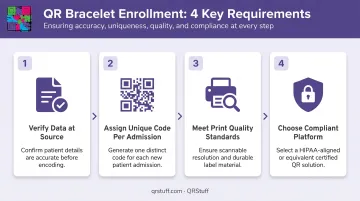
Once enrollment is complete, the protocols governing day-to-day scanning are just as critical.
Safety During Active Clinical Use
- Scanning is a verification step, not a replacement for it. Staff must still confirm the patient matches the scanned record — verbally for conscious patients, visually for others.
- Prepare for scan failures. Moisture, dirt, chemical sanitizers, bracelet damage, and glare can all compromise readability. Staff need a defined fallback: manual lookup by patient number. A bracelet that can't be scanned provides no safety benefit.
- Restrict access to authorised staff only. HIPAA technical safeguards (45 CFR 164.312) require unique user identification and access controls for protected health information. An open QR code that exposes a full medical profile to anyone with a phone is a compliance failure.
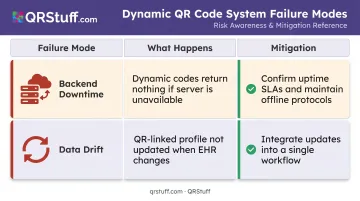
Beyond active scanning protocols, two system-level failure modes can silently undermine the entire setup.
Data Integrity and System Reliability
| Failure Mode | What Happens | Mitigation |
|---|---|---|
| Backend downtime | Dynamic codes retrieve data from a server. If that server is unavailable, the code returns nothing. | Confirm uptime SLAs with your QR provider. QRStuff guarantees 99.9% uptime on all paid plans, with a recorded uptime of 99.968% since 2008. Maintain offline contingency protocols. |
| Data drift | A patient's EHR is updated, but the QR-linked profile is not synchronized. Staff reading the bracelet see stale information. | Integrate QR record updates into the same workflow as EHR updates. Treat them as one task, not two. |
Common Safety Mistakes to Avoid
Even well-intentioned QR bracelet programs can create safety gaps when implementation shortcuts are taken. These three mistakes account for most avoidable failures.
- Static codes instead of dynamic ones: A static code cannot be updated after printing. Any change to allergy status, medication, or diagnosis during a patient's stay won't be reflected when staff scan the bracelet — the same limitation as the engraved wristbands this technology is meant to replace.
- Skipping pre-deployment scan testing: Every code should be tested across multiple device types, lighting conditions, and scan angles before it goes on a patient. A code that fails in a low-light ward or at an awkward wrist angle offers no safety benefit. In an emergency, it actively delays care.
- Using the QR code as the sole identifier: QR bracelets are one layer of a multi-factor identification system. The Joint Commission requires at least two patient identifiers. Scanning a bracelet without cross-referencing a second (date of birth, verbal confirmation) increases the risk of acting on a mismatched record, especially when bracelets are damaged, transferred, or misprinted.
Conclusion
QR codes on hospital bracelets are a practical patient safety tool — but only when accurate data, dynamic updatability, controlled access, and clinical discipline work together. The technology creates the capability; the protocols determine whether it's actually safe.
Healthcare teams should treat QR bracelet safety as an ongoing operational standard. That means building three habits into routine operations:
- Audit linked record accuracy on a regular schedule, not just at onboarding
- Train staff on scanning protocols and fallback procedures before incidents occur
- Review access permissions whenever team composition changes
Done consistently, these steps keep the QR code worth scanning — and the patient record worth trusting.
Frequently Asked Questions
What are the QR codes on hospital bracelets?
QR codes on hospital bracelets are scannable codes linked to a patient's digital medical profile. When clinical staff scan the code, they instantly retrieve essential information — including name, allergies, current medications, and emergency contacts — enabling accurate, timely care decisions.
Are QR code medical alert bracelets safe?
Yes, when implemented correctly. Safety depends on using dynamic codes with access controls, keeping linked records current, and integrating QR scanning into established patient identification protocols rather than using it as a standalone verification method.
How do you scan a QR code on a bracelet?
Any standard smartphone camera or QR-enabled scanner can read a hospital bracelet QR code. Staff point the camera at the code and the linked record opens automatically in a browser — no app download required, provided the system is configured to use a standard URL destination.
What information should be stored in a hospital bracelet QR code?
Essential fields include full name, date of birth, hospital or patient number, known allergies, current medications, active diagnoses, blood type, and emergency contact. Limit stored data to what is clinically relevant, and host any sensitive records on a secure, access-controlled platform rather than embedding them directly in the code.
Can QR codes on hospital bracelets replace traditional barcodes?
QR codes can replace or complement traditional 1D barcodes. A standard GS1-128 barcode holds up to 48 characters, while a QR code encodes significantly more data and is readable from multiple angles. When dynamic, it also links to a full updatable record — making it more versatile for patient identification and medication verification workflows.
What happens if the QR code on a hospital bracelet cannot be scanned?
Staff should revert to manual patient identification using the printed ID number on the bracelet and look up the record directly in the hospital system. A damaged or unreadable bracelet should be replaced promptly. Hospitals must have this fallback protocol documented and trained before QR bracelets are deployed.