Introduction
Running a dental practice in 2026 means managing rising patient expectations alongside real staffing pressure. According to the ADA's Q1 2026 dental economy report, 37.6% of dentists are actively recruiting hygienists, and 33% say they're not busy enough — a combination that points to a retention and acquisition problem, not just a capacity one.
Paper-based workflows make both problems worse. Intake forms pile up at the front desk. Post-op instructions get lost or forgotten. Review requests never get made. Meanwhile, competitors who've digitized these touchpoints are pulling ahead in local search and patient experience scores.
QR codes address both the workflow friction and the patient acquisition gap — at low cost. They connect physical clinic materials (appointment cards, waiting room signage, post-visit handouts) directly to digital workflows. Patients scan and land exactly where you need them, with no app download or manual typing required.
This article covers what QR codes actually do for dental clinics, where the measurable benefits show up, and how to avoid common implementation mistakes.
Key Takeaways
- Patient compliance improves when aftercare instructions are one scan away, not buried in a forgotten paper handout
- Review volume grows faster when patients are prompted at checkout rather than hoping they remember later
- Front desk workload drops when intake forms, WiFi access, and payments are handled through self-service QR codes
- Dynamic QR codes let you update destinations without reprinting, which matters when care guides or booking links change
- Track scan data monthly to see which codes drive action and adjust placement accordingly
What Are QR Codes for Dental Clinics?
A QR code is a scannable shortcut: patients point their phone camera at it, and they land on a webpage, form, video, or contact card — no app, no typing required.
In a dental setting, that means placing them wherever information currently changes hands on paper:
- Appointment reminder cards and confirmation emails
- Reception desk signage (intake forms, WiFi access)
- Treatment room posters (procedure explainers, consent forms)
- Post-visit handouts (aftercare guides, review prompts)
- Business cards and exit signage
What the code unlocks matters more than the code itself — faster patient communication, higher review counts, and less manual work at the front desk.
Static vs. Dynamic: The Distinction That Matters Most
Not all QR codes work the same way. The difference between static and dynamic codes determines how much flexibility your clinic actually gets.
| Type | How It Works | Best For |
|---|---|---|
| Static | Destination is fixed at creation — changing it means reprinting | One-time uses: WiFi passwords, permanent URLs |
| Dynamic | Destination updates via dashboard; the printed code never changes | Anything that evolves: care instructions, booking links, insurance info, seasonal offers |
For most clinic use cases, dynamic codes are the practical choice.
QRStuff supports dynamic QR codes across all paid tiers, with real-time scan analytics built in. For US dental clinics handling patient-facing links, HIPAA compliance is the relevant standard — verify that any platform you use meets those requirements before deployment.
Key Advantages of QR Codes for Dental Clinics
The three advantages below are each tied to metrics that practice managers actually track — not abstract "modernization" benefits.
Advantage 1: Improved Patient Communication and Treatment Compliance
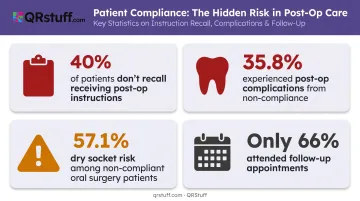
The problem: Patients leave with paper instructions they don't read, can't find, or don't remember receiving. A third-molar surgery study found 40% of patients didn't recall receiving both verbal and written post-op instructions. A separate 2025 study of 227 dental patients found 35.8% experienced post-operative complications attributable to non-compliance with post-treatment instructions.
How QR codes help: A code printed on a post-visit card links directly to a video walkthrough of aftercare steps, medication schedules, or activity restrictions. Patients can revisit it at home — at the exact moment they need it — without calling the office.
This matters especially for:
- Oral surgery and extractions (dry socket risk from non-compliance can reach 57.1% among non-compliant patients)
- Implant and orthodontic cases with multi-step aftercare
- Pediatric cases where parents need accessible follow-up guidance
Compliance data reinforces the value. The same 2025 study found follow-up appointment attendance was only 66%, with 45% of patients citing forgetfulness as the main reason for missing scheduled visits. A QR code on an appointment reminder that links to one-tap rescheduling makes rescheduling instant.
KPIs this affects:
- Post-operative complication rate
- Post-visit inbound call volume
- Appointment no-show rate
- Patient satisfaction scores
When patients can re-access their care instructions without calling, staff time is freed up and liability exposure drops — both measurable outcomes on any practice manager's scorecard.
Advantage 2: More Online Reviews and New Patient Acquisition
The problem: Most satisfied patients don't leave reviews — not because they're unwilling, but because by the time they remember to, the moment has passed.
How QR codes help: A code at the checkout desk or on the printed receipt takes patients directly to your Google review page in one scan. No searching, no typing the practice name, no navigating from a homepage. QRStuff offers a dedicated Google Review QR code type that routes patients straight to the review submission screen.
Why review volume matters:
- 97% of consumers read online reviews for local businesses, with 41% saying they always read them
- 47% won't use a business with fewer than 20 reviews
- 74% only value reviews written in the last three months — recency is as important as volume
- 31% require a rating of 4.5 stars or higher before considering a provider
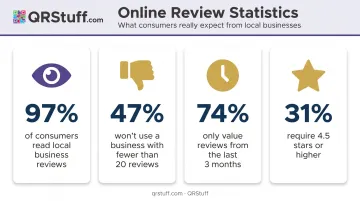
The ADA confirms that soliciting reviews can directly improve search engine ranking by generating fresh content about the practice. Google's local ranking factors include both review count and review score — meaning a consistent review collection strategy translates to measurable visibility gains, alongside the social proof it generates.
KPIs this affects:
- Monthly review count
- Average star rating
- Google local search position
- New patient volume from organic search
Practices in competitive local markets — or those opening new locations — see the sharpest gains, since online reputation is typically the first filter prospective patients apply before picking up the phone.
Advantage 3: Reduced Administrative Burden and Front Desk Efficiency
The problem: Front desk staff spend significant time on tasks that don't require clinical judgment — distributing intake forms, explaining WiFi passwords, manually entering patient data, processing payments. These tasks create bottlenecks and introduce data entry errors that staff then have to correct.
A 2022 MGMA poll of 652 healthcare leaders found 83% of practices still used the front desk as the primary check-in method, with only 7% using online check-in — even though 49% of patients said they wanted to complete health forms digitally before arriving.
How QR codes close that gap:
| Use Case | QR Code Type | Placement |
|---|---|---|
| Patient intake forms | URL or Form QR | Pre-appointment email, waiting room poster |
| WiFi access | WiFi QR | Reception desk signage |
| Payment | Payment QR (PayPal, UPI) | Checkout counter |
| Contact details / vCard | vCard QR | Business cards, exit signage |
| Post-visit instructions | PDF or URL QR | Post-visit handout |
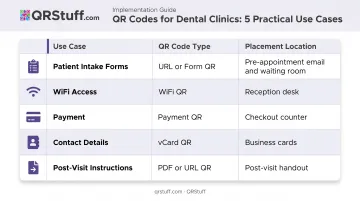
A 2024 hospital study found that a patient history form took 45 minutes on paper versus 12 minutes digitally — a 73% reduction in completion time. The implication for dental practices is direct: faster intake means shorter wait times and fewer manual errors for staff to resolve.
What this moves on your dashboard:
- Average patient check-in time
- Front desk data entry error rate
- Staff hours on non-clinical tasks
- Patient wait time satisfaction scores
This advantage delivers the highest return in high-volume practices with limited front desk staff, or during peak morning hours when check-in bottlenecks directly affect patient experience.
What Happens When Dental Clinics Skip QR Codes
Staying paper-dependent isn't neutral — it has compounding costs:
- Reprinting costs accumulate every time care protocols change, insurance information updates, or booking links move
- Staff time drain continues for every intake form handed out, WiFi password explained, and post-op callback fielded
- Reputation gap widens as competitors using QR review prompts build review volume faster — and local search ranking reflects it
Those operational costs are only part of the problem. Patient expectations have shifted too: a 2023 Redpoint/Dynata survey of 1,000 U.S. consumers found 62% expect online healthcare communications to match in-person experiences, and 57% reported increasing their use of digital tools to engage with providers over the prior year.
A fully paper-based check-in process signals, before the appointment even starts, that the practice hasn't kept pace. That perception affects satisfaction scores and return visit likelihood regardless of clinical quality.
How to Get the Most Value from QR Codes in Your Dental Practice
Implementation quality determines whether QR codes become a genuine operational tool or an ignored sticker on the wall.
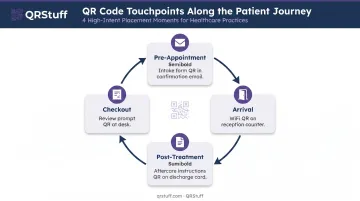
Place codes at high-intent moments
The most effective placement is at the exact moment a patient would naturally take the action the code enables:
- Review prompt → checkout desk or printed receipt
- Aftercare instructions → post-visit handout, handed over at departure
- Intake form → pre-appointment confirmation email or waiting room poster
- WiFi access → visible on the reception counter before patients ask
Use dynamic codes for anything that changes
Static codes are fine for fixed destinations — a permanent booking page, a stable vCard. But for care instructions, insurance guides, seasonal promotions, or any link that might change, dynamic codes are the only practical choice. Update the destination in the dashboard; the printed code stays valid.
Platform choice matters when patient data is involved. QRStuff is both GDPR and SOC2 certified, which means scan data is handled with the security standards dental practices need for any patient-facing application.
Track and audit regularly
QRStuff's analytics dashboard captures total scans, unique scans, scan timing, device type, and geographic data. Use it:
- Monthly: Check which codes are being scanned and which aren't
- Quarterly: Audit all linked destinations to confirm nothing is broken or outdated
- On placement changes: Compare scan rates before and after to test what works
Codes that aren't being scanned aren't a QR code problem — they're a placement or visibility problem. The data tells you where to adjust.
Frequently Asked Questions
Are QR codes safe to use in a dental clinic that handles patient information?
QR codes don't store patient data — they link to external destinations. The security responsibility sits with the destination (the form, portal, or page the code points to). Choosing a GDPR-compliant platform like QRStuff means the platform itself is accountable for how scan data is handled.
Do patients actually scan QR codes at a dental office?
Insider Intelligence projected U.S. smartphone QR scanners would reach 99.5 million by 2025, and a U.S. Census Bureau usability study found 95% of participants felt "very comfortable" scanning them — completing the action in an average of 12.4 seconds. Placement at the right moment (checkout, post-visit card, appointment reminder) is what drives actual scan behavior.
What types of QR codes are most useful for dental clinics?
The highest-impact types for dental practices include:
- URL — booking pages, aftercare guides, patient portals
- vCard — staff contact sharing
- WiFi — waiting area access
- Google Review — checkout prompts
- PDF/Form — intake documents, discharge instructions
QRStuff supports all of these as distinct code types within one dashboard.
What is the difference between static and dynamic QR codes for a dental practice?
Static codes are permanent — change the linked content and you need a new code and new printed materials. Dynamic codes redirect through a hosted link, so you update the destination without reprinting. For anything that changes (care guides, booking links, insurance info), dynamic codes are the practical choice.
Can QR codes replace printed forms and handouts at a dental clinic?
They can digitize most patient-facing documents, but they work best alongside print rather than instead of it. A QR code on a printed appointment card gives patients both the physical reminder and the digital shortcut — neither format alone is as effective.
How do I know if my dental clinic's QR codes are actually working?
Dynamic QR code platforms provide scan analytics including total scans, unique users, scan timing, device type, and geographic data. Check monthly which codes are generating scans and which aren't. Low scan rates on a working code almost always point to a placement or timing problem, not a technical failure.