QR codes have moved well past novelty status in clinical settings. They're now doing real operational work: cutting intake queues, keeping patients better informed after discharge, and creating scan-based audit trails for equipment and patient identification.
This article covers the three most measurable advantages of QR codes in healthcare, what happens when they're absent or poorly deployed, and how to extract genuine value from them in practice.
Key Takeaways
- QR codes connect physical touchpoints — wristbands, discharge papers, prescription labels — directly to digital workflows, cutting delays at every transition point
- Measurable results include faster patient intake, fewer medication errors, improved adherence rates, and real-time asset tracking
- Dynamic QR codes are the right choice for most healthcare applications — linked content updates centrally without reprinting
- Patients benefit too — QR codes on discharge paperwork and prescription labels give direct access to care instructions, refill portals, and follow-up scheduling
- Consistent deployment, analytics monitoring, and integration with existing systems determine whether QR codes drive measurable outcomes across the facility
What Are QR Codes in Healthcare?
QR codes are two-dimensional barcodes that, when scanned by a smartphone, instantly connect users to digital content — web pages, forms, videos, documents, or patient portals — without requiring an app download or manual URL entry.
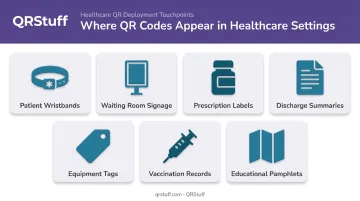
In healthcare, they appear across a wide range of physical touchpoints:
- Patient wristbands and ID labels
- Waiting room and reception signage
- Prescription packaging and medication labels
- Discharge summaries and post-appointment follow-up materials
- Equipment tags and supply bin labels
- Vaccination records and consent forms
- Educational pamphlets and poster displays
What makes QR codes genuinely useful in healthcare isn't the technology itself — it's the problem they solve. A printed leaflet is fixed at the moment it comes off the press. A QR code on that same leaflet can point to content updated yesterday, whether that's revised dosage instructions, new clinical guidelines, or a patient portal that didn't exist when the leaflet was designed.
In a setting where information accuracy can directly affect patient outcomes, that updateability matters.
Key Advantages of QR Codes in Healthcare
The three advantages below aren't theoretical. Each is tied to specific operational outcomes that healthcare administrators, practice managers, and clinical staff can measure directly.
Advantage 1: Faster Patient Intake and Reduced Administrative Burden
QR codes placed at reception desks, waiting room entrances, or in appointment confirmation messages allow patients to self-check in, complete intake forms, and submit insurance or consent information digitally before staff interaction begins.
In practice: a patient scans a code on arrival, completes a digital form on their own device, and that data flows directly into the practice management system. No paper. No manual transcription. No queue at the front desk.
Why this matters operationally:
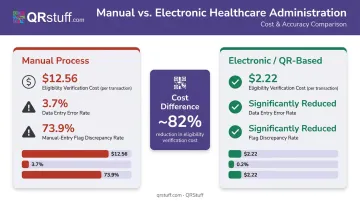
Manual data entry is a significant source of administrative error in healthcare settings. A JAMIA study of outpatient point-of-care testing found 3.7% of manually entered results were discrepant from interfaced results, with 73.9% of manual-entry flags differing from laboratory information system flags. Wrong-patient errors at check-in aren't minor nuisances — AHRQ data indicates they appear in roughly 15% of health IT-related events.
The cost dimension compounds this. According to the CAQH 2023 Index Report, a manual eligibility and benefit verification costs $12.56 on average versus $2.22 electronically — a cost difference that multiplies fast in high-volume settings.
KPIs this affects:
- Patient wait times and intake processing time per patient
- Administrative staff hours spent on data correction
- Data entry error rates at registration
- Patient satisfaction scores at check-in
When it matters most: High-volume outpatient departments, urgent care centers, vaccination clinics, and any practice where check-in speed is directly tied to throughput.
Advantage 2: Improved Patient Education and Medication Adherence
QR codes on discharge summaries, prescription labels, and post-appointment materials give patients instant access to accurate, up-to-date health information on their own device. Patients can revisit it at home, share it with a family member, or pull up dosage instructions at 2am — without hunting for a printed leaflet that may already be misplaced.
Rather than relying on a single handout that can be misread or go out of date, a QR code links to video explanations of dosage schedules, side-effect guidance, post-operative care instructions, or condition management resources. Dynamic QR codes, available through platforms like QRStuff, allow linked content to be updated centrally without changing the printed code — so discharge paperwork always points to the most current clinical guidance.
Why non-adherence deserves attention:
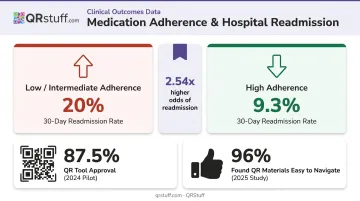
Medication non-adherence costs the US healthcare system between $100 billion and $290 billion annually. A 2017 inpatient study found patients with low or intermediate medication adherence had a 20% 30-day readmission rate, compared with 9.3% for high-adherence patients — a 2.54-fold increase in adjusted odds of readmission.
QR-linked education directly addresses two root causes: patients not fully understanding their instructions, and patients forgetting what they were told. A 2024 feasibility pilot on discharge medication communication reported 87.5% patient approval of QR-based medication tools. A separate 2025 outpatient study found 96% of participants found QR-linked patient information materials easy to navigate.
KPIs this affects:
- Medication adherence rates
- 30-day hospital readmission rates
- Volume of post-discharge patient queries to the practice
- Patient portal engagement
When it matters most: Chronic disease management (diabetes, hypertension, COPD), post-surgical discharge, polypharmacy patients, and any scenario where patients need to retain and act on complex instructions at home.
Advantage 3: Safer Clinical Operations Through Asset and Patient Tracking
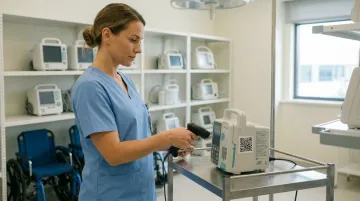
QR codes on medical equipment, supply bins, patient wristbands, and specimen containers give clinical staff instant access to location data, maintenance histories, usage logs, and patient identifiers. Manual checklists and verbal handoffs get replaced with a scan-based audit trail that's faster and harder to skip.
A nurse scanning a code on a piece of equipment immediately confirms its last service date and calibration status. A ward staff member scanning a patient wristband pulls up verified identity and current care plan details before administering medication.
The patient safety stakes are real:
A 2023 JAMIA analysis of medication ordering errors found incorrect dose accounted for 29.7% of errors and incorrect medication for 16.3%. Together, these two error types made up 80% of severe harm or death events in the dataset. Separately, a 2020 review of Joint Commission sentinel events found patient identification errors behind 37 out of 436 sentinel events — and attributed 10% to 15% of all health insurance denials to incorrect patient identification.
QR-based patient identification and asset tracking reduces the conditions that make these errors possible.
From a financial perspective, hospitals spent over $10 billion on surgical and medical instruments in 2024 according to the American Hospital Association. Equipment that goes missing, fails compliance checks, or falls out of service without detection is a material cost — and a safety risk.
KPIs this affects:
- Medication administration error rates
- Equipment utilisation and compliance audit pass rates
- Asset loss and misplacement incidents
- Time spent on manual inventory checks
When it matters most: Inpatient hospital settings, surgical suites, multi-site health systems, and any environment where patient safety events carry significant clinical and regulatory consequence.
What Happens When QR Codes Are Missing or Underused
Without QR codes, healthcare facilities default to paper forms, verbal instructions, manual tracking, and printed materials. Each of these creates predictable risks — and in high-volume facilities, those risks multiply fast.
The common operational consequences:
- Slower intake, higher error rates — Manual transcription during registration introduces wrong-patient and data-entry mistakes that create downstream billing and care coordination problems.
- Patients acting on outdated information — A printed leaflet can't be updated after it leaves the building, leaving patients to act on superseded guidance or lose the document entirely.
- Blind spots in asset management — Paper equipment logs and manual inventory checks let out-of-service gear stay in rotation and maintenance schedules go untracked until audits surface the gap.
- Staff time lost to low-value tasks — Hours spent on data entry, form filing, and error correction are hours not spent on patient-facing work — operating cost with no care-quality return.
Together, these gaps don't just slow operations — they create conditions where errors become routine and staff bandwidth gets consumed by work that digital tools would otherwise handle automatically.
How to Get the Most Value from QR Codes in Healthcare
QR codes work in healthcare when deployed as part of a deliberate workflow — not placed ad hoc on a wall and left unmonitored.
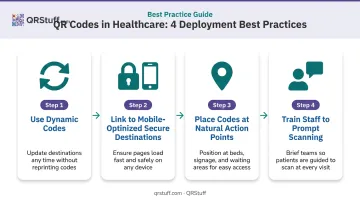
Practical principles for deployment:
- Use dynamic codes — Content updates without reprinting. Essential for medication guides, clinical protocols, appointment links, and anything tied to guidelines that evolve.
- Link to mobile-optimized, secure destinations — Patients scan on phones. Forms and content need to work on a 6-inch screen. Destinations should use encryption, and any platform handling patient data should align with HIPAA requirements.
- Place codes where action is natural — Wristbands, waiting room signage, appointment confirmation messages, and discharge documents. Codes patients have to seek out will see lower scan rates.
- Train staff to prompt scanning — Especially with older patients who may be unfamiliar with QR codes, a brief verbal cue from staff boosts scan rates. Don't assume it happens automatically.
Scan analytics are what turn QR codes from a one-way broadcast into a feedback loop. Knowing which codes are scanned, how often, and from which locations tells you where patient engagement is working — and where it isn't. A drop in scans on a discharge education code could mean poor placement, irrelevant content, or a page that isn't loading on mobile. The data tells you which problem to fix.
Healthcare providers that need to manage QR codes at scale — across wristbands, medication labels, and patient-facing signage — can explore QRStuff. The platform supports bulk generation, GS1 Digital Link codes for pharmaceutical tracking, API integration with existing clinical systems, and SOC2-compliant security with 99.9% uptime.
Frequently Asked Questions
Are QR codes HIPAA compliant in healthcare settings?
QR codes themselves aren't inherently HIPAA compliant or non-compliant — compliance depends on what the code links to and how that destination handles protected health information. Providers should ensure linked platforms use encryption, access controls, and business associate agreements where patient data is involved.
What types of QR codes work best for healthcare use cases?
Dynamic QR codes are generally preferred in healthcare because linked content can be updated without reprinting — essential for medication guides, appointment links, and clinical protocols that change over time. Static codes work well for permanent information like facility maps or general wellness resources.
Can QR codes help reduce patient no-show rates?
QR codes on appointment reminders or waiting room signage can link directly to scheduling or rescheduling tools, reducing friction for patients who need to confirm or modify bookings. Automated reminder systems consistently cut no-show rates — adding a direct QR link to confirm or reschedule removes one more step that causes patients to disengage.
What are the main security risks of using QR codes in healthcare?
The primary risk is quishing — QR phishing attacks where malicious codes replace legitimate ones and redirect patients to credential-harvesting sites. HHS HC3 has identified this as a specific health-sector threat. Mitigation includes using branded, verified codes from a trusted platform, training patients to check URLs before entering information, and applying password protection to sensitive content.
How do dynamic QR codes differ from static QR codes in a clinical environment?
Static codes encode a fixed destination that cannot be changed after printing. Dynamic codes use a short redirect URL, meaning the destination can be updated at any time without reprinting. In clinical settings, dynamic codes are far more practical — a single code on discharge paperwork always points to the most current version of care instructions.
How should healthcare providers measure whether their QR codes are working?
Track scan volume, scan location, device type, and completion rates for linked forms or content. Organize codes by campaign — waiting room signage, discharge documents, prescription labels — so performance can be compared across touchpoints. A sustained drop in scans on a high-priority code signals a placement, visibility, or content problem that needs attention.